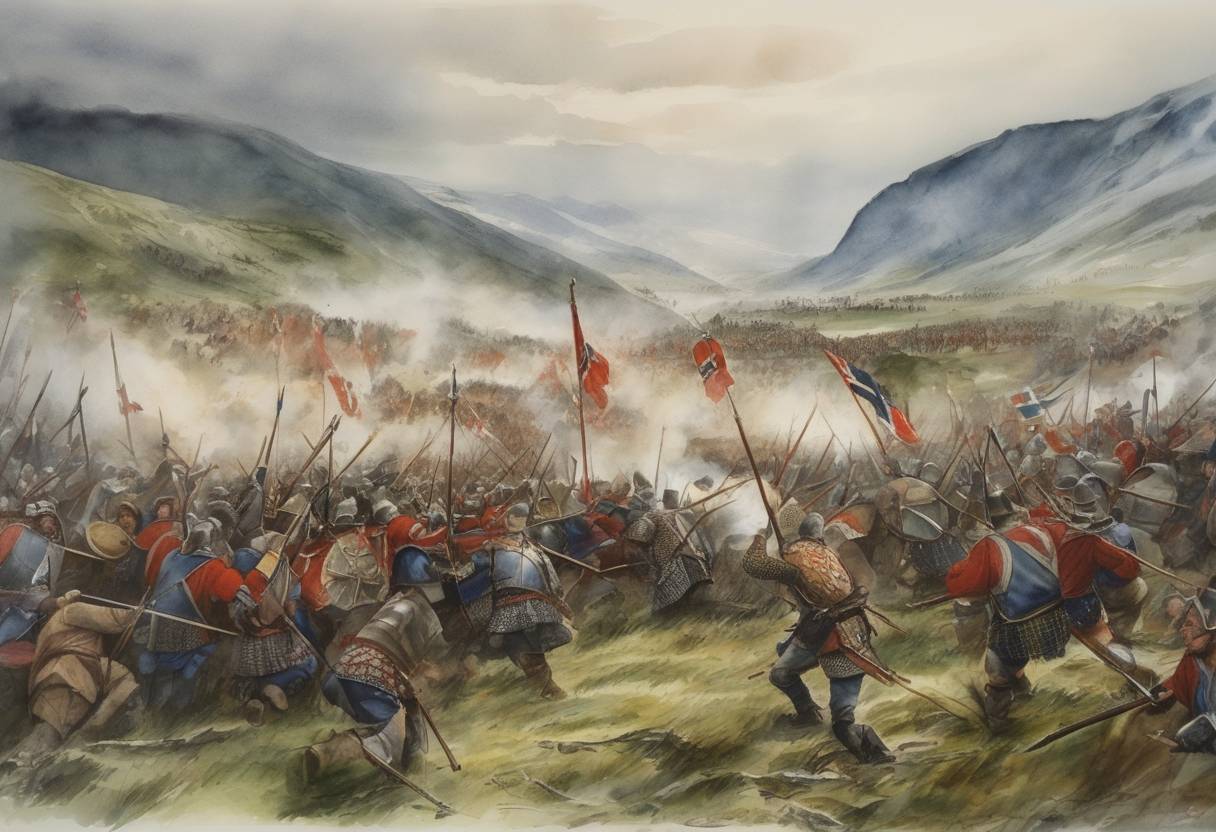
The Battle of Stiklestad - July 29, 1030
The Battle of Stiklestad, fought on July 29, 1030, is a significant event in Norwegian history, marking the demise of King Olaf II Haraldsson and his subsequent canonization as Saint Olaf, the patron saint of Norway. This battle held profound repercussions on the cultural and religious landscape of Norway.
Background
King Olaf II Haraldsson sought to consolidate Christianity in Norway, a mission fraught with challenges as it met resistance from entrenched pagan practices and local chieftains who saw their power threatened. Olaf, having ascended to the throne in 1015, embarked on efforts to unify Norway under a centralized Christian rule, which disturbed the traditional autonomy of regional leaders and sparked unrest.
By the late 1020s, Olaf’s once firm grip on the throne became increasingly tenuous. Opposition grew as powerful earls and local nobles, unwilling to yield their influence, formed a coalition against him. This alliance was supported by Denmark’s King Cnut the Great, who had interests in stabilizing the region under his influence and favored leaders.
The Battle at Stiklestad
Olaf returned to Norway in 1030 after a period of exile, seeking to reclaim the throne. His return culminated in the Battle of Stiklestad, fought in Trøndelag. Consisting of a coalition of Olaf’s enemies, the opposing forces included Norwegian nobles dissatisfied with Olaf’s rule and Danish mercenaries supported by the powerful King Cnut.
The battle was fierce and concluded with the death of Olaf, who was reportedly slain by the blows of three attackers, effectively ending his attempt to retake the throne. His death symbolized the triumph of his adversaries, but his influence would grow posthumously.
Aftermath and Canonization
Shortly after his death, reports emerged of miracles occurring at Olaf’s gravesite, contributing to his veneration. By 1031, just a year after the battle, Olaf was canonized as a saint by Bishop Grimkell. This canonization facilitated the unification of Norway under Christianity, as Olaf’s memory became synonymous with the Christian identity in the nation.
Olaf’s legacy endured as he was later recognized as a martyr for the Christian cause. The emergence of St. Olaf as a national symbol contributed significantly to the consolidation of Christianity in Norway, overshadowing previous pagan traditions.
Broader Historical Significance
The Battle of Stiklestad and the transformation of King Olaf into St. Olaf had lasting impacts on Norway’s cultural and religious landscape. The battle marked a turning point in the country’s shift from Norse paganism to Christianity, serving as a unifying force across the distinct regions of Norway. The legacy of St. Olaf remains a central element of Norwegian identity and is celebrated annually in various commemorations and cultural traditions.