Death of Emperor Valentinian I
375 · Brigetio, Roman Empire
Emperor Valentinian I dies of a stroke at Brigetio (modern-day Szőny, Hungary) while negotiating with the Quadi, a Germanic tribe.
June 22, 0363
The Roman Emperor Julian the Apostate dies during his campaign against the Sassanid Empire; Jovian is proclaimed as his successor.
Maranga (modern location not specifically identified, but within the region of present-day Iraq), Sassanid Empire (modern-day Iraq) | Roman Empire
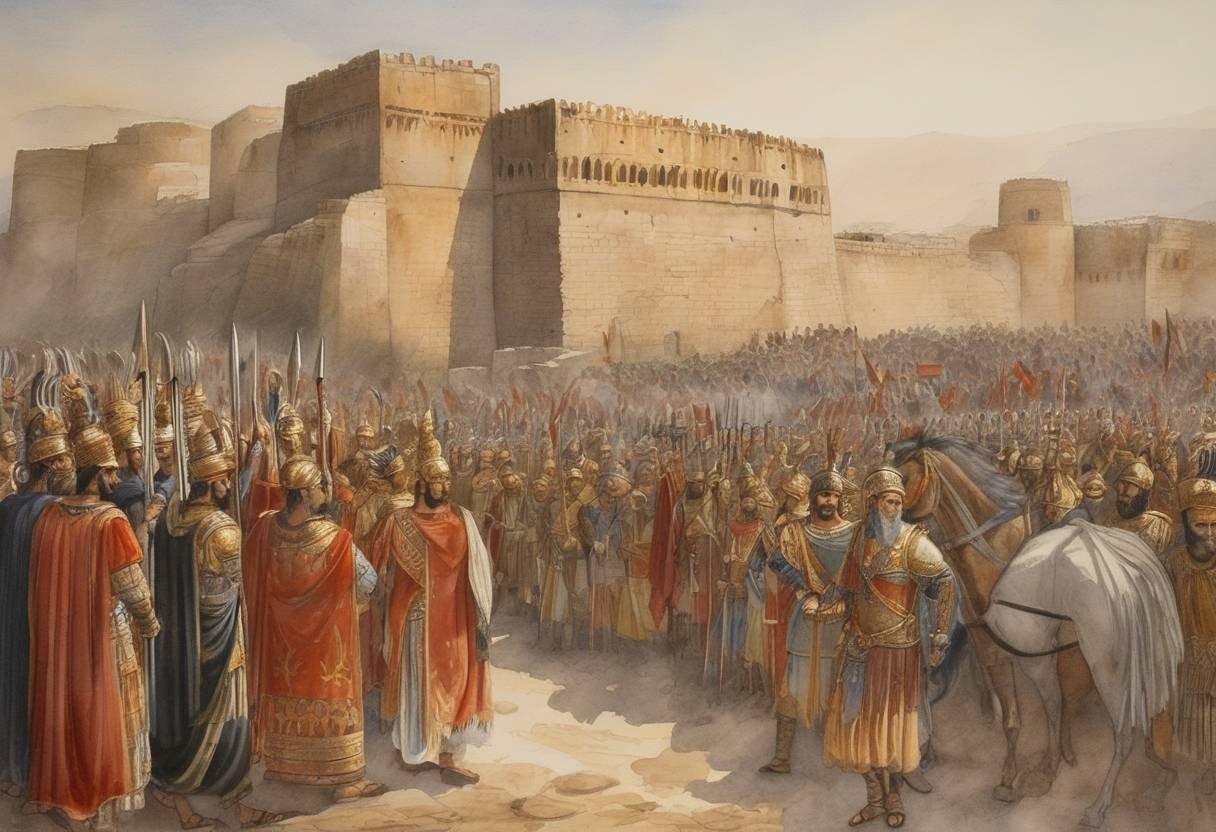
On June 22, 363, a critical moment in Roman history unfolded during the latter stages of the Roman-Sassanid Wars. The sitting Roman Emperor, Julian, often referred to as Julian the Apostate due to his attempts to restore paganism in an increasingly Christian Empire, died during a military campaign against the Sassanid Empire.
Emperor Julian ascended to the throne in 361 AD, following the death of Constantius II. Known for his philosophical inclinations and efforts to reinstate pagan religion and diminish the established Christian dominance, Julian’s short reign was marked by substantial administrative and military campaigns, most notably his campaign against the Sassanid Empire in Persia.
Julian’s Persian campaign was part of his wider strategic goals to secure the eastern borders of the Roman Empire and perhaps even seeking to emulate the legendary feats of Alexander the Great. In early 363 AD, Julian embarked through Mesopotamia, making significant initial advances into Persian territory. However, the campaign faced logistical challenges, supply issues, and staunch Persian resistance under their ruler, Shapur II.
During a skirmish in the extended campaign, Julian suffered a fatal wound. The details regarding his death are somewhat obscured by various historical accounts, but it is generally accepted that he was struck by a spear, reportedly during the Battle of Samarra in Mesopotamia. Historical accounts differ on whether the spear was thrown by a Persian soldier or by one of his own men, but his death marked a swift turning point.
Following Julian’s death, the Roman army needed to ensure a quick succession to prevent chaos. Jovian, a senior officer and member of Julian’s bodyguard, was quickly proclaimed emperor by his troops. Jovian’s ascension was primarily driven by the necessity for stability amidst a dire military situation. He immediately faced the daunting task of extricating his forces from the deeply entrenched position in enemy territory.
Jovian’s rule, albeit brief over several months, was marked chiefly by the negotiations of a peace treaty with the Sassanids that ended the campaign. This treaty, which was considered unfavorable to Rome, led to territorial concessions. However, it provided the much-needed respite and allowed for the retreat and preservation of Roman military forces.
Jovian’s reign also marked a return to Christianity as the state religion, pausing the religious reforms initiated by Julian. His sudden death in 364 would later see the rise of Valentinian I and Valens, setting the stage for further developments in the Roman Empire.
This moment marked a significant pivot in both military and religious policy, setting precedents that would ripple throughout the subsequent history of the Roman Empire.
Source: en.wikipedia.org