The Armistice of Compiègne: November 11, 1918
1918 · Compiègne, France
World War I ended with the signing of the Armistice of Compiègne between the Allies and Germany, marking a victory for the Allies and a defeat for Germany.
April 25, 1915
The Gallipoli Campaign began during World War I, as Allied forces landed on the Gallipoli Peninsula in an attempt to secure a sea route to Russia.
Gallipoli, Turkey | Allied Powers
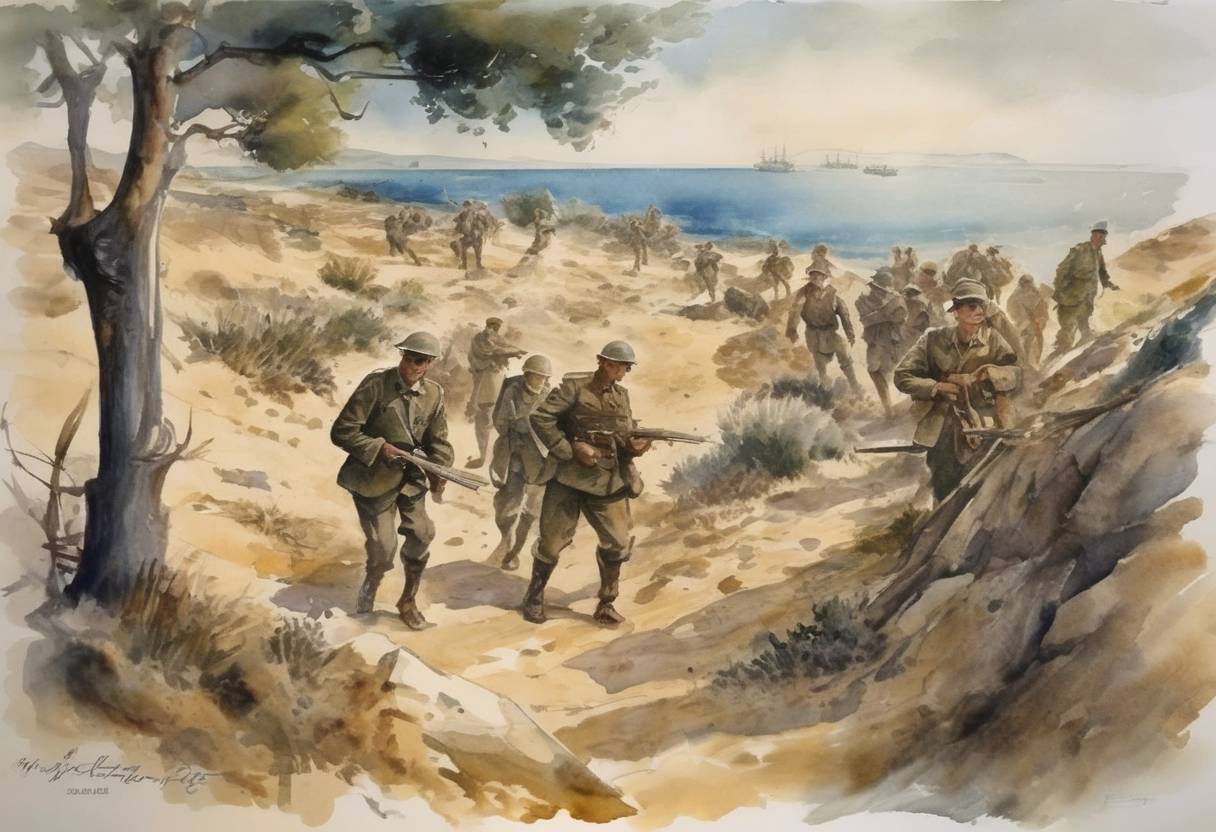
The Gallipoli Campaign, also known as the Dardanelles Campaign, was a significant military operation during World War I, initiated by the Allied forces on April 25, 1915. This campaign aimed to secure a sea route to Russia, a crucial ally, by capturing the Gallipoli Peninsula in the Ottoman Empire.
Strategic Importance: The Gallipoli Peninsula is located in modern-day Turkey, controlling the Dardanelles Strait, a vital maritime route connecting the Aegean Sea to the Sea of Marmara, and further to the Black Sea. Control of this strait was essential for the Allies to supply Russia with arms and other resources.
Allied Powers’ Objectives: The Allies, primarily Britain and France, sought to knock the Ottoman Empire out of the war, open a new front, and relieve pressure on the Eastern Front where Russia was struggling against the Central Powers.
Initial Naval Operations: Prior to the land invasion, the Allies attempted a naval assault in February and March 1915, which failed due to strong Ottoman defenses, including mines and artillery.
Date and Forces Involved: On April 25, 1915, the Allied forces, including troops from Britain, Australia, New Zealand (ANZAC), and France, launched a large-scale amphibious landing on the Gallipoli Peninsula.
Key Landing Sites: The main landings occurred at several beaches, notably Anzac Cove and Cape Helles. The ANZAC forces landed at Anzac Cove, while British and French troops targeted Cape Helles.
Challenges and Resistance: The landings faced fierce resistance from the Ottoman forces, commanded by Mustafa Kemal (later known as Atatürk), who played a crucial role in organizing the defense. The rugged terrain and well-prepared Ottoman positions made the landings extremely difficult.
Stalemate and Casualties: The campaign quickly devolved into a stalemate, with both sides suffering heavy casualties. The harsh conditions, disease, and strong Ottoman defense led to a prolonged and costly battle.
Evacuation: By December 1915, the Allies decided to evacuate, completing the withdrawal by January 1916. The campaign was a failure for the Allies, with significant loss of life and no strategic gains.
Impact on National Identities: The Gallipoli Campaign had a profound impact on national consciousness, particularly in Australia and New Zealand, where ANZAC Day (April 25) is commemorated annually to honor those who served.
Legacy: The campaign highlighted the importance of intelligence, planning, and the challenges of amphibious warfare. It also marked a significant moment in the rise of Mustafa Kemal Atatürk, who would later become the founder of modern Turkey.
The Gallipoli Campaign remains a poignant reminder of the complexities and tragedies of war, illustrating both the strategic ambitions and human costs of World War I.
Source: en.wikipedia.org