Incorporation of Washington, D.C. as a City on May 3, 1802
1802 · Washington, D.C., United States
Washington, D.C. was incorporated as a city.
November 17, 1800
The United States Congress held its first session in Washington, D.C., in the partially completed Capitol building.
Washington, D.C., United States | United States Congress
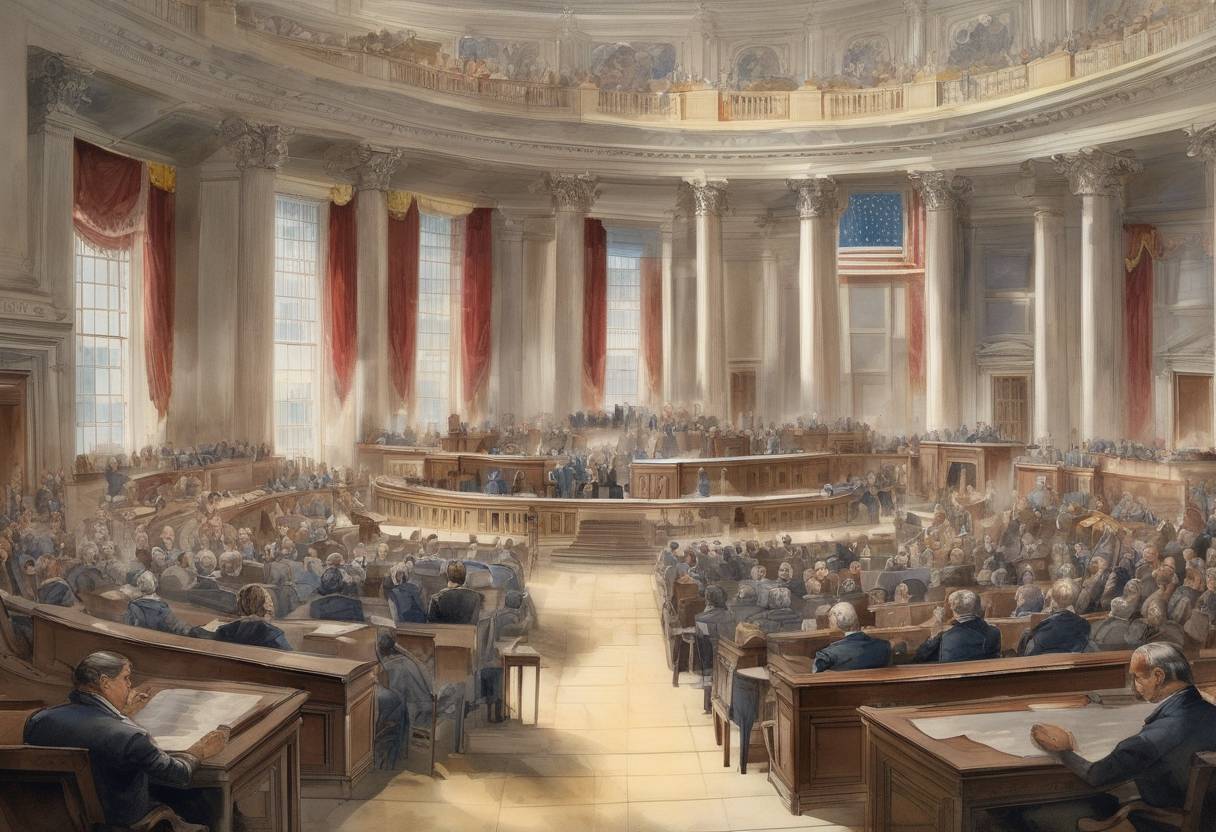
On November 17, 1800, the United States Congress convened for the first time in Washington, D.C., marking a significant moment in American history. This session took place in the partially completed Capitol building, which would become the enduring symbol of the U.S. legislative branch.
The Residence Act of 1790: The decision to move the capital from Philadelphia to a new location along the Potomac River was formalized by the Residence Act, signed by President George Washington. The act aimed to create a distinct federal district, separate from the influence of any state, to serve as the nation’s capital.
Design and Construction: The Capitol’s design was selected through a competition, with the winning proposal submitted by Dr. William Thornton. Construction began in 1793, but progress was slow due to financial constraints and labor shortages. By 1800, only the north wing was completed, which was sufficient to house Congress.
Opening of Congress: The 6th United States Congress met for the first time in the new capital. This session was significant as it marked the transition of the federal government to Washington, D.C., a city still in its infancy and largely undeveloped.
Challenges: Members of Congress faced numerous challenges, including inadequate accommodations and the unfinished state of the city. The Capitol itself was surrounded by a landscape of muddy roads and sparse infrastructure.
Symbol of Unity: The relocation of Congress to Washington, D.C., was a critical step in establishing a permanent seat of government, symbolizing unity and the federal nature of the United States.
Development of Washington, D.C.: The presence of Congress spurred the development of the city, gradually transforming it into the political and administrative heart of the nation.
Historical Legacy: The Capitol building, despite its initial incomplete state, would grow to become an iconic symbol of American democracy, witnessing numerous pivotal events in U.S. history.
The first session of Congress in Washington, D.C., was a foundational moment that set the stage for the city’s evolution into the capital we recognize today. Despite the early challenges, it underscored the commitment to creating a distinct and enduring center for the U.S. government.
Source: en.wikipedia.org