Coronation of Pedro I and the Establishment of the Empire of Brazil
1822 · Rio de Janeiro, Brazil
Pedro I was crowned Emperor of Brazil, marking the establishment of the Empire of Brazil.
January 22, 1808
The Portuguese royal family, led by Prince Regent John VI, arrives in Brazil to establish the Portuguese government in the colony amid the Napoleonic Wars.
Rio de Janeiro, Brazil | Portuguese Monarchy
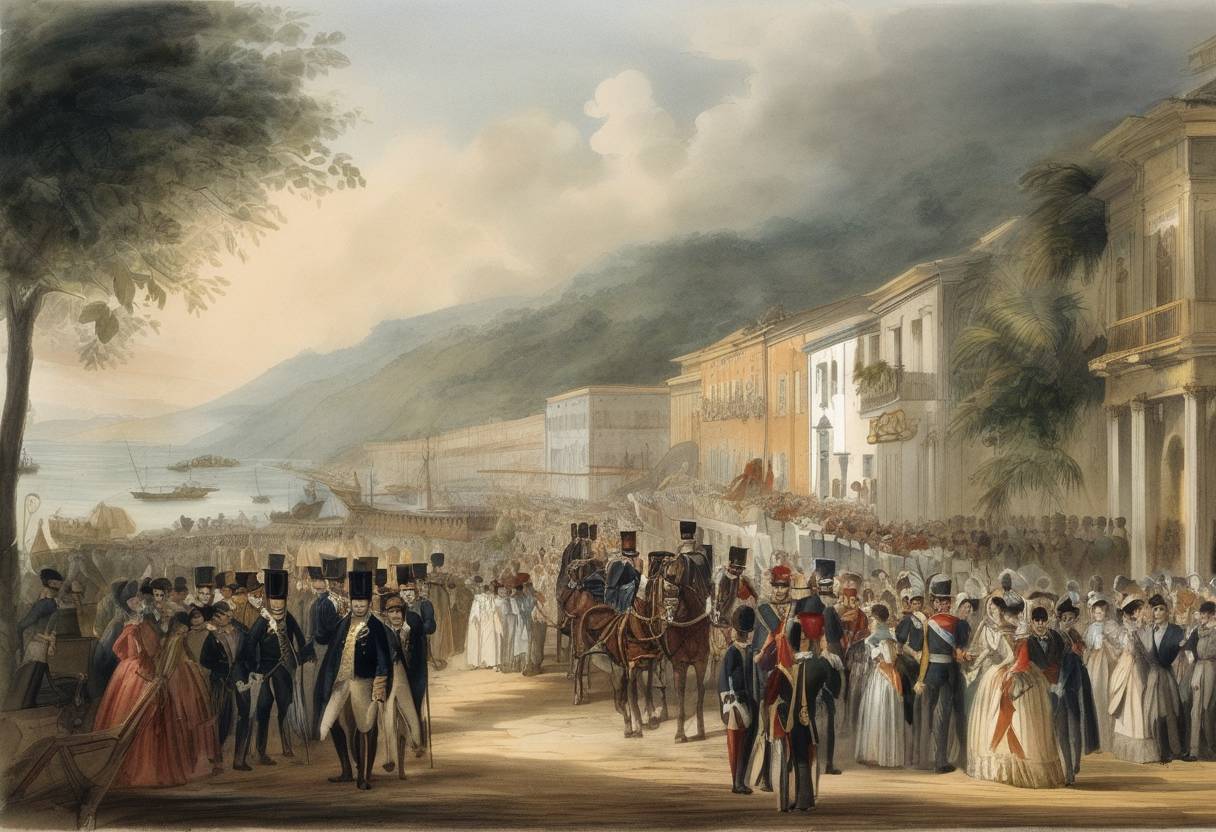
On January 22, 1808, the Portuguese royal family, led by Prince Regent Dom João VI, arrived in Salvador, Bahia, Brazil, an event that would significantly alter the course of Brazilian and Portuguese history. This relocation was made amid the chaotic backdrop of the Napoleonic Wars that saw much of Europe embroiled in conflict.
The Napoleonic Wars, which began in the early 19th century, posed a direct threat to Portugal. In 1807, Napoleon Bonaparte sought to enforce the Continental System—a blockade designed to cripple Britain’s economy by prohibiting European trade with the British Isles. When Portugal hesitated to join this system due to its longstanding alliance with Britain, Napoleon ordered the invasion of Portugal.
Foreseeing the advance of French forces and the imminent fall of Lisbon, the Portuguese court, under the stewardship of Prince Regent Dom João (later King John VI), made the strategic decision to relocate the government to their largest overseas colony, Brazil.
The fleet that carried the royal family departed Lisbon on November 29, 1807, under precarious conditions and with haste to avoid capture by the advancing French troops. The entourage included courtiers, government officials, and a significant portion of the noble class, establishing a government-in-exile.
Upon arrival in Salvador, Bahia, on January 22, 1808, the royal family was warmly received by local officials and Brazilian society. Their presence marked the first time a European royal family had relocated to the Americas, and this movement shifted the political epicenter of the Portuguese Empire across the Atlantic.
The relocation of the Portuguese court to Brazil had profound implications:
Economic and Administrative Reforms: The presence of the royal court transformed Rio de Janeiro into the de facto capital of the Portuguese Empire. Prince Regent João implemented policies that advanced Brazil’s development, such as opening Brazilian ports to allied nations, namely the British, thereby stimulating trade and economic growth.
Socio-Political Impact: The royal presence increased the status of Brazil within the empire, sowing the seeds for eventual independence. It also led to the foundation of important cultural and educational institutions in Brazil, including the creation of the Banco do Brasil and the establishment of a royal library.
Liberalization Efforts: Pressured by both Brazilian locals and external forces, the Prince Regent took steps that progressively liberalized Brazilian society, including the authorization of local manufacturing, previously restricted, which began Brazil’s industrial emphasis.
This pivotal day on January 22, 1808, marked not merely a relocation but was a milestone that catalyzed Brazil’s pathway towards independence and transformed it into a crucial part of the Portuguese Empire.
Source: en.wikipedia.org