1650 · Stockholm, Sweden
René Descartes, the influential French philosopher, mathematician, and scientist, known for his statement 'Cogito, ergo sum' (I think, therefore I am), died in Stockholm.
January 12, 1665
Pierre de Fermat's Last Theorem is stated, despite being first mentioned in a letter dated 1637. His claim that he has a proof too large to fit in the margin became famous, sparking centuries of mathematical pursuit.
Toulouse, France | None
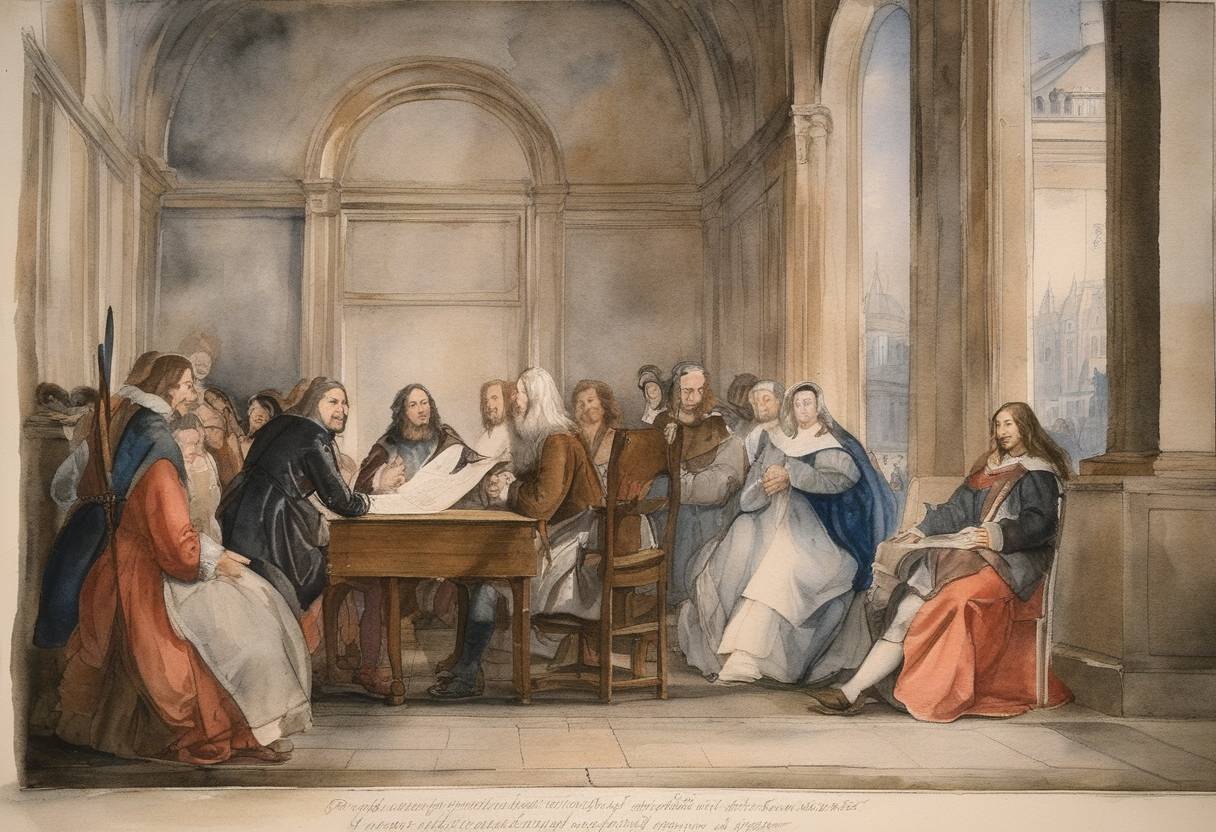
On January 12, 1665, Pierre de Fermat, a prominent French mathematician, passed away, leaving behind a legacy that would puzzle mathematicians for centuries. Fermat is best known for his “Last Theorem,” a conjecture he first noted in 1637 in the margin of his copy of the book “Arithmetica” by Diophantus of Alexandria. He famously claimed to have discovered a “truly marvelous proof of this proposition which this margin is too narrow to contain.”
Fermat’s Last Theorem states that there are no three positive integers ( a ), ( b ), and ( c ) that satisfy the equation:
[ a^n + b^n = c^n ]
for any integer value of ( n ) greater than 2. While the case for ( n = 2 ) is the well-known Pythagorean theorem, Fermat’s assertion introduced a challenge for higher powers.
At the time of Fermat’s death on January 12, his theorem remained unproven, despite his claim of a proof. His note set off a historic pursuit among mathematicians to find an actual proof. During the centuries that followed, the theorem was tested and proven true for numerous specific values of ( n ), but a general proof remained elusive.
Fermat’s Last Theorem held its place as one of mathematics’ most famous unsolved problems until 1994, when British mathematician Andrew Wiles, with assistance from Richard Taylor, successfully completed a proof. Wiles’s proof was a landmark achievement in mathematics and drew upon vast areas of contemporary mathematical theory, particularly modular forms and elliptic curves.
The theorem became symbolic of the intrigue and challenge that pure mathematical conjectures can represent. Fermat’s Last Theorem’s impact can be seen in its stimulation of computational developments, improvements in number theory, and the collaborative spirit it inspired across the global mathematical community.
Source: en.wikipedia.org