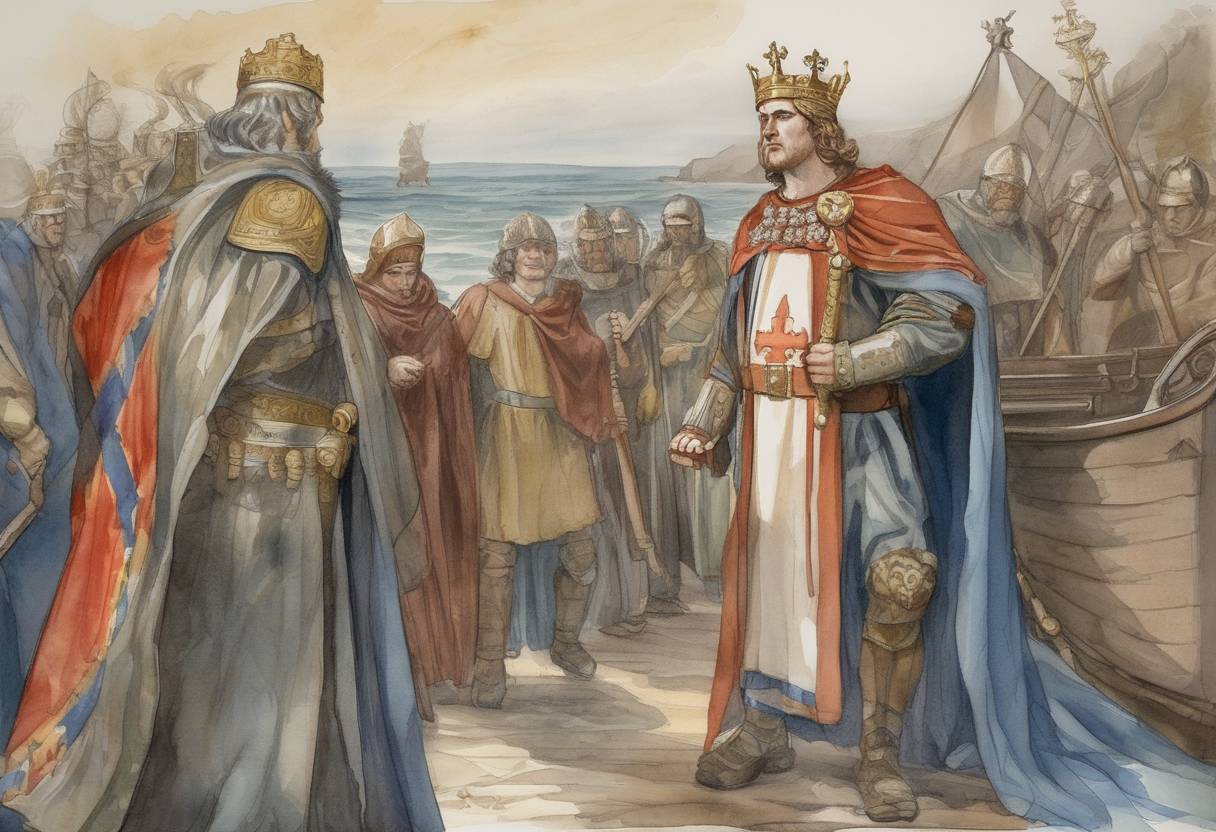
Death of Canute the Great: November 12, 1035
On November 12, 1035, Canute the Great, the King of England, Denmark, and Norway, passed away, marking a pivotal moment in medieval European history. His death led to a succession crisis that ultimately resulted in the dissolution of the North Sea Empire he had established.
Background
Canute the Great, born circa 995, was a formidable ruler who managed to unite the crowns of England, Denmark, and Norway under his control, creating what is often referred to as the North Sea Empire. His reign was characterized by a blend of Viking and Christian influences, and he was known for his efforts to maintain peace and stability across his territories.
- England: Canute became King of England in 1016 after a series of battles against Edmund Ironside, the son of Æthelred the Unready. The Treaty of Alney divided the kingdom between them, but Edmund’s death later that year left Canute as the sole ruler.
- Denmark: He inherited the Danish throne in 1018 following the death of his father, Sweyn Forkbeard.
- Norway: Canute extended his influence over Norway in 1028, consolidating his power across the Scandinavian region.
Canute’s Reign
Canute’s rule was marked by his ability to integrate the Anglo-Saxon and Viking cultures, fostering economic prosperity and relative peace. He was a patron of the Church and worked to strengthen the Christian faith in his realms. His administration was efficient, and he maintained a strong central authority, which was crucial for managing his vast empire.
Succession Crisis
Canute’s death in 1035 triggered a succession crisis due to the lack of a clear heir. His sons, Harold Harefoot and Harthacnut, were both contenders for the throne, but neither was immediately able to secure control over all of Canute’s territories.
- Harold Harefoot: He was proclaimed regent of England in 1035 and became king in 1037, ruling until his death in 1040.
- Harthacnut: Initially focused on securing his position in Denmark, he eventually became King of England after Harold’s death.
Aftermath and Historical Significance
The succession crisis weakened the unity of the North Sea Empire. Harthacnut’s reign was short-lived, and upon his death in 1042, the English crown passed to Edward the Confessor, marking the end of Danish rule in England.
The dissolution of Canute’s empire had significant implications:
- England: The return to Anglo-Saxon rule set the stage for the Norman Conquest in 1066.
- Scandinavia: The fragmentation of Canute’s empire led to the re-establishment of separate kingdoms in Denmark and Norway.
Canute the Great’s death and the subsequent events highlight the challenges of maintaining a multi-national empire in the medieval period. His legacy, however, remains significant as a ruler who managed to bring together diverse cultures and lay the groundwork for future political developments in Northern Europe.