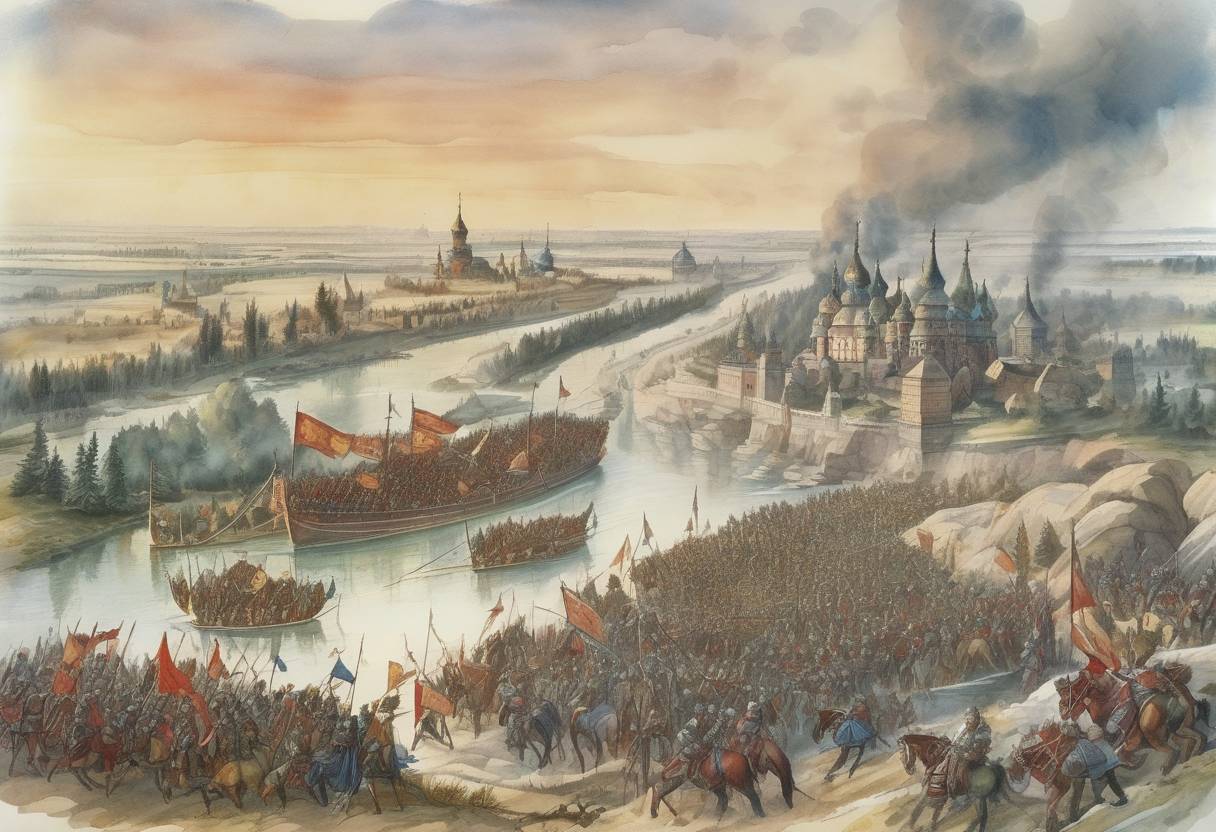
The Great Stand on the Ugra River: October 8, 1480
The Great Stand on the Ugra River, which reached its climax on October 8, 1480, was a pivotal moment in Russian history, marking the end of Mongol domination over Moscow and the beginning of the rise of the Grand Duchy of Moscow as a powerful state. This event was characterized by a standoff between the forces of the Grand Duchy of Moscow, led by Grand Prince Ivan III, and the army of the Golden Horde, commanded by Khan Akhmat.
Historical Context
- Mongol Domination: Since the early 13th century, the Mongol Empire, through its western segment known as the Golden Horde, had exerted control over the Russian principalities. This period, often referred to as the “Tatar Yoke,” involved the payment of tribute and submission to Mongol authority.
- Rise of Moscow: By the late 15th century, the Grand Duchy of Moscow had grown in power and influence, largely due to strategic marriages, territorial expansion, and the weakening of the Golden Horde due to internal strife and external pressures.
Key Events Leading to the Standoff
- Refusal to Pay Tribute: In 1476, Ivan III stopped paying tribute to the Golden Horde, signaling a challenge to Mongol authority. This act of defiance set the stage for a confrontation.
- Khan Akhmat’s Campaign: In 1480, Khan Akhmat sought to reassert control over Moscow by launching a military campaign. His forces advanced towards the Ugra River, a strategic location near the borders of Moscow’s territory.
The Standoff
- Positioning: The two armies faced each other across the Ugra River in October 1480. The river served as a natural barrier, and neither side was willing to make the first move to cross it and engage in battle.
- Strategic Impasse: The standoff lasted for several weeks, with both sides hesitant to initiate combat. Ivan III’s forces were well-positioned defensively, and the onset of winter further complicated military operations for Khan Akhmat.
Resolution and Aftermath
- Retreat of the Golden Horde: On October 8, 1480, Khan Akhmat decided to withdraw his forces, effectively ending the standoff without a battle. This retreat was influenced by the logistical difficulties of sustaining an army in hostile territory and the lack of support from other Mongol factions.
- End of Mongol Domination: The withdrawal marked a significant turning point, as it symbolized the end of Mongol dominance over Moscow. Ivan III’s successful defiance of the Golden Horde paved the way for the consolidation of Russian lands under Moscow’s leadership.
- Rise of Moscow: The event is often seen as a foundational moment in the emergence of the Russian state. It allowed Ivan III to further centralize power and expand his territory, setting the stage for the future Tsardom of Russia.
Broader Historical Significance
The Great Stand on the Ugra River is a landmark event in Russian history, representing the decline of Mongol influence in Eastern Europe and the rise of Moscow as a dominant power. It marked the beginning of a new era of Russian sovereignty and expansion, laying the groundwork for the eventual establishment of the Russian Empire.