Emperor Shirakawa's Abdication
1156 · Kyoto, Japan
Emperor Shirakawa of Japan abdicated the throne.
August 2, 1377
Enthronement of Emperor Kōmyō as the pretender emperor of Japan.
Kyoto, Japan | Imperial Court of Japan
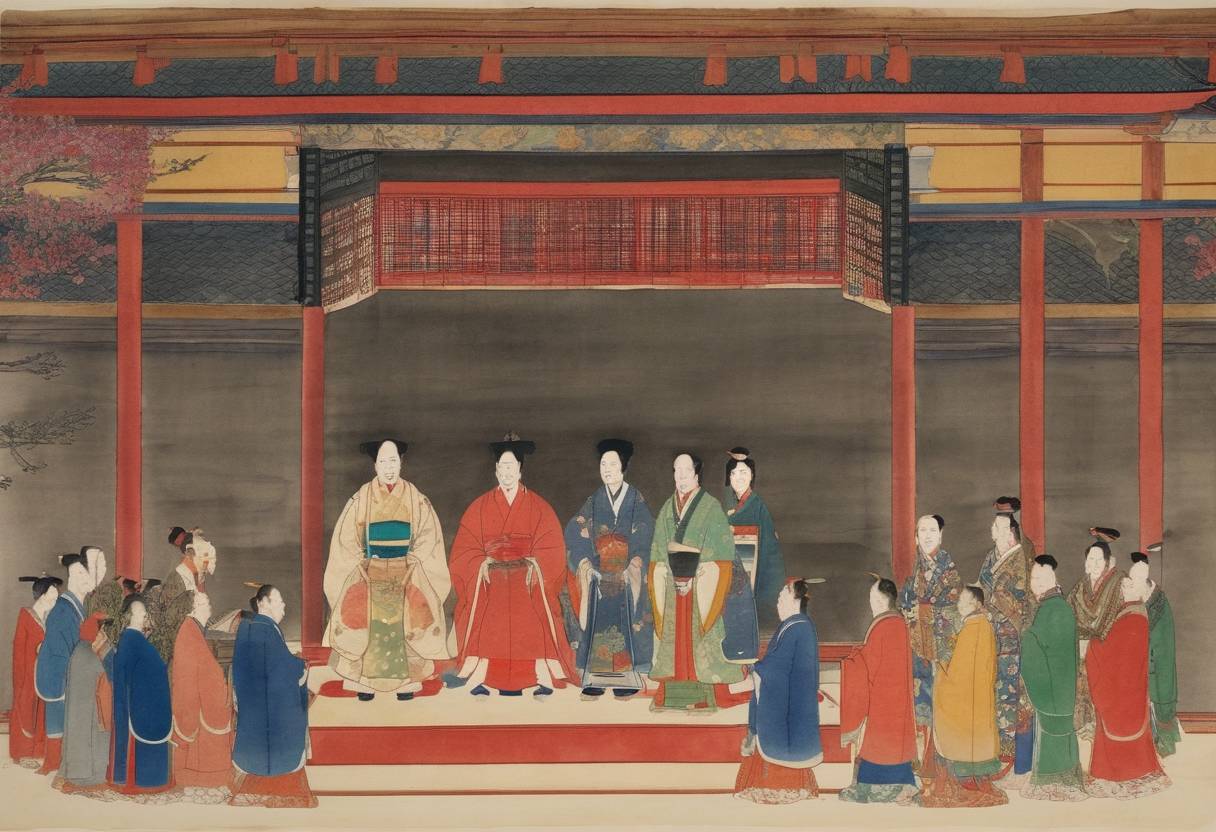
On August 2, 1377, in Japan, a significant event marked this day as Emperor Kōmyō was enthroned as a pretender emperor. This event occurred during the period of the Nanboku-chō (Northern and Southern Courts) era, which spanned from 1336 to 1392. The enthronement of Kōmyō must be understood in the context of the ongoing struggles between the Northern and Southern Courts of Japan.
The Nanboku-chō period was characterized by the conflict between two rival imperial courts: the Northern Court, situated in Kyoto and backed by the Ashikaga shogunate, and the Southern Court, based in Yoshino and led by the loyalists of the legitimate royal line. This schism was rooted in political disputes over succession that began with Emperor Go-Daigo’s attempts to overthrow the Kamakura shogunate and restore full imperial rule.
Emperor Kōmyō was initially enthroned as a figurehead by the militarily dominant Northern Court. His rise to power as a pretender emperor was orchestrated by the Ashikaga shogun Ashikaga Takauji, who sought to legitimize his authority by installing a compliant puppet ruler. Kōmyō was the fourth son of Emperor Go-Fushimi and belonged to the Jimyōin-tō line of the imperial family, which rivaled the Daikakuji-tō line that claimed the throne as the Southern Court.
The enthronement of Kōmyō in 1377 was emblematic of the ongoing disputes and fracture within the imperial succession line. His court in Kyoto was recognized by the Ashikaga and their supporters but not by the Southern imperial court, which continued to assert its claim to the throne. This duality further entrenched the division within the imperial institution.
The Nanboku-chō period, with its competing courts, weakened the authority and unity of the Japanese imperial institution. It was not until 1392 that the Southern Court capitulated and a compromise was reached, reuniting the imperial line under the Northern Court’s leadership, which the Ashikaga supported. This reunification marked the end of the Nanboku-chō turmoil and solidified the authority of the Northern Court under Emperor Go-Komatsu.
Emperor Kōmyō’s reign, albeit as a pretender, highlights the complex interplay between military power and imperial legitimacy during a transformative period in Japan’s history. His enthronement serves as a poignant reminder of the intricate dynamics that defined Japan’s medieval era conflict and shaped the eventual structures of governance.
Source: en.wikipedia.org