The Gulf War: Operation Desert Storm
1991 · Baghdad, Iraq
The Gulf War, also known as Operation Desert Storm, began as coalition forces led by the United States launched air strikes against Iraq in response to Iraq's invasion of Kuwait.
January 17, 1991
Operation Desert Storm begins as the United States and coalition forces launch a massive air offensive against Iraq in response to Iraq's invasion of Kuwait.
Baghdad, Iraq | United States and Coalition Forces
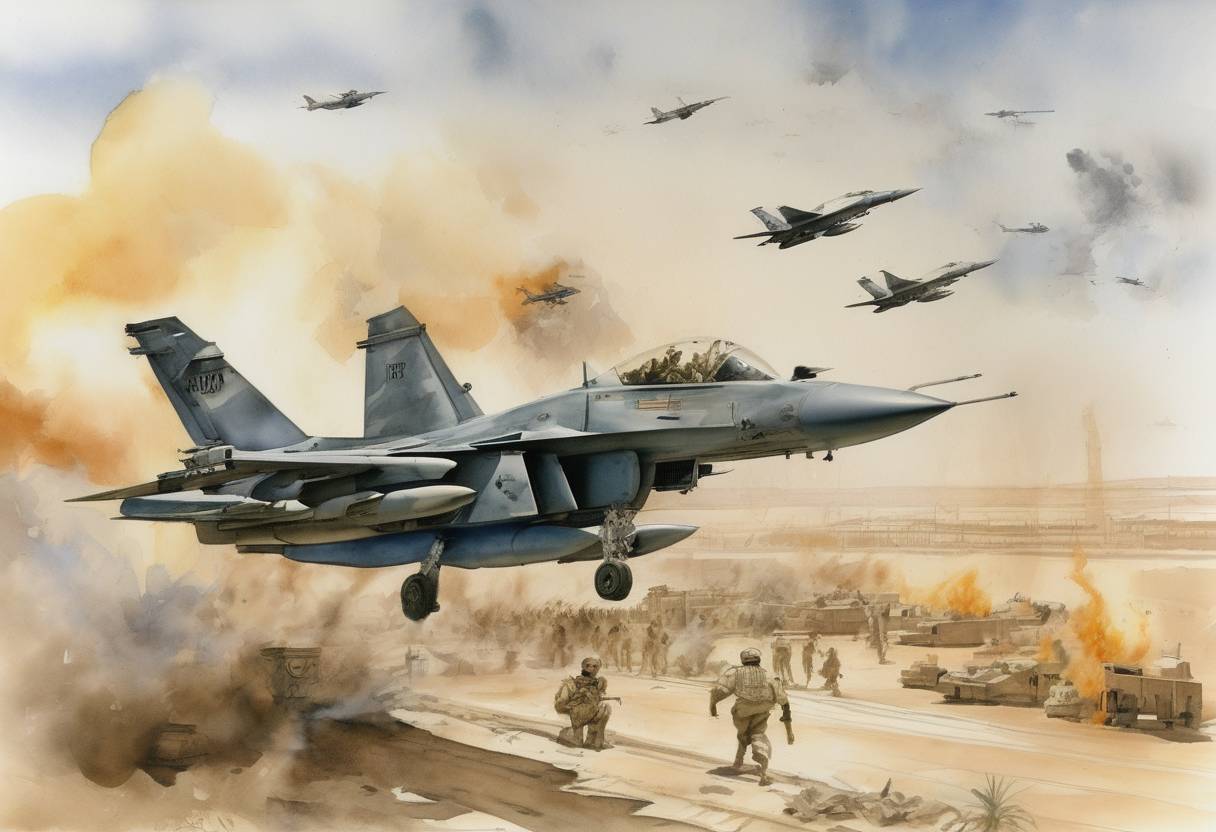
On January 17, 1991, Operation Desert Storm commenced as the United States, alongside a coalition of 34 nations, launched a massive air offensive against Iraq. This military action was a direct response to Iraq’s invasion and subsequent annexation of Kuwait on August 2, 1990, which had sparked international condemnation and a series of United Nations resolutions demanding Iraq’s withdrawal.
Invasion of Kuwait: On August 2, 1990, Iraqi forces, under the command of President Saddam Hussein, invaded Kuwait, citing economic disputes and territorial claims. The invasion was met with swift international backlash, leading to economic sanctions and demands for Iraq’s immediate withdrawal.
UN Resolutions: The United Nations Security Council passed several resolutions, including Resolution 660, which condemned the invasion, and Resolution 678, which authorized the use of force if Iraq did not withdraw by January 15, 1991.
Coalition Formation: The United States, under President George H. W. Bush, spearheaded the formation of a broad coalition, including NATO allies, Arab nations, and other countries, to oppose Iraq’s aggression. This coalition was notable for its diversity and the inclusion of countries like Saudi Arabia and Egypt.
Operation Desert Shield: Prior to the offensive, Operation Desert Shield was initiated to protect Saudi Arabia and deter further Iraqi aggression. This operation involved the deployment of hundreds of thousands of troops to the region.
Air Campaign: At 2:38 AM local time on January 17, 1991, the coalition launched a massive air campaign. The operation began with a series of precision airstrikes aimed at crippling Iraq’s air defenses, communication networks, and key military infrastructure.
Technological Superiority: The coalition forces utilized advanced technology, including stealth aircraft like the F-117 Nighthawk, precision-guided munitions, and satellite navigation systems, which played a crucial role in minimizing coalition casualties and maximizing the effectiveness of the strikes.
Ground Offensive: Following the success of the air campaign, a ground offensive, known as Operation Desert Sabre, was launched on February 24, 1991. This swiftly led to the liberation of Kuwait and the retreat of Iraqi forces.
Ceasefire and Consequences: A ceasefire was declared on February 28, 1991, after just 100 hours of ground combat. The conflict resulted in significant Iraqi military and civilian casualties and widespread destruction of infrastructure.
Geopolitical Impact: Operation Desert Storm demonstrated the effectiveness of coalition warfare and advanced military technology. It also reinforced the United States’ role as a dominant military power in the post-Cold War era and had lasting implications for Middle Eastern geopolitics.
Operation Desert Storm remains a pivotal moment in late 20th-century history, illustrating the complexities of international diplomacy, military strategy, and the global response to acts of aggression.
Source: en.wikipedia.org