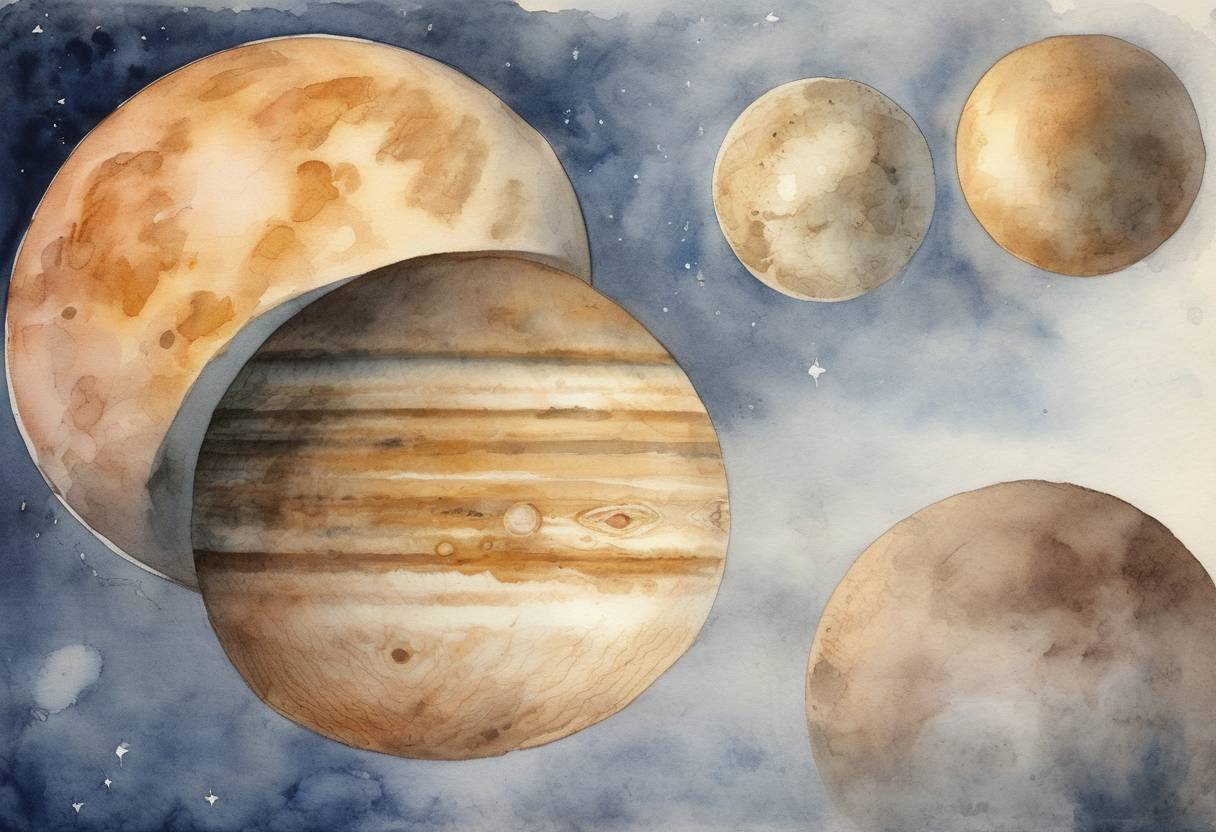
Galileo’s Observation of the Galilean Moons
On January 7, 1610, the renowned Italian astronomer Galileo Galilei made a groundbreaking astronomical observation that would forever change our understanding of the cosmos. Using a telescope he had improved upon, Galileo observed four celestial bodies near Jupiter, which he initially thought were stars. These bodies were later identified as the largest moons of Jupiter: Ganymede, Callisto, Io, and Europa, now collectively known as the Galilean moons.
Context and Background
Galileo Galilei: Born in 1564 in Pisa, Italy, Galileo was a polymath whose work laid the foundations for modern physics and observational astronomy. By the early 17th century, he had become a prominent figure in the scientific community, known for his advocacy of the Copernican heliocentric model, which posited that the Earth and other planets orbit the Sun.
The Telescope: Although Galileo did not invent the telescope, he significantly improved its design, increasing its magnification power. His version of the telescope allowed him to make detailed observations of celestial bodies, which were not possible with the naked eye.
The Observation
- Date: January 7, 1610
- Location: Padua, Italy
- Discovery: While observing Jupiter, Galileo noticed three small “stars” near the planet. Over the following nights, he observed these bodies and noted their changes in position relative to Jupiter. By January 13, he had identified a fourth body.
Significance
Heliocentric Support: The discovery of the Galilean moons provided strong evidence against the geocentric model of the universe, which held that all celestial bodies revolved around the Earth. The moons clearly orbited Jupiter, demonstrating that not everything in the cosmos revolved around our planet.
Impact on Astronomy: Galileo’s observations were pivotal in advancing the Copernican model and laid the groundwork for future astronomical discoveries. They also highlighted the potential of the telescope as a tool for scientific inquiry.
Cultural and Scientific Shift: The discovery challenged prevailing scientific and religious views, contributing to the broader scientific revolution that was reshaping European thought during this period.
Aftermath
Publication: Galileo published his findings in March 1610 in a short treatise titled “Sidereus Nuncius” (The Starry Messenger), which brought him immediate fame and recognition.
Legacy: The Galilean moons remain some of the most studied celestial bodies in our solar system. Their discovery marked a significant milestone in the history of astronomy and underscored the importance of empirical observation in scientific practice.
Galileo’s observation of the Galilean moons not only expanded our understanding of the universe but also exemplified the transformative power of scientific innovation and inquiry.