The FCC Grants CBS the First License to Broadcast Television in Color
1950 · Washington, D.C., United States
The Federal Communications Commission (FCC) issued the first license to broadcast television in color to CBS.
April 7, 1927
The first long-distance public television broadcast is made from Washington, D.C., to New York City, displaying the image of Commerce Secretary Herbert Hoover.
Washington, D.C., United States | Bell Telephone Company
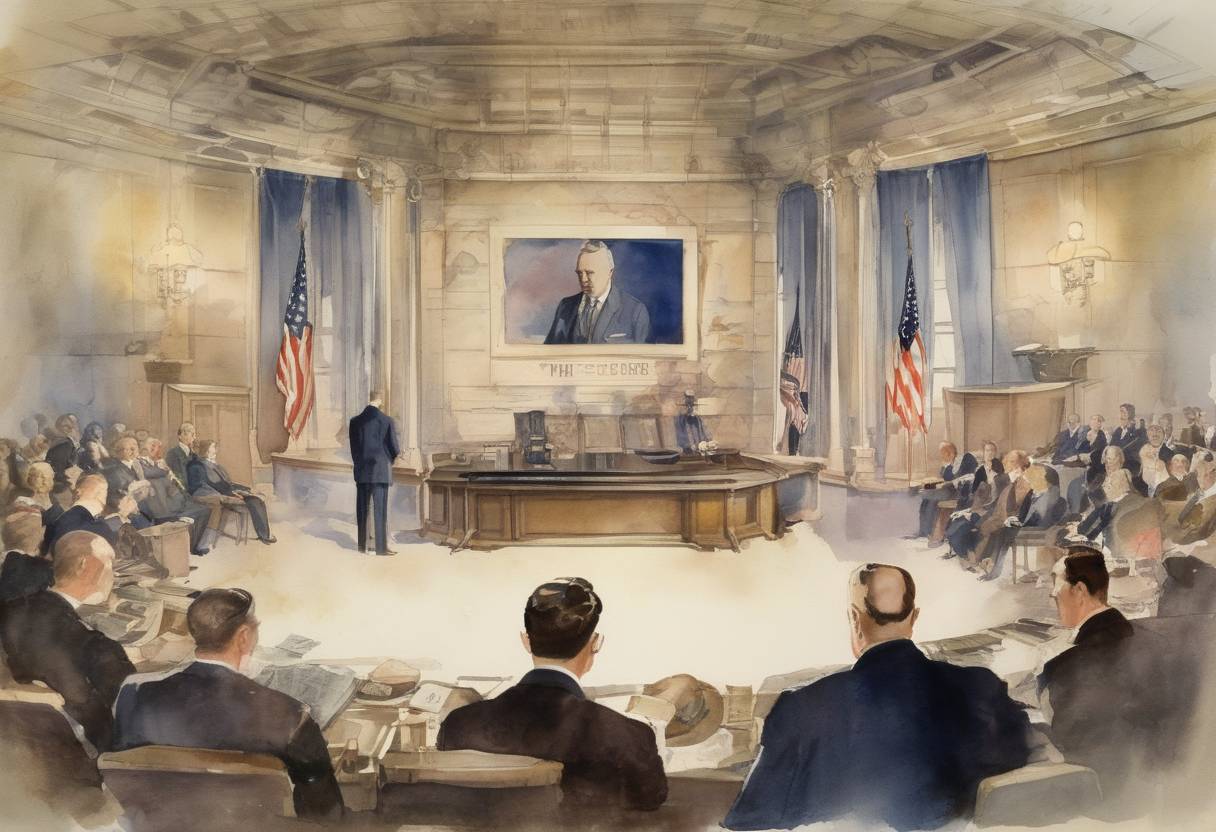
On April 7, 1927, a groundbreaking event in the history of communication technology took place: the first long-distance public television broadcast. This historic broadcast was transmitted from Washington, D.C., to New York City and featured the image of the then U.S. Secretary of Commerce, Herbert Hoover.
The 1920s were a period of rapid technological advancement, particularly in the field of communication. Radio had already become a popular medium, and inventors and scientists were exploring the potential of television as a new form of mass communication. The concept of transmitting moving images over long distances was a significant challenge, requiring innovations in both electronic and mechanical technologies.
The broadcast was organized by the American Telephone and Telegraph Company (AT&T) and Bell Telephone Laboratories. It utilized a system developed by Charles Francis Jenkins and John Logie Baird, pioneers in early television technology. The transmission was made possible through the use of a combination of wired and wireless technologies, including the use of telephone lines to carry the video signal.
This event marked a significant milestone in the development of television as a medium. It demonstrated the feasibility of long-distance television transmission and paved the way for future advancements in broadcasting technology. The successful demonstration captured public and governmental interest, leading to increased investment and research in television technology.
In summary, the first long-distance public television broadcast on April 7, 1927, was a pivotal moment in the history of media and communication, setting the stage for the television era that would follow.
Source: en.wikipedia.org