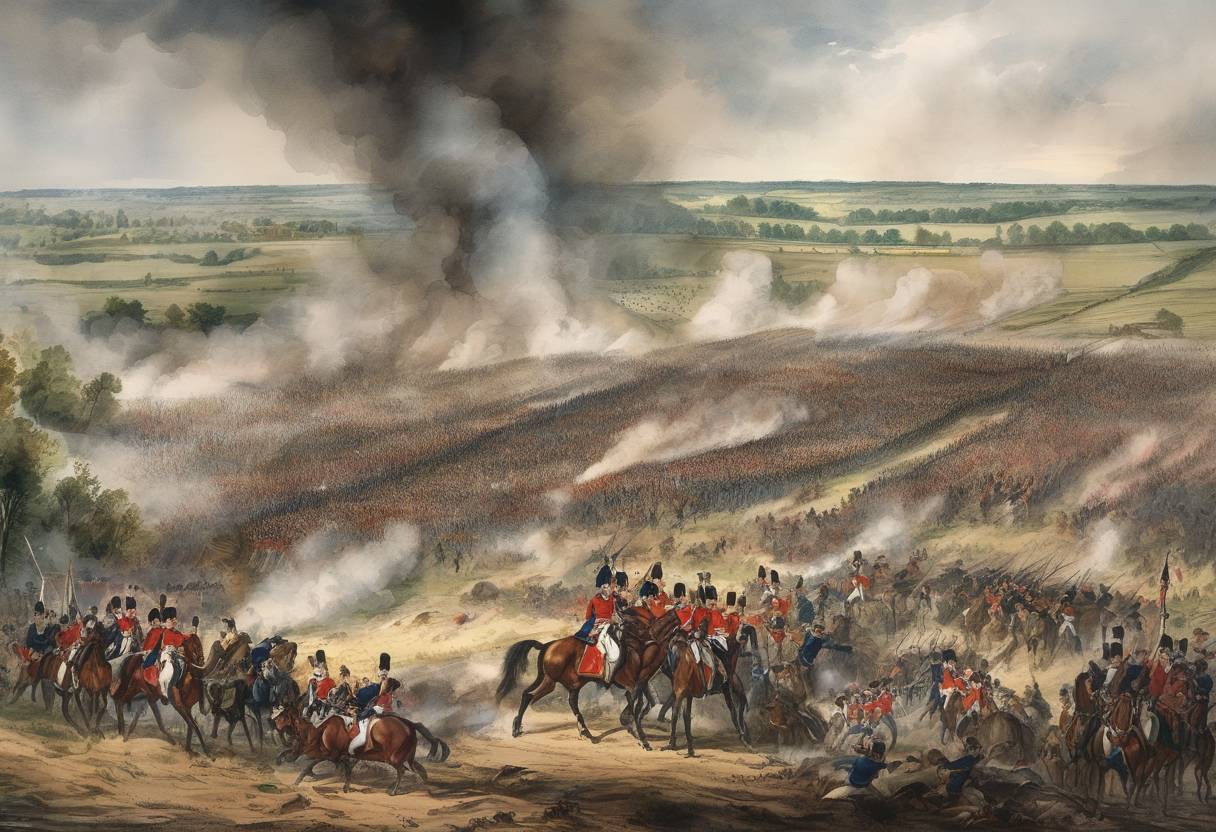
The Battle of Waterloo: June 18, 1815
The Battle of Waterloo, fought on June 18, 1815, was a pivotal moment in European history, marking the end of the Napoleonic Wars and the final defeat of Napoleon Bonaparte. This decisive battle took place near Waterloo, in present-day Belgium, and involved the forces of the French Empire against the Seventh Coalition, primarily led by the Duke of Wellington from Britain and Prussian Field Marshal Gebhard Leberecht von Blücher.
Context and Prelude
- Napoleon’s Return: After escaping from exile on the island of Elba in March 1815, Napoleon returned to France and quickly regained power, initiating the period known as the Hundred Days.
- Formation of the Seventh Coalition: In response to Napoleon’s resurgence, a coalition of European powers, including the United Kingdom, Prussia, Austria, and Russia, formed to oppose him.
- Strategic Positioning: Napoleon aimed to defeat the coalition forces separately before they could unite. He moved his army into Belgium, hoping to strike a decisive blow against the British and Prussian armies.
The Battle
- Location: The battle took place near the village of Waterloo, approximately 15 kilometers south of Brussels.
- Forces Involved: Napoleon commanded approximately 73,000 troops, while the coalition forces, under Wellington and Blücher, numbered around 118,000.
- Key Phases:
- Morning Engagements: The battle began with French attacks on the coalition’s left flank at Hougoumont, a fortified farmhouse.
- Midday Assaults: Napoleon launched a massive infantry assault on the center of Wellington’s line, which was repelled with heavy casualties.
- Arrival of the Prussians: In the afternoon, Blücher’s Prussian forces arrived on the battlefield, attacking the French right flank and providing crucial support to Wellington.
- Final French Offensive: Napoleon’s Imperial Guard, his elite troops, made a last desperate attack but were ultimately repelled, leading to the collapse of the French army.
Aftermath and Consequences
- Napoleon’s Abdication: Following his defeat, Napoleon abdicated for the second time on June 22, 1815.
- Exile to Saint Helena: Napoleon was exiled to the remote island of Saint Helena in the South Atlantic Ocean, where he spent the remainder of his life until his death in 1821.
- End of the Napoleonic Wars: The Battle of Waterloo effectively ended the Napoleonic Wars, leading to a period of relative peace in Europe.
- Congress of Vienna: The victory of the Seventh Coalition reinforced the decisions made at the Congress of Vienna, which sought to restore balance and order in Europe after years of revolutionary and Napoleonic upheaval.
Historical Significance
The Battle of Waterloo is often regarded as a turning point in European history. It not only ended Napoleon’s rule but also set the stage for the reshaping of European borders and the establishment of a new political order. The defeat of Napoleon ensured the dominance of the conservative powers in Europe and laid the groundwork for the 19th-century balance of power that sought to prevent the rise of another singularly powerful state.