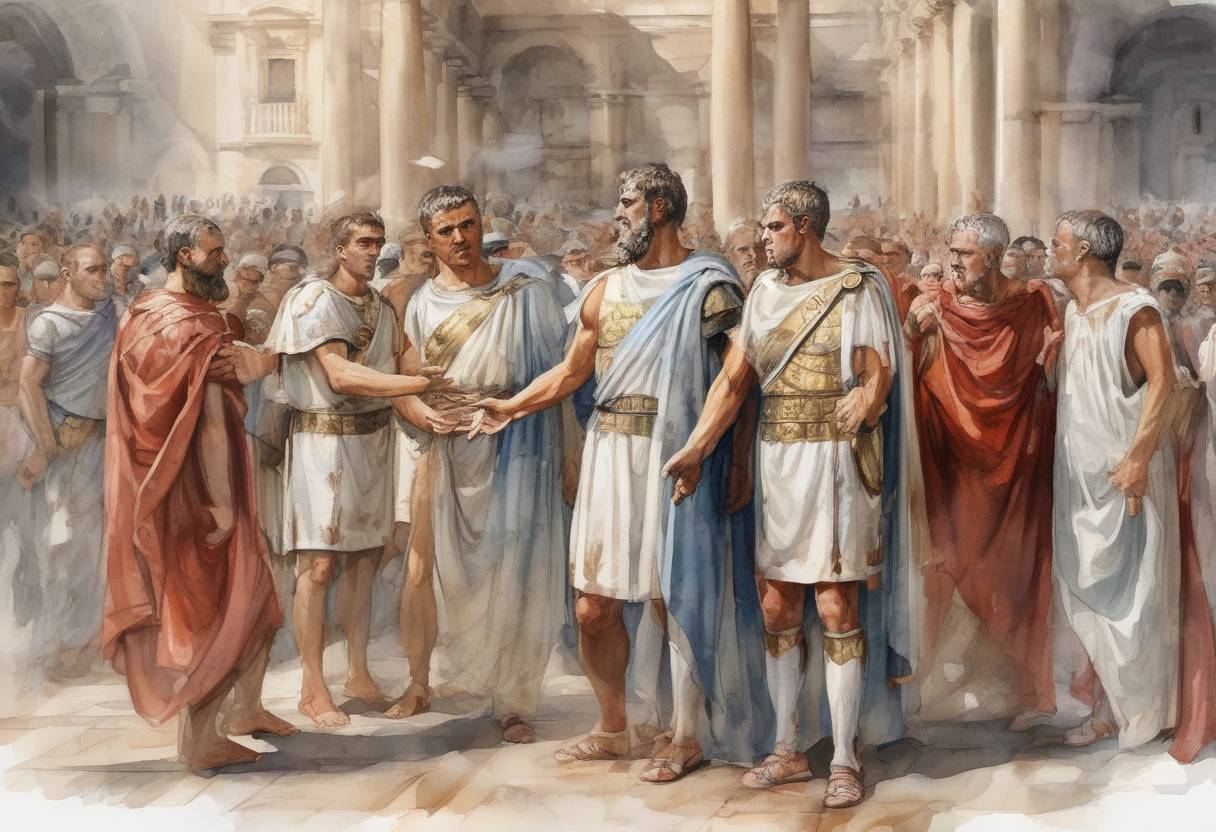
The Establishment of the Tetrarchy: March 1, 293
On March 1, 293, a significant restructuring of the Roman Empire’s governance took place under the leadership of Emperor Diocletian. This event marked the formal establishment of the Tetrarchy, a system designed to bring stability and efficient management to the sprawling Roman Empire, which had been plagued by internal strife and external threats.
Background
Before the Tetrarchy, the Roman Empire faced numerous challenges, including economic difficulties, military threats from both internal and external forces, and administrative inefficiencies. Diocletian, who became emperor in 284, recognized the need for reform to address these issues and ensure the empire’s survival.
The Tetrarchy System
The Tetrarchy, meaning “rule of four,” was Diocletian’s innovative solution. It divided the empire into two main parts, each governed by an Augustus (senior emperor) and a Caesar (junior emperor). This system aimed to provide more localized and responsive governance, as well as a clear line of succession to prevent power struggles.
- Diocletian retained control as the Augustus of the Eastern Roman Empire.
- Maximian, his trusted colleague, was appointed as the Augustus of the Western Roman Empire.
On March 1, 293, Diocletian appointed two Caesars to assist the Augusti:
- Constantius Chlorus was appointed as Caesar in the West, serving under Maximian. He was responsible for the provinces of Gaul, Britain, and Hispania.
- Galerius was appointed as Caesar in the East, serving under Diocletian. He was tasked with defending the Danube frontier and managing the Balkans.
Significance and Consequences
The Tetrarchy was a groundbreaking administrative reform that temporarily stabilized the Roman Empire. It allowed for more effective military responses to threats and improved governance by decentralizing power. The clear succession plan also reduced the likelihood of civil wars over the imperial throne.
However, the Tetrarchy’s success was short-lived. After Diocletian and Maximian abdicated in 305, the system began to unravel due to the ambitions of their successors and the inherent challenges of maintaining a power-sharing arrangement. By 313, the Tetrarchy had effectively collapsed, leading to the rise of Constantine the Great and the eventual reunification of the empire under a single ruler.
Legacy
Despite its eventual failure, the Tetrarchy was a significant experiment in governance that influenced later administrative divisions within the Roman Empire. It demonstrated the challenges of ruling a vast and diverse empire and highlighted the need for adaptable and innovative political solutions.
The appointment of Constantius Chlorus and Galerius as Caesars on March 1, 293, remains a pivotal moment in Roman history, illustrating both the potential and limitations of shared imperial power.