Galileo Galilei and the 1616 Church Ban on Heliocentrism
1616 · Rome, Italy
Galileo Galilei was formally banned by the Roman Catholic Church from teaching or defending the heliocentric ideas of Copernicus.
May 9, 1457
Nicolaus of Cusa, a German philosopher, theologian, jurist, mathematician, and astronomer, discarded the traditional geocentric model of the universe, advocating a form of celestial philosophy that suggests a more complex and less Earth-centered universe.
Rome, Papal States
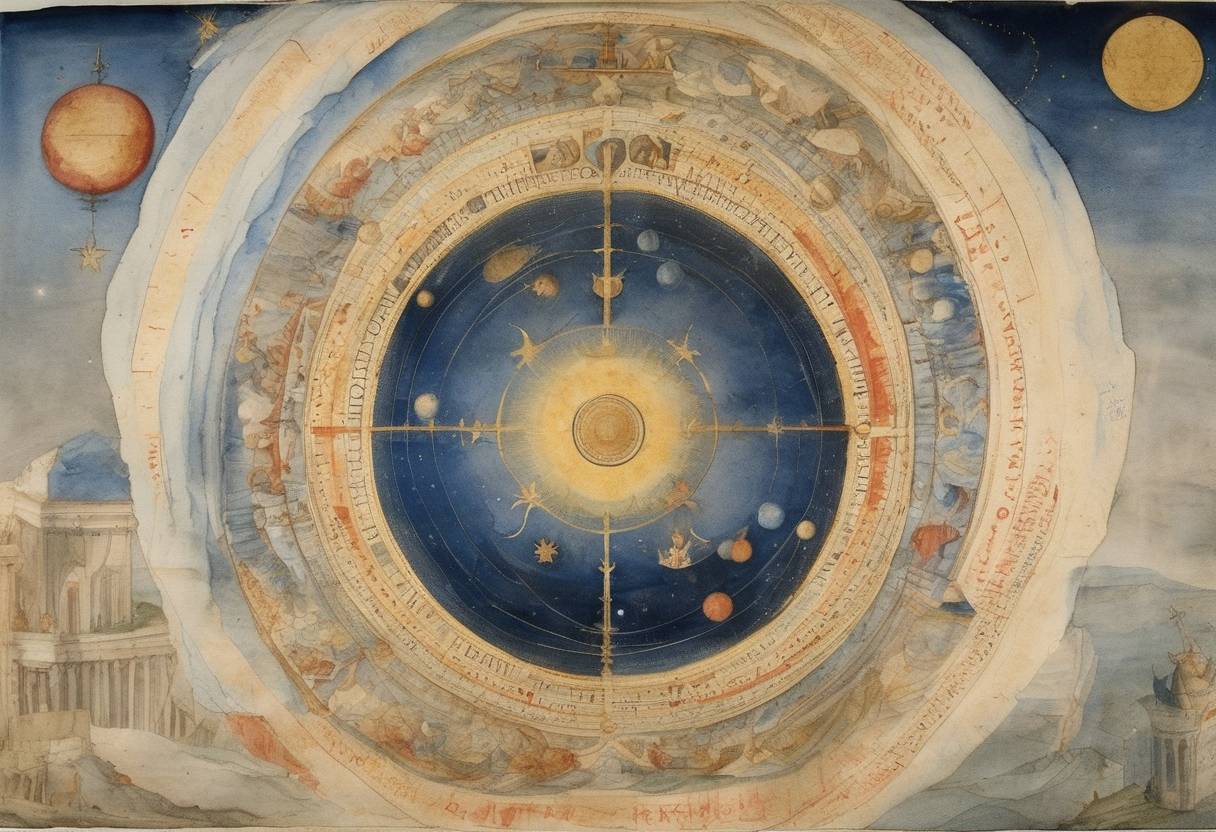
Nicolaus of Cusa, a pivotal figure of the 15th century, was renowned for his innovative thinking across numerous disciplines, including philosophy, astronomy, and theology. As a German philosopher and cardinal, he played a critical role in challenging established thought—most notably through his advocacy for a more complex, non-geocentric understanding of the universe.
Nicolaus was born in 1401 in the vicinity of Trier, within the Holy Roman Empire. His education spanned studies in canon law, mathematics, and the nascent field of humanism. His intellectual contributions were marked by a blend of mathematical clarity and theological insight, which he summarized in his principal work, “De Docta Ignorantia” (On Learned Ignorance), published in 1440. This work laid the foundation for his later assertions on the cosmos, reflecting the significant intellectual shifts leading up to the Renaissance.
On May 9, 1457, Nicolaus of Cusa continued his scholarly pursuits and ecclesiastical engagements. While specific records of this exact date detailing his activities or writings that fundamentally discarded the traditional geocentric model do not exist, this time period encapsulates his period of active reform and intellectual exploration that paved the way for later astronomical discoveries.
Cusanus proposed that the universe was infinite and not centered around the Earth—a radical idea that predated and anticipated discoveries by Copernicus and Galileo. His concept of relative motion and the Earth’s rotation were particularly forward-thinking, especially considering the dominant Ptolemaic model of the cosmos at the time.
Nicolaus of Cusa’s insights suggested that the universe had no fixed center, with the Earth merely one part of a boundless cosmos. This celestial philosophy challenged the established Aristotelian worldview and theologically placed God as the infinite center rather than the physical universe itself.
Though Cusanus’s complex ideas did not gain immediate widespread acceptance, they significantly influenced later Renaissance thinkers. His theories laid philosophical groundwork challenging human-centric conceptions of the universe, encouraging a broader understanding beyond the confines of medieval thought.
By questioning the geocentric model, Nicolaus of Cusa contributed to a shift towards a more scientific approach in observing and theorizing about the universe—a legacy that resonates in the worlds of science and philosophy to this day.