The Battle of Tukaroi: The End of the Bengal Sultanate
1575 · Tukaroi, India
The Mughal Emperor Akbar decisively defeats the Sultan of Bengal Daud Khan in the Battle of Tukaroi, which effectively ends the Bengal Sultanate.
November 5, 1556
The Second Battle of Panipat was fought between the forces of the Mughal Empire led by Akbar and the Suri Empire troops led by Hemu. The battle ended in victory for the Mughal Empire, significantly reinforcing Akbar's rule over northern India.
Panipat, India | Mughal Empire
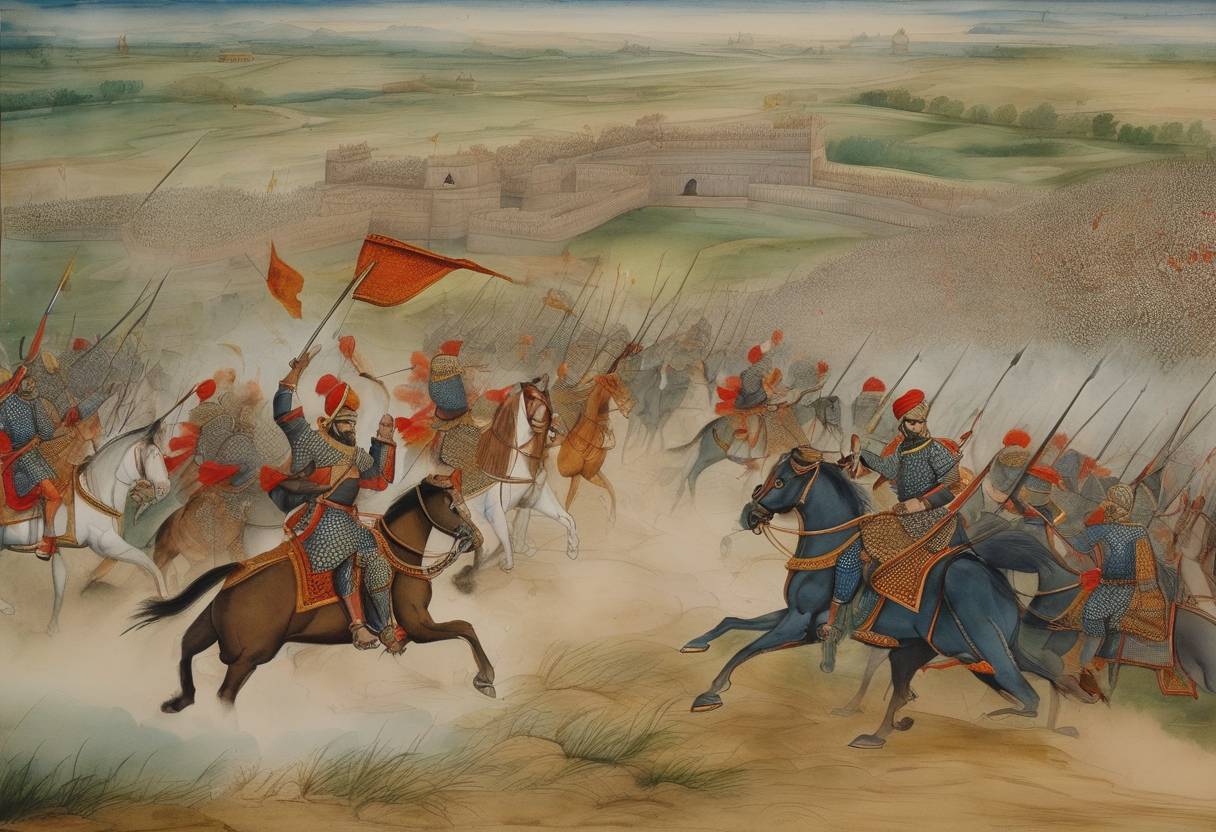
The Second Battle of Panipat, fought on November 5, 1556, was a decisive engagement between the forces of the Mughal Empire, led by the young emperor Akbar and his regent Bairam Khan, and the army of the Suri Empire, led by the Hindu king Hemu. This battle took place near the town of Panipat in present-day Haryana, India, and was crucial in reinstating Mughal control over northern India following the disruption caused by the Suri dynasty.
Following the death of the Mughal Emperor Humayun in January 1556, his son Akbar ascended to the throne at a tender age. However, the Mughal influence had waned significantly due to the previous reign of Sher Shah Suri, whose dynasty briefly wrested control of much of North India from the Mughals. After Sher Shah’s death, his successor Sultan Adil Shah Suri appointed Hemu as his chief minister. Hemu played a key role in reasserting the Suri dynasty’s power, capturing large territories, including Delhi and Agra.
The Second Battle of Panipat resulted in a decisive victory for the Mughal Empire. Hemu, captured after the collapse caused by his injury, was executed, marking a turning point that effectively ended the Suri dynasty’s bid for power. The success of the Mughals at Panipat reinforced Akbar’s rule and paved the way for the consolidation and expansion of the Mughal Empire in India.
In the years following the battle, Akbar, with the support of his regent Bairam Khan, implemented policies that helped stabilize and expand the empire. This victory laid the foundation for Akbar’s eventual reputation as one of the greatest rulers in Indian history, noted for his administrative reforms, cultural patronage, and efforts toward religious tolerance.
The Second Battle of Panipat thus stands as a key event that not only shaped the political landscape of 16th-century India but also set the stage for the Mughal Empire’s golden age under Akbar’s leadership.
Source: en.wikipedia.org