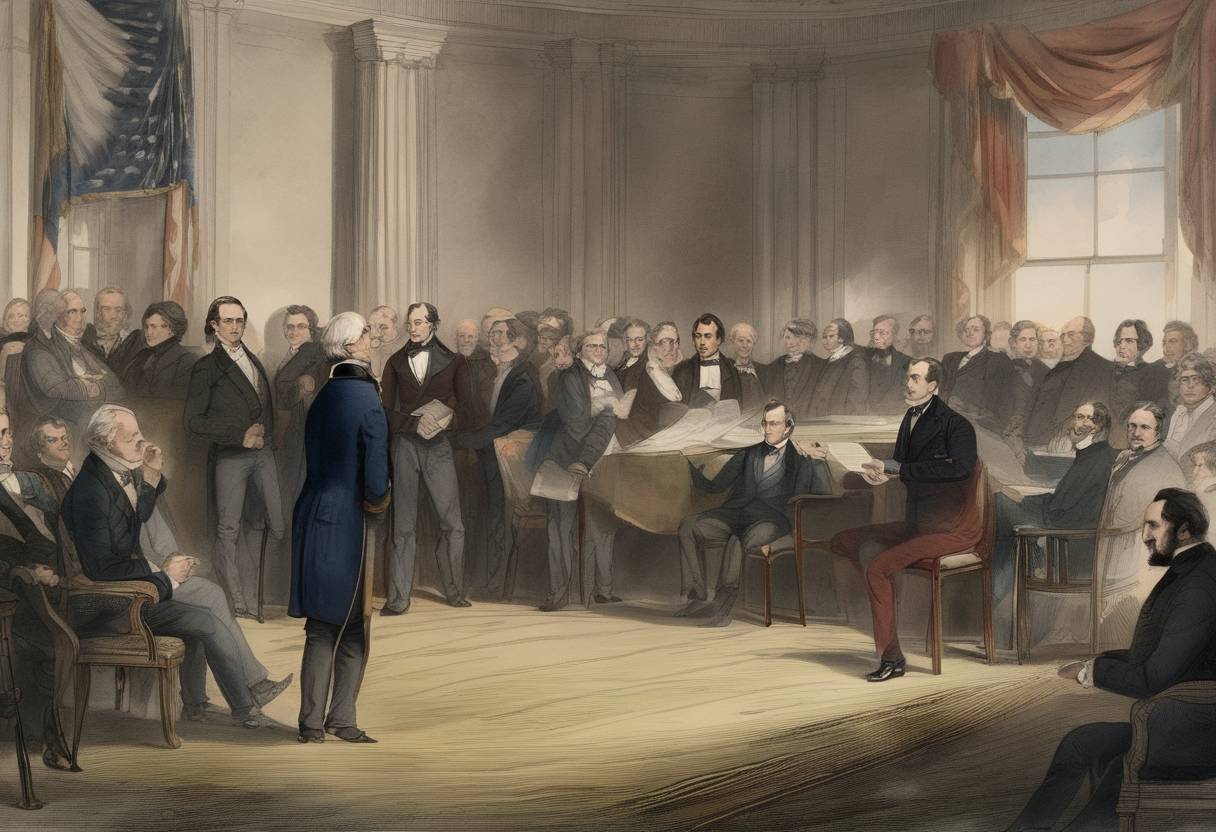
U.S. Presidential Election of 1844
On November 6, 1844, the United States held its presidential election, where James K. Polk, the Democratic candidate, defeated Henry Clay, the Whig candidate. This election was pivotal, focused primarily on the hotly debated topic of territorial expansion, most notably the annexation of Texas.
Candidates
James K. Polk: Representing the Democratic Party, Polk was a staunch advocate for the expansionist movement, often summarized by the phrase “Manifest Destiny.” He and his party supported the annexation of Texas and the acquisition of more territory, including present-day Oregon, California, and other regions to the west.
Henry Clay: Running for the Whig Party, Clay took a more cautious approach toward expansion. He was wary of annexing Texas as it could lead to war with Mexico and further inflame the sectional divide over slavery.
Key Issues
Manifest Destiny and Territorial Expansion: The belief that the U.S. was destined to expand across the North American continent was a driving force in the election. Polk’s platform embraced this ideology, advocating for the annexation of Texas, settling the Oregon boundary dispute with Great Britain, and expansion into California.
Annexation of Texas: Texas, having declared independence from Mexico in 1836, was a significant issue. The possibility of annexing the Republic of Texas raised concerns about war with Mexico and the balance of slave vs. free states in the Union.
Slavery: The expansion of U.S. territory raised significant concerns regarding the extension of slavery into new states and territories, intensifying the sectional conflict between Northern and Southern states.
Election Outcome
- James K. Polk won the electoral vote 170 to Henry Clay’s 105.
- The popular vote was closer, with Polk receiving 49.5% and Clay garnering 48.1%. The narrow margin underscored the contentious nature of the election and the issues at stake.
Consequences
Polk’s victory signaled a mandate for the expansionist agenda. Texas was admitted as a state on December 29, 1845, shortly after Polk took office. This set off a chain of events that led to the Mexican-American War from 1846 to 1848, following disputes over Texas’s southern border.
Historical Significance
The election of 1844 demonstrated the power of the Manifest Destiny doctrine and its impact on American politics. It also highlighted the emerging sectional tensions over slavery, which would continue to escalate in the following decades, eventually leading to the American Civil War. Polk’s presidency is often marked by significant territorial expansion, including the acquisition of the Oregon Territory and the lands ceded by Mexico after the war, reshaping the map of the United States.