The Siege of Jerusalem: October 2, 1187
1187 · Jerusalem, Kingdom of Jerusalem
The Siege of Jerusalem ended with the city being captured by Saladin, the Sultan of Egypt and Syria, marking a significant event in the Crusades.
June 7, 1099
The Siege of Jerusalem began during the First Crusade. Thousands of European knights and soldiers arrived outside the city, then controlled by the Fatimid Caliphate, marking the start of a pivotal and brutal siege that would culminate on July 15, 1099, with the capture of Jerusalem by the Crusaders.
Jerusalem, Fatimid Caliphate (modern-day Israel) | First Crusade
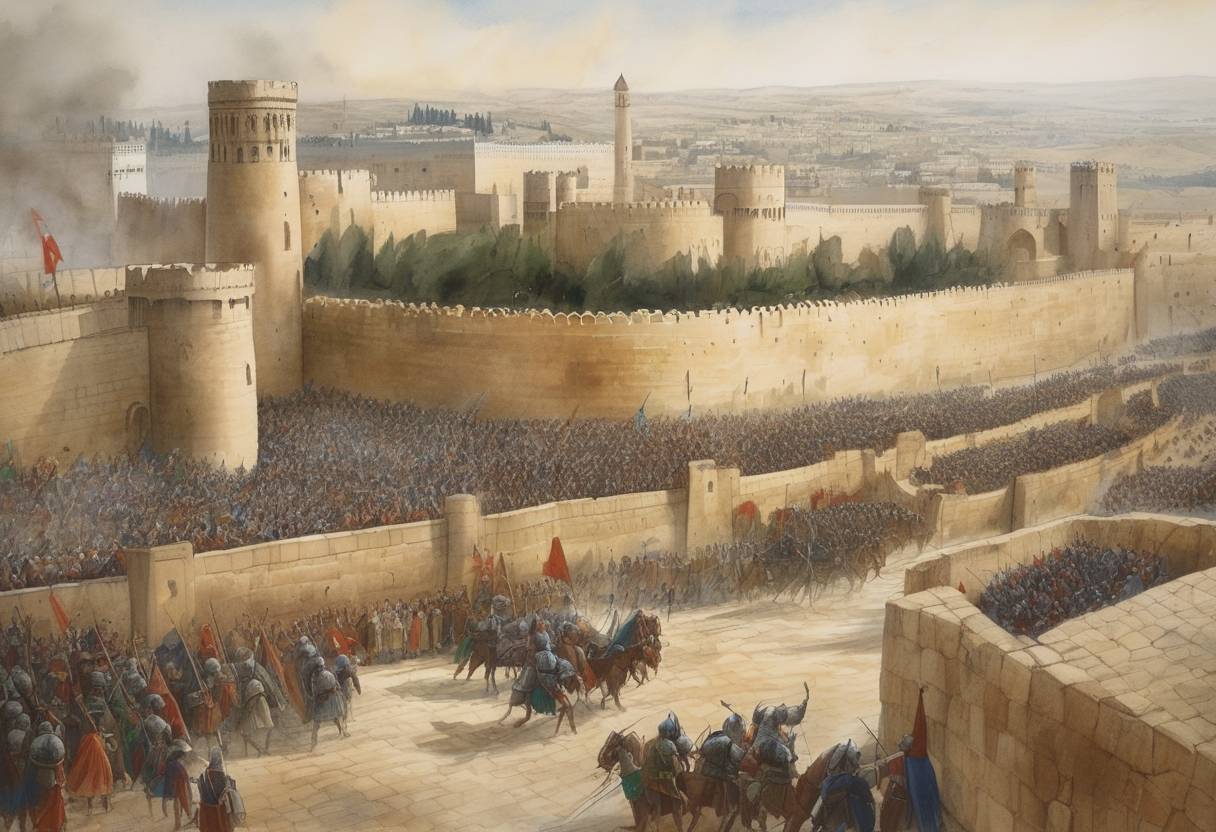
On June 7, 1099, the armies of the First Crusade arrived at the walls of Jerusalem, initiating one of the most pivotal sieges of medieval history. The city, under the control of the Fatimid Caliphate since 1098, became the focal point for the Crusaders led by several prominent knights and nobles, including Raymond IV of Toulouse, Godfrey of Bouillon, and Tancred of Hauteville. This marked the beginning of a concerted effort to capture one of the most significant religious and strategic locations of the time.
The First Crusade was launched in response to a call from Pope Urban II in 1095, urging Western European Christians to reclaim the Holy Land from Muslim control. This call followed several significant events, including the Battle of Manzikert in 1071, which drastically weakened the Byzantine Empire and led to appeals for military aid from the Eastern Orthodox Church.
As the Crusaders marched towards Jerusalem, they faced grueling conditions including a treacherous journey across Asia Minor, delayed sieges, and scarcity of resources. By the time they reached the Holy City, the once vast and diverse force had dwindled due to desertion, disease, and battles along the way.
Arriving outside Jerusalem, the Crusader forces encountered a well-fortified city defended by Fatimid forces. Despite their tired state, the Crusaders laid siege to Jerusalem, utilizing siege weapons and strategies learned during their campaign from Europe to the Levant. The Fatimids, aware of the approaching army, had already strengthened the city’s defenses and prepared for a prolonged conflict.
The besieging forces constructed siege towers and other military engines, preparing for what would become an intense and fierce battle to breach the city walls. Acutely aware of the strategic and religious importance of Jerusalem, the Crusaders were determined to succeed, despite their diminished resources and the tough defenses they faced.
The siege culminated on July 15, 1099, with the famous fall of Jerusalem to the Crusaders. This victory established several Crusader states in the region and laid the groundwork for the complex geopolitical tapestry of the medieval Levant. The taking of Jerusalem also had profound impacts on Christian-Muslim relations, with reverberations felt in subsequent crusades and throughout history.
The success of the siege demonstrated both the fervor and resilience of the Crusading forces, yet also marked a tragic event characterized by violence and the massacre of many of Jerusalem’s Muslim and Jewish inhabitants following the city’s capture.
The siege and its outcome became a lasting symbol of the intertwining of religious ambition and military strategy, setting a precedent for future conflicts over the Holy Land.
The Siege of Jerusalem in 1099 not only marked a turning point in the First Crusade but also represented a significant moment in the history of both Christianity and Islam. It illustrated the power of religious motivation in medieval warfare and set the stage for centuries of conflict, diplomacy, and cultural exchanges between the Christian West and the Muslim East.
Source: www.britannica.com