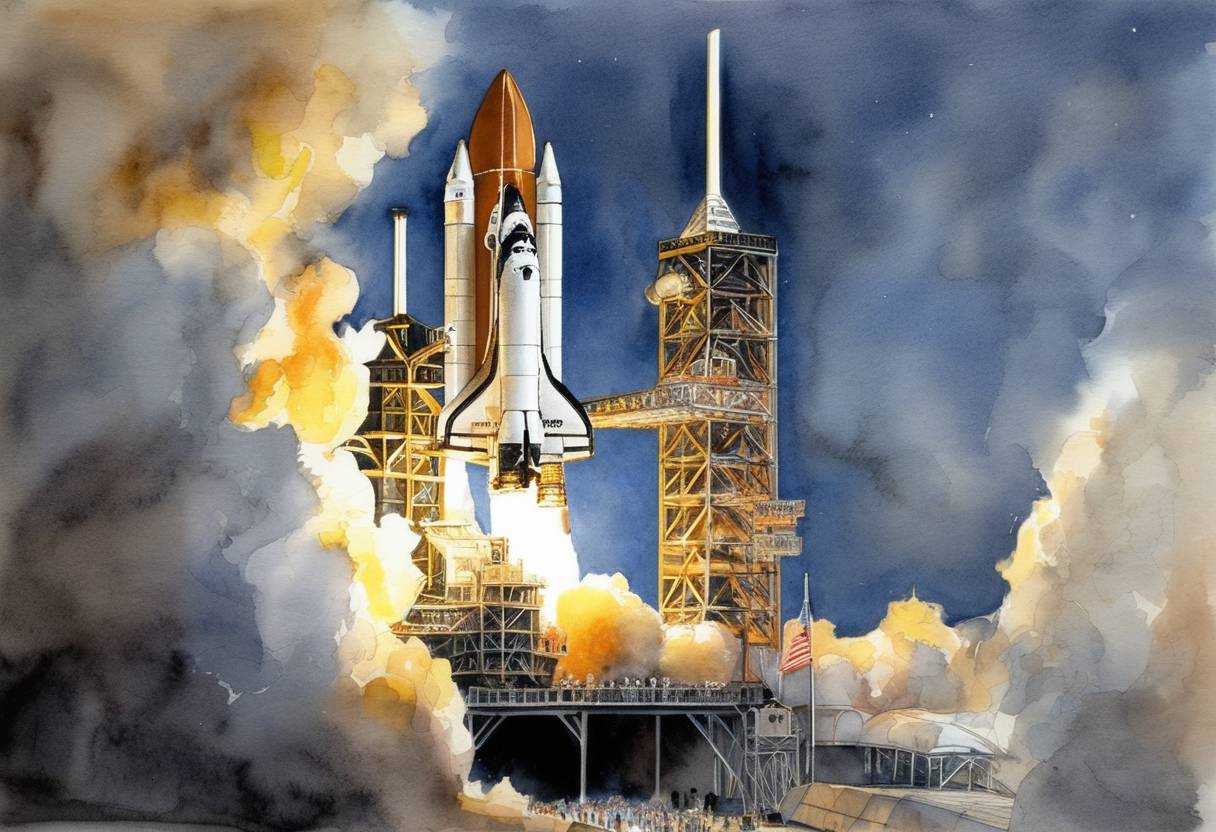
Space Shuttle Discovery STS-105 Mission
Date: August 10, 2001
Overview
On August 10, 2001, the Space Shuttle Discovery launched from Kennedy Space Center in Florida on mission STS-105. This was the 11th mission to the International Space Station (ISS) and the 29th flight of the Space Shuttle Discovery. The primary objectives included delivering supplies, equipment, and a new crew for Expedition 3 aboard the ISS, as well as returning the crew of Expedition 2 to Earth.
Mission Objectives
Crew Rotation:
- Expedition 3 Crew: Commander Frank Culbertson, Flight Engineer Vladimir Dezhurov, and Flight Engineer Mikhail Tyurin were delivered to the ISS.
- Returning Crew: The mission facilitated the return of Expedition 2 crew members, consisting of Commander Yury Usachov as well as Flight Engineers Susan Helms and James Voss.
Logistics and Supplies:
- The mission delivered the Italian-built Multi-Purpose Logistics Module (MPLM) named “Leonardo”. Leonardo carried supplies, scientific experiments, and equipment crucial for the ongoing operations of the ISS.
Maintenance and Upgrades:
- The mission included equipment installation and maintenance activities necessary to support the ISS’s increasing operational capacity and readiness.
Spacewalks
As part of the mission’s objectives, two spacewalks were conducted:
First Spacewalk: Conducted by crew members Dan Barry and Pat Forrester, focused on installing equipment and performing checks on the ISS exterior.
Second Spacewalk: Further equipment installations and preparations for future Space Shuttle missions were completed during this EVA.
Scientific Contributions
During the mission, various scientific experiments and technical demonstrations were transported to the ISS, enhancing the research capabilities of the station and contributing to a wide range of fields such as biology, physics, and materials science.
Historical Context
Launching in a pre-9⁄11 context, STS-105 was part of a series of regular missions aimed at building, equipping, and maintaining the ISS, which had entered its assembly phase just a few years prior in 1998. The success of these missions established a continuous human presence in space and facilitated international collaboration.
Conclusion
STS-105 successfully completed its mission objectives, continuing the legacy of cooperation and scientific advancement symbolized by the International Space Station. This mission reinforced logistical support for the station while completing a routine yet crucial exchange of crew members, underscoring the Shuttle program’s role in developing and maintaining a human outpost in low Earth orbit.