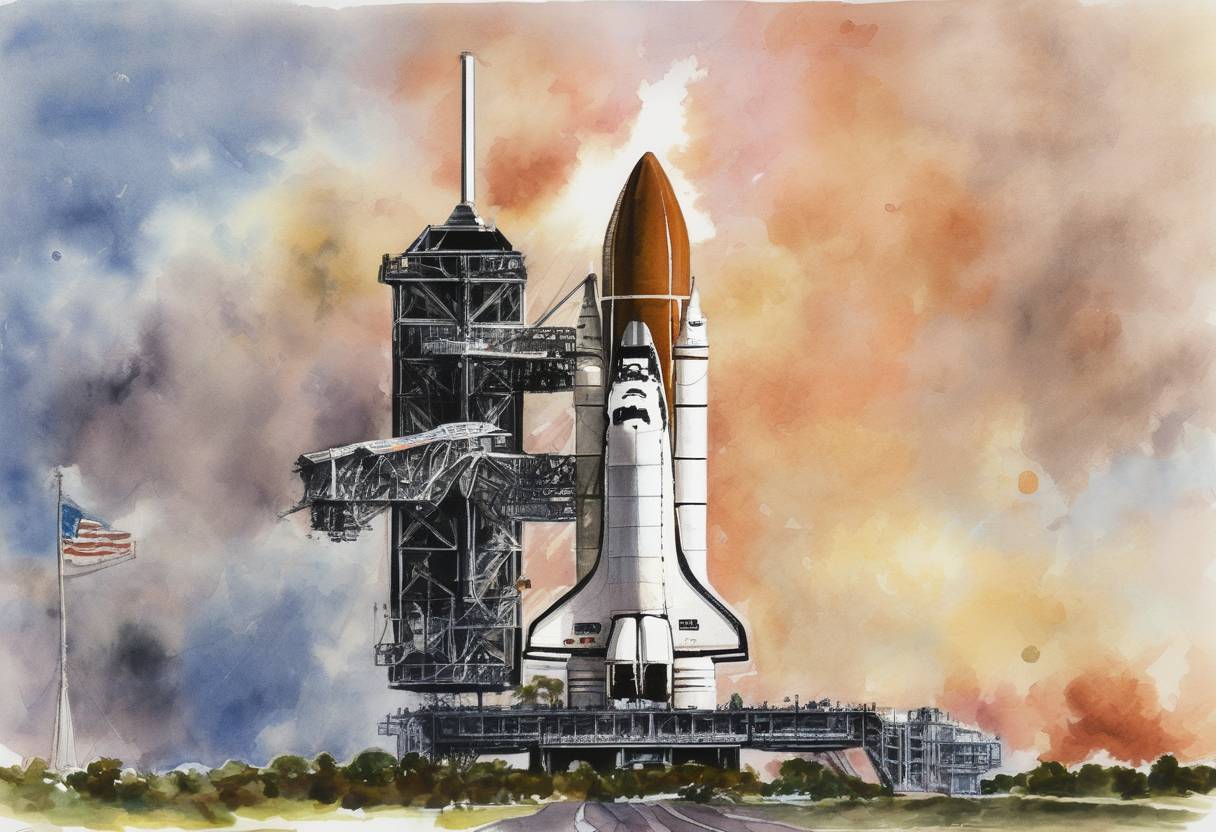
Space Shuttle Columbia: STS-4 Mission
Overview
The Space Shuttle Columbia launched on its final test flight mission, STS-4, on June 27, 1982. This mission marked a significant milestone in NASA’s Space Shuttle program, as it was the last of the four test flights intended to validate the shuttle’s design and performance before it was declared operational.
Key Details
- Launch Date: June 27, 1982
- Launch Site: Kennedy Space Center, Florida, Launch Complex 39A
- Mission Duration: 7 days, 1 hour, 9 minutes, and 31 seconds
- Landing Date: July 4, 1982
- Landing Site: Edwards Air Force Base, California
Crew
- Commander: Thomas K. Mattingly
- Pilot: Henry W. Hartsfield Jr.
Both astronauts were experienced pilots, with Mattingly having previously flown on the Apollo 16 mission to the Moon.
Mission Objectives
The primary objectives of STS-4 were to further test the shuttle’s systems and capabilities, including:
- Thermal Protection System: Evaluating the heat shield’s performance during re-entry.
- Orbital Maneuvering System: Testing the shuttle’s ability to change orbits and perform other maneuvers.
- Payload Operations: Carrying and deploying scientific instruments and experiments, including the Induced Environment Contamination Monitor (IECM) and the Continuous Flow Electrophoresis System (CFES).
Notable Achievements
- First Operational Payload: Although still a test flight, STS-4 carried the first operational payload for the Department of Defense, marking the beginning of the shuttle’s role in national security missions.
- Independence Day Landing: The mission concluded with a landing on July 4, 1982, symbolically celebrating American independence and technological achievement. President Ronald Reagan and First Lady Nancy Reagan attended the landing, underscoring the mission’s significance.
Historical Significance
The successful completion of STS-4 marked the end of the Space Shuttle’s test phase, allowing NASA to declare the shuttle operational. This transition paved the way for a new era of reusable spacecraft, enabling more frequent and diverse missions, including satellite deployments, scientific research, and construction of the International Space Station.
The STS-4 mission demonstrated the shuttle’s versatility and reliability, reinforcing its role as a cornerstone of American space exploration efforts throughout the 1980s and beyond.