The November Constitution and the Second Schleswig War
1863 · Copenhagen, Denmark
King Christian IX of Denmark signed the November Constitution, which declared Schleswig a part of Denmark, leading to the Second Schleswig War.
June 10, 1523
Copenhagen is taken by 3,000 Danish and Hanseatic soldiers led by Søren Norby, marking a critical moment in the Count's Feud.
Copenhagen, Denmark | Hanseatic League
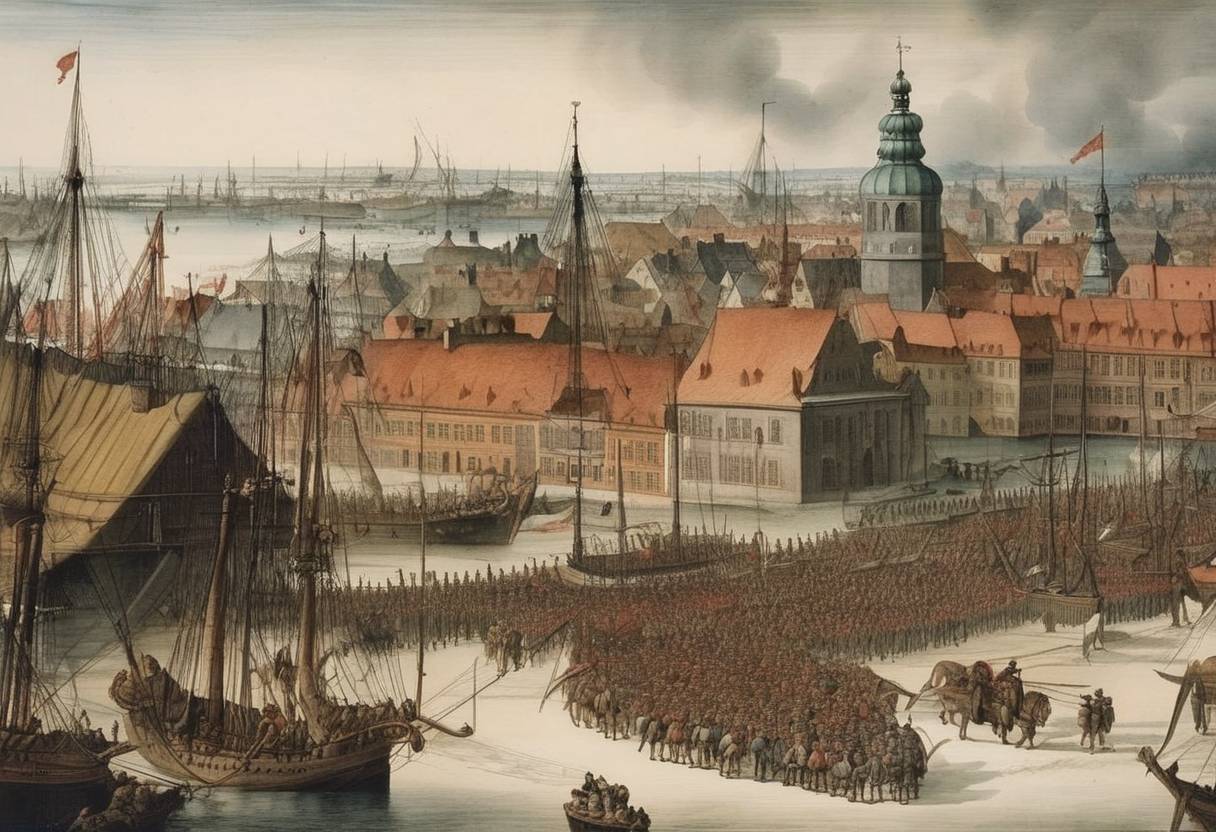
On June 10, 1523, the city of Copenhagen fell to a combined force of Danish and Hanseatic soldiers led by Søren Norby, a significant event during the Count’s Feud, a civil conflict in Denmark.
The Count’s Feud (Grevens Fejde) was a civil war in Denmark (1534-1536) partly sparked by disputes over royal succession, religious tensions following the Reformation, and economic interests of the Hanseatic League. However, the conflict described on this date likely relates to the earlier political maneuverings leading up to Christian II’s deposition in 1523. Christian II, King of Denmark and Norway, was a controversial ruler with ambitious reform plans that alienated the nobility and clergy. His autocratic style and the repercussions from the Stockholm Bloodbath in 1520 led to widespread dissatisfaction, culminated in his deposition.
By June 1523, Christian II had been deposed in favor of his uncle, Frederick I. As part of the ongoing conflict between supporters of the deposed Christian II and the new King Frederick I, Søren Norby, a staunch ally of Christian II and a naval commander renowned for his loyalty and military prowess, led a force of approximately 3,000 soldiers. This contingent comprised both Danish loyalists and mercenaries from the Hanseatic League, a powerful commercial and defensive confederation of merchant guilds and market towns in Northwestern and Central Europe.
The capture of Copenhagen was a strategic victory for Norby and the remnants of Christian II’s supporters. It exemplified the tensions between different factions within the Danish kingdom and highlighted the intertwined interests of foreign powers in the region’s internal affairs.
Very shortly after the events of June 10, the political landscape further shifted. Frederick I continued to solidify his hold over Denmark, and Norby’s temporary successes would ultimately be undone as the larger conflicts evolved into what is known historically as the Count’s Feud in the following decade.
The Count’s Feud eventually resulted in significant political and religious changes in Scandinavia. It laid the groundwork for the Lutheran Reformation in Denmark, leading to the establishment of the Lutheran Church as the state church under Frederick I’s successor, Christian III. This period of Danish history marks an essential step toward modern state formation and the current religious landscape in the Nordic countries.
The capture of Copenhagen in 1523 under Søren Norby’s command thus stands as a pivotal event that reflected the deep-seated socio-political tensions of the time and became a precursor to larger continental shifts during the Reformation.