Albert Einstein Publishes Special Theory of Relativity
1905 · Bern, Switzerland
Albert Einstein publishes his paper on the special theory of relativity in the journal Annalen der Physik.
April 11, 1905
Albert Einstein completes his dissertation, 'A New Determination of Molecular Dimensions,' which he submits to the University of Zurich.
Zurich, Switzerland | University of Zurich
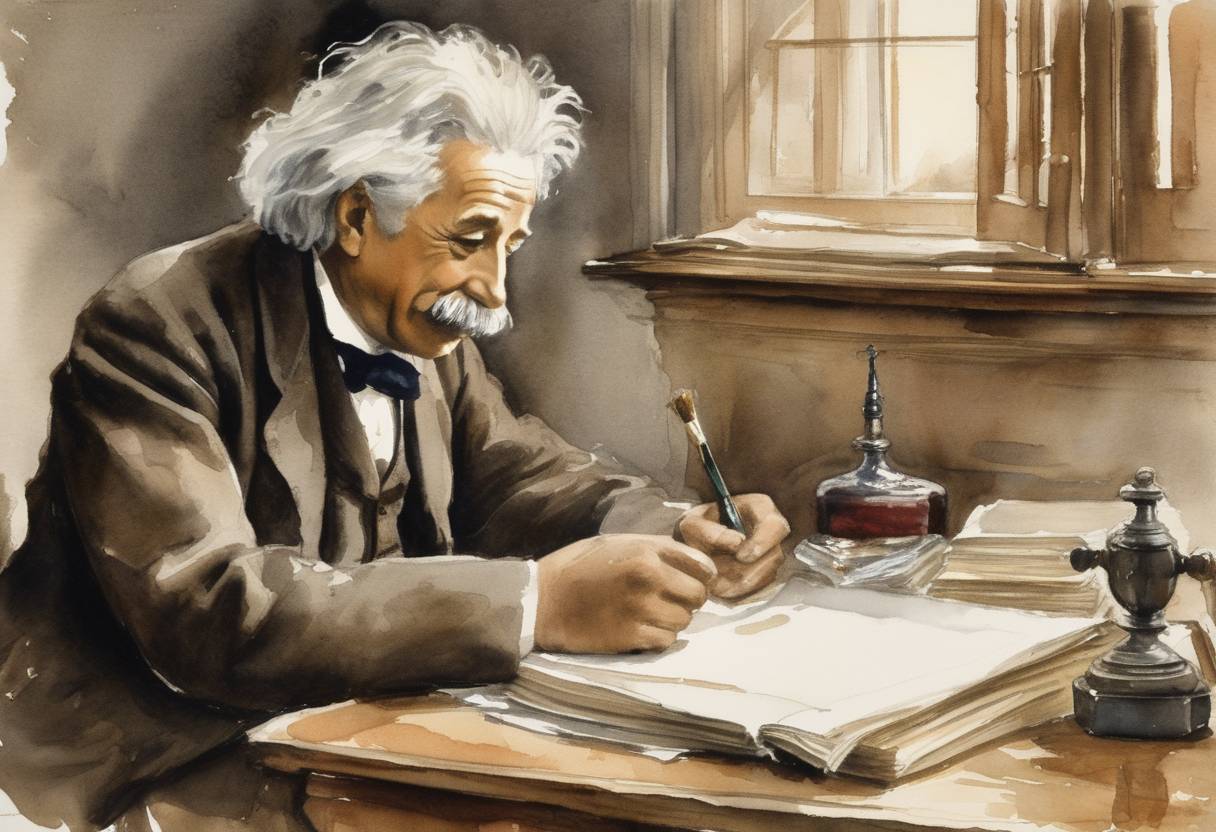
On April 11, 1905, Albert Einstein completed his doctoral dissertation entitled “Eine neue Bestimmung der Moleküldimensionen” (“A New Determination of Molecular Dimensions”) and submitted it to the University of Zurich. This thesis was a critical component of his foundational work in statistical physics and played a significant role in the broader scope of his scientific achievements during what would later be called his “Miracle Year” or “Annus Mirabilis.”
At the time of submission, Einstein was working as a patent examiner at the Swiss Patent Office in Bern. Despite his non-academic position, Einstein dedicated considerable time to theoretical physics, producing several groundbreaking papers in 1905. His dissertation focused on the calculation of Avogadro’s number and the size of molecules, using statistical mechanics and the kinetic theory of gases.
Molecular Dimensions: Einstein’s dissertation presented a new calculation for the size of molecules, particularly sugar molecules in solution, which was a crucial advancement for the field of physical chemistry. By applying theoretical models to experimental data, he was able to estimate molecular radii with remarkable accuracy for the time.
Applied Statistical Mechanics: The work underscored the power of statistical mechanics in deriving macroscopic properties from microscopic theory. Einstein’s methods helped solidify the statistical approach to physics, providing a rigorous framework for understanding the behavior of particles.
Following rigorous review, Einstein was awarded his doctorate on January 15, 1906, and his dissertation was published later that year in the journal “Annalen der Physik.” This achievement was part of a broader set of contributions during 1905, which included seminal papers on the photoelectric effect, Brownian motion, and special relativity. Each of these works significantly shifted scientific perspectives and cemented Einstein’s reputation as a pioneering physicist.
Einstein’s work on molecular dimensions helped bridge the gap between physics and chemistry, influencing both theoretical developments and experimental techniques in the years to follow. It exemplified his ability to solve practical problems with profound theoretical insights, paving the way for future advancements in atomic theory and quantum mechanics.
Source: www.einstein-website.de