The Duel Between Alexander Hamilton and Aaron Burr
1804 · Weehawken, United States
Alexander Hamilton was mortally wounded in a duel with Aaron Burr, the sitting Vice President of the United States, in Weehawken, New Jersey.
July 12, 1804
Former U.S. Secretary of the Treasury Alexander Hamilton died after being shot in a duel with Vice President Aaron Burr the previous day. This event marked the end of Hamilton's influential political career and had significant repercussions in American politics.
Weehawken, United States | Federalist Party
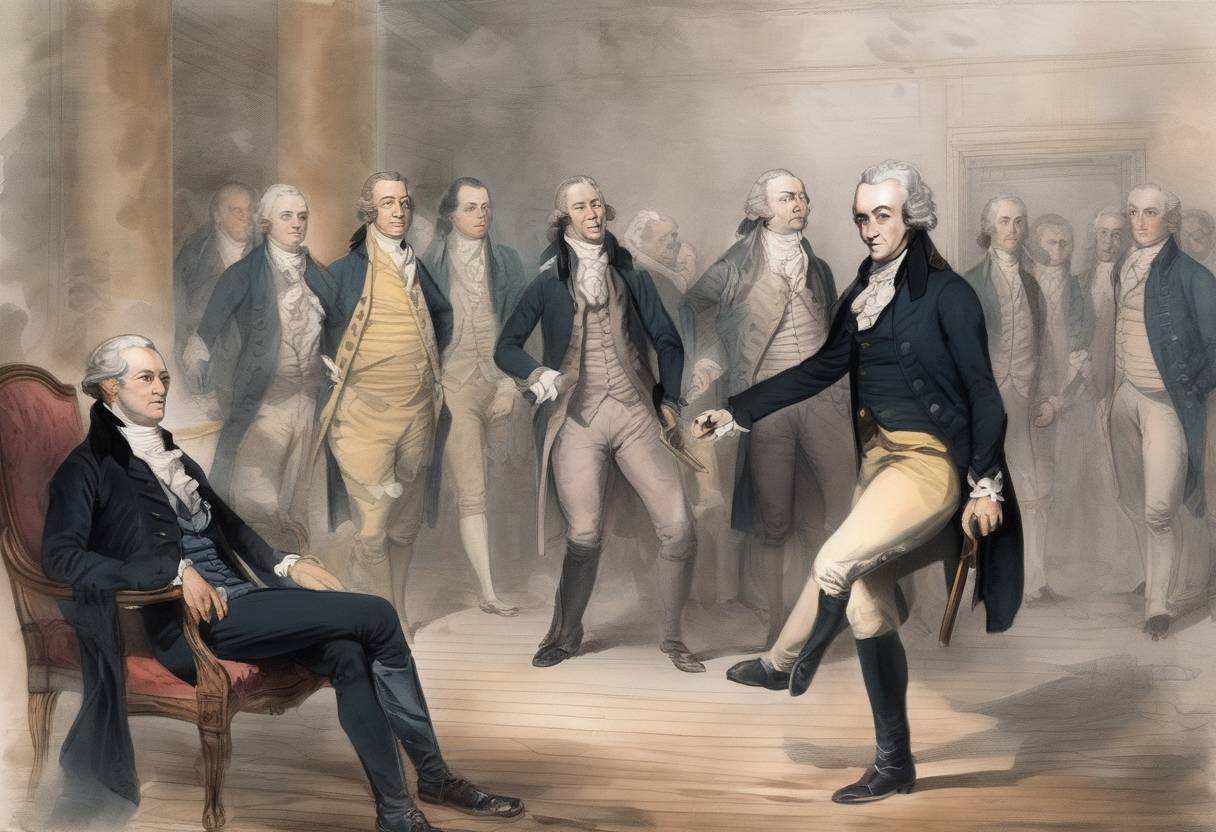
On July 12, 1804, Alexander Hamilton, the former U.S. Secretary of the Treasury, succumbed to injuries sustained in a duel with Vice President Aaron Burr. This event not only marked the tragic end of Hamilton’s influential political career but also had lasting repercussions in American politics.
The duel between Hamilton and Burr was the culmination of a long-standing personal and political rivalry. Hamilton, a leading Federalist and one of the Founding Fathers of the United States, had been a vocal critic of Burr, who was a prominent Democratic-Republican. Their animosity intensified during the 1800 presidential election, where Hamilton’s influence helped Thomas Jefferson win the presidency over Burr, who became vice president.
In 1804, Burr ran for governor of New York, and Hamilton’s continued opposition played a role in Burr’s defeat. A series of disparaging remarks attributed to Hamilton further inflamed tensions, leading Burr to challenge Hamilton to a duel.
The duel took place on July 11, 1804, in Weehawken, New Jersey, a common dueling ground at the time due to its relative seclusion and the fact that dueling was illegal in New York. The exact details of the duel remain somewhat ambiguous, but it is generally believed that Hamilton fired his shot into the air, a practice known as a “delop,” intended to avoid hitting Burr. Burr, however, shot Hamilton in the abdomen, causing severe injuries.
Hamilton was transported back to New York City, where he died the following day, on July 12, 1804, at the age of 47. His death was widely mourned, and he was buried in the Trinity Churchyard Cemetery in Manhattan.
The duel had significant repercussions:
Burr’s Political Downfall: Although Burr was never tried for murder, the duel effectively ended his political career. He completed his term as vice president but was politically ostracized and faced charges of treason in a separate incident in 1807, though he was acquitted.
Impact on Dueling: The duel highlighted the deadly consequences of the practice, contributing to its decline in popularity in the United States. Public sentiment increasingly turned against dueling as a means of resolving disputes.
Hamilton’s Legacy: Hamilton’s contributions to the founding of the United States, particularly his role in establishing the nation’s financial system, were celebrated and remembered. His death underscored the volatile nature of early American politics and the personal rivalries that often influenced public affairs.
In summary, the death of Alexander Hamilton on July 12, 1804, was a pivotal moment in American history, reflecting the intense political rivalries of the era and marking the end of a significant chapter in the nation’s early development.
Source: en.wikipedia.org