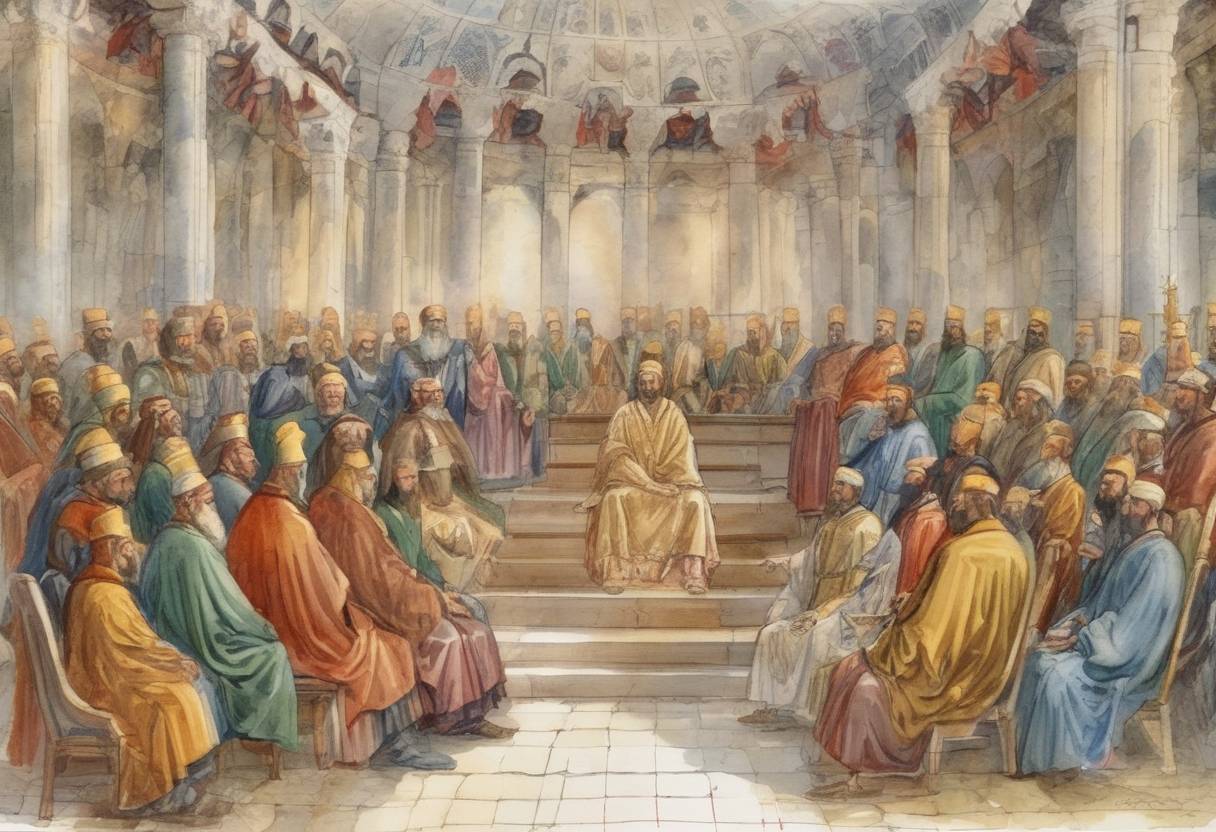
The Sixth Ecumenical Council: The Third Council of Constantinople
The Sixth Ecumenical Council, also known as the Third Council of Constantinople, concluded on September 16, 681. This council was a pivotal moment in the history of the Christian Church, primarily addressing the theological controversy of Monothelitism.
Background
Monothelitism was a doctrine that emerged in the 7th century, proposing that Jesus Christ had two natures (divine and human) but only one will (the divine). This doctrine was seen as a compromise to reconcile the Chalcedonian Christians, who believed in the dual nature of Christ, with the Monophysites, who emphasized a single, unified nature. However, Monothelitism was controversial as it appeared to undermine the full humanity of Christ by denying the existence of a human will.
Key Events Leading to the Council
- Early Controversies: The roots of the controversy lay in earlier Christological debates, particularly those addressed by the Council of Chalcedon in 451, which affirmed the doctrine of two natures in Christ.
- Political and Religious Tensions: The Byzantine Empire, under Emperor Heraclius, sought religious unity to strengthen the empire against external threats, particularly from the expanding Islamic Caliphate. Monothelitism was initially supported as a unifying doctrine.
- Papal Opposition: Pope Martin I and theologians like Maximus the Confessor strongly opposed Monothelitism, arguing for the necessity of acknowledging both a human and divine will in Christ to preserve orthodox Christology.
The Council’s Proceedings
The Third Council of Constantinople was convened by Emperor Constantine IV and took place from 680 to 681. It was attended by representatives from both the Eastern and Western Churches, including papal legates.
- Debates and Discussions: The council engaged in extensive theological debates, examining the writings and teachings of earlier Church Fathers and theologians.
- Condemnation of Monothelitism: The council ultimately condemned Monothelitism as heretical. It affirmed the doctrine of Dyothelitism, which professes that Christ possesses two wills, divine and human, in harmony but distinct.
Aftermath and Significance
- Doctrinal Clarity: The council’s decisions provided clarity and unity on the nature of Christ, reinforcing the Chalcedonian definition and ensuring the doctrine of two wills became a cornerstone of orthodox Christian theology.
- Impact on Church Unity: While the council’s decisions were accepted by the majority of the Christian world, some regions, particularly those with strong Monophysite traditions, remained resistant, contributing to ongoing theological and ecclesiastical divisions.
- Legacy: The Third Council of Constantinople is considered a significant milestone in the development of Christological doctrine, influencing subsequent theological discourse and ecumenical relations.
The Sixth Ecumenical Council’s resolution of the Monothelitism controversy underscored the importance of maintaining doctrinal integrity while navigating the complex interplay of theology and politics in the early medieval period.