Juan Carlos I Becomes King of Spain: November 22, 1975
1975 · Madrid, Spain
Juan Carlos I was declared King of Spain following the death of dictator Francisco Franco, marking the beginning of Spain's transition to democracy.
March 28, 1939
Spanish Civil War: Generalissimo Francisco Franco captured Madrid, effectively ending the Spanish Civil War with a Nationalist victory.
Madrid, Spain | Nationalist forces
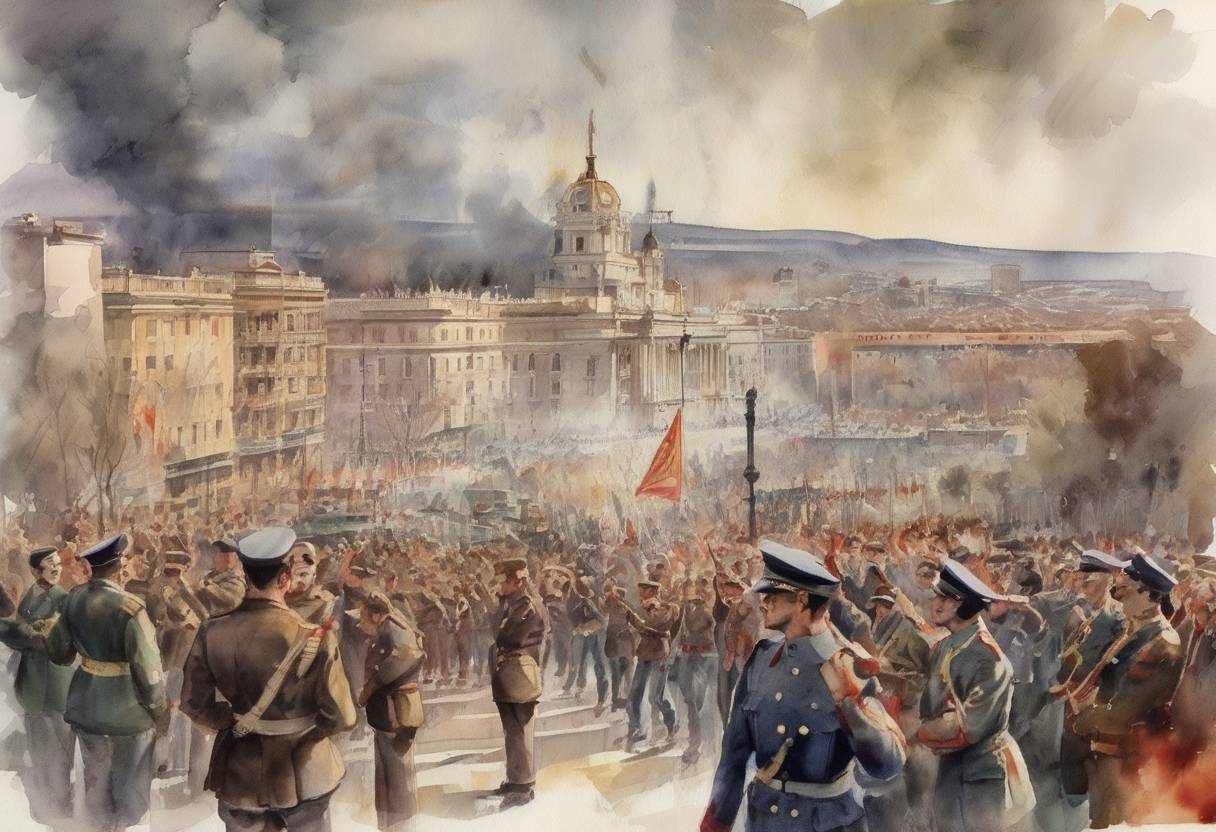
On March 28, 1939, Generalissimo Francisco Franco’s Nationalist forces captured Madrid, marking a decisive moment in the Spanish Civil War and effectively bringing the conflict to an end with a Nationalist victory. This event was the culmination of nearly three years of brutal civil war that had ravaged Spain, pitting the Nationalists against the Republicans.
The Spanish Civil War began in July 1936, following a military coup against the democratically elected Republican government. The coup was led by a group of conservative generals, including Francisco Franco, who sought to overthrow the leftist government. The conflict quickly escalated into a full-scale war, drawing in international involvement, with Nazi Germany and Fascist Italy supporting the Nationalists, while the Soviet Union and international brigades backed the Republicans.
Madrid, the capital of Spain, became a focal point of the war early on. The city was under siege by Nationalist forces from November 1936, enduring intense bombardment and suffering severe shortages of food and supplies. Despite these hardships, the Republican defenders managed to hold the city for nearly three years, becoming a symbol of Republican resistance.
By early 1939, the Nationalists had gained significant ground, capturing key Republican strongholds and cutting off Madrid from potential reinforcements. The Republican forces were weakened by internal divisions and dwindling resources. On March 26, 1939, Franco launched a final offensive against Madrid. The city’s defenders, demoralized and outnumbered, were unable to mount an effective resistance.
On March 28, 1939, Nationalist troops entered Madrid with little opposition. The capture of the city signaled the collapse of Republican resistance across Spain. Within days, the remaining Republican forces surrendered, and Franco declared victory on April 1, 1939.
The fall of Madrid and the end of the Spanish Civil War had profound consequences for Spain and the world:
Franco’s Dictatorship: Francisco Franco established a military dictatorship that lasted until his death in 1975. His regime was characterized by repression, censorship, and the persecution of political opponents.
Human Cost: The war resulted in the deaths of an estimated 500,000 people, with many more suffering from the war’s devastation and the subsequent repression.
International Impact: The Spanish Civil War was a precursor to World War II, highlighting the ideological conflicts between fascism, communism, and democracy. It also served as a testing ground for military tactics and technologies that would be used in the global conflict.
Cultural Legacy: The war inspired numerous works of literature, art, and film, capturing the attention of the international community and leaving a lasting impact on cultural memory.
The capture of Madrid and the end of the Spanish Civil War marked a significant turning point in Spanish history, shaping the nation’s political landscape for decades to come.
Source: en.wikipedia.org