The Duel Between Alexander Hamilton and Aaron Burr
1804 · Weehawken, United States
Alexander Hamilton was mortally wounded in a duel with Aaron Burr, the sitting Vice President of the United States, in Weehawken, New Jersey.
May 30, 1806
Future U.S. President Andrew Jackson killed Charles Dickinson in a duel after a long-standing dispute. The duel took place in Logan County, Kentucky, and was one of many duels Jackson participated in during his lifetime.
Logan County, United States | none
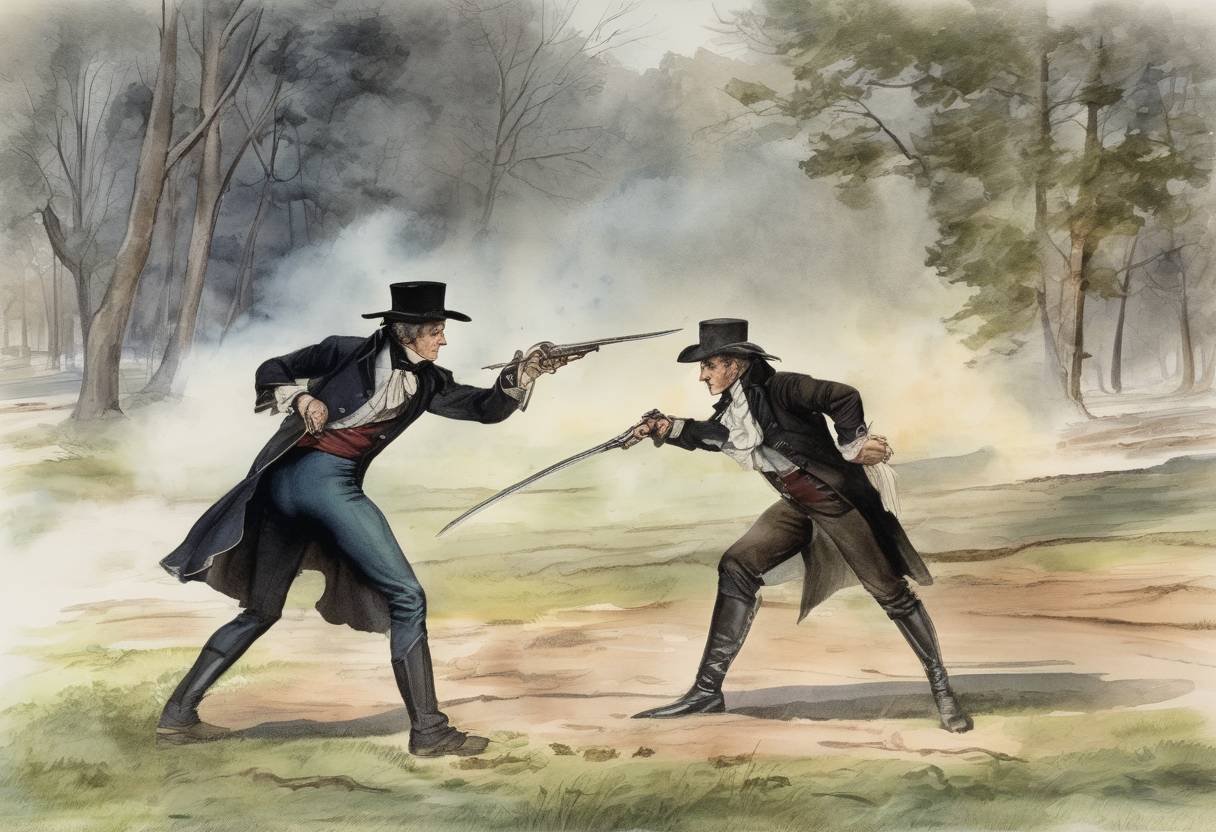
On May 30, 1806, a significant and violent episode unfolded in Logan County, Kentucky, when future U.S. President Andrew Jackson engaged in a duel with Charles Dickinson. This event was one of the many duels that Jackson participated in throughout his life, reflecting the volatile nature of personal honor and conflict resolution in early 19th-century America.
The duel between Jackson and Dickinson was the culmination of a long-standing dispute that involved both personal and professional grievances. The conflict began over a horse racing bet and escalated due to insults exchanged between the two men. Dickinson, known for his skill as a marksman and his fiery temper, had publicly insulted Jackson, calling him a “worthless scoundrel” and questioning the legitimacy of his marriage to Rachel Donelson Robards.
In the early 1800s, dueling was a common practice among gentlemen to defend one’s honor, despite its legal prohibition in many states. Jackson, a man of intense pride and quick to defend his reputation, felt compelled to respond to Dickinson’s provocations.
The duel took place at Harrison’s Mills on Red River in Logan County, Kentucky. The rules of the duel were typical for the time: the two men stood a set distance apart, and upon a signal, they would fire at each other.
Jackson, aware of Dickinson’s reputation as an expert shot, adopted a risky strategy. He allowed Dickinson to fire first, hoping to withstand the shot and take careful aim afterward. Dickinson’s bullet struck Jackson in the chest, dangerously close to his heart. Despite the severe wound, Jackson remained standing and took deliberate aim, firing a shot that fatally wounded Dickinson.
Jackson’s survival and victory in the duel bolstered his reputation as a fearless and resilient individual. However, the incident also contributed to his controversial image, as dueling was increasingly viewed as a barbaric practice. The bullet from Dickinson remained lodged in Jackson’s body for the rest of his life, a constant reminder of the duel.
This event is emblematic of Jackson’s complex character—his fierce defense of personal honor and his willingness to resort to violence. It foreshadowed the tenacity and determination that would later define his military and political career, ultimately leading to his presidency in 1829.
The duel with Dickinson is a reflection of the broader cultural and social norms of the time, illustrating the lengths to which individuals would go to protect their honor and reputation. It also highlights the turbulent and often violent nature of early American political and social life.
Source: en.wikipedia.org