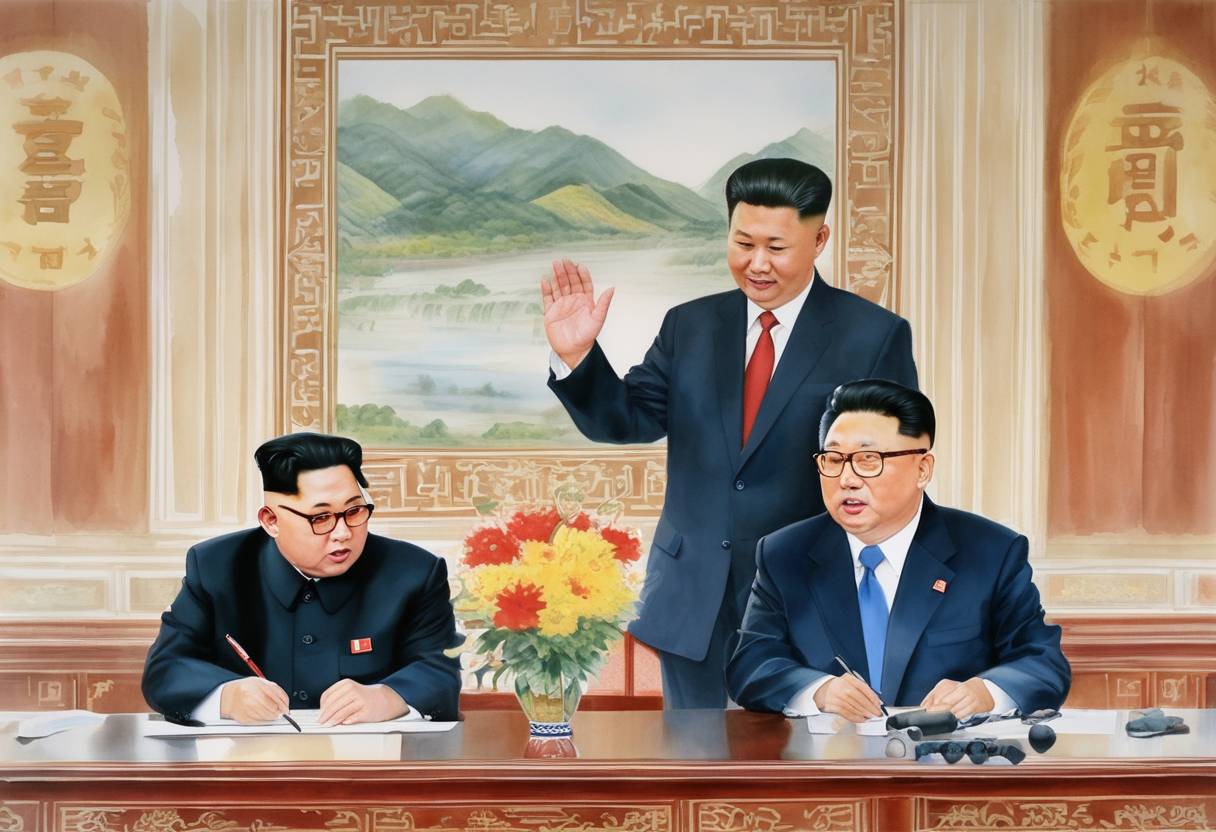
June 15th North-South Joint Declaration
On June 15, 2000, a landmark moment in inter-Korean relations occurred when South Korean President Kim Dae-jung and North Korean leader Kim Jong-il signed the June 15th North-South Joint Declaration. This event marked the first inter-Korean summit since the Korean War armistice in 1953, signaling a significant warming of relations between the two halves of the Korean Peninsula.
Context
- Background: The Korean Peninsula was divided following World War II, leading to the Korean War (1950-1953). The armistice agreement ended active hostilities but did not establish a peace treaty, leaving North and South Korea in a technically perpetual state of war.
- South Korean Policy: President Kim Dae-jung, elected in 1997, pursued a “Sunshine Policy” aimed at engaging North Korea through diplomacy and reconciliation, contrasting with previous hardline stances.
- North Korean Economic Difficulties: In the 1990s, North Korea faced severe economic hardships and famines, motivating it to seek improved relations with its southern neighbor.
The Summit
The summit took place in Pyongyang, North Korea’s capital. The meeting lasted from June 13 to June 15, 2000, culminating in the signing of the Joint Declaration on June 15.
Key Provisions of the Declaration
- Pursuit of Reunification: The declaration committed both Koreas to work towards peaceful reunification, acknowledging common elements in proposals from both sides.
- Political and Economic Cooperation: It emphasized increased economic cooperation and exchanges, including family reunifications and cultural contacts.
- Resolution of Humanitarian Issues: The agreement facilitated family reunions for those separated by the Korean War, addressing a deeply emotional issue on both sides.
- Cooperation in Various Fields: The declaration aimed to promote cooperation in social, cultural, and other areas to foster mutual understanding and trust.
Aftermath and Significance
- International Reception: The summit and the declaration were widely hailed as a triumph of diplomacy, earning President Kim Dae-jung the Nobel Peace Prize later that year.
- Subsequent Developments: While the declaration set a precedent for future inter-Korean dialogues, subsequent tensions and geopolitical shifts, including North Korea’s nuclear ambitions, often strained relations between the two countries.
- Sunshine Policy: The Sunshine Policy remained a key framework for South Korean engagement with the North, although it faced criticism and adjustments due to varying political climates and changing leadership.
This groundbreaking summit and the resulting declaration laid the groundwork for subsequent dialogues and attempts to ease the military and political tensions on the Korean Peninsula. The event remains a pivotal moment in the complex and evolving dynamics of inter-Korean relations.