Battle of Jonesborough: August 31, 1864
1864 · Jonesborough, United States
During the American Civil War, the Battle of Jonesborough began, leading to a significant Union victory that resulted in the fall of Atlanta.
November 25, 1863
The Battle of Missionary Ridge took place as part of the Chattanooga Campaign during the American Civil War, where Union forces led by General Ulysses S. Grant defeated Confederate troops under General Braxton Bragg.
Chattanooga, United States | Union Army
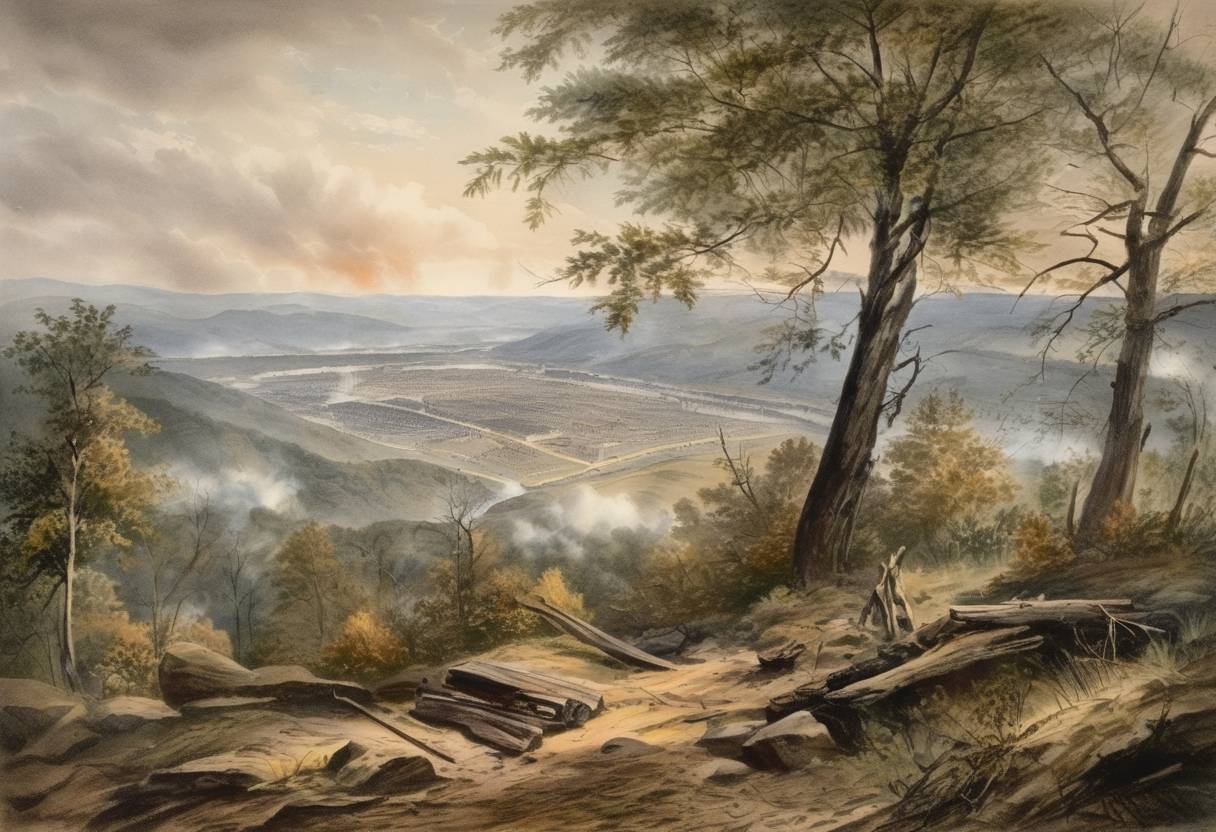
The Battle of Missionary Ridge occurred on November 25, 1863, as a critical engagement in the American Civil War, forming part of the Chattanooga Campaign. This battle was pivotal in securing a strategic victory for the Union forces, effectively ending the Confederate siege of Chattanooga, Tennessee.
In the months leading up to the battle, the Union army aimed to break the Confederate hold on Chattanooga, a vital rail hub known as the “Gateway to the Deep South.” After the Confederate victory at the Battle of Chickamauga, Confederate General Braxton Bragg’s forces had besieged Chattanooga, surrounding Union troops led by Major General William Rosecrans.
Subsequently, Union leadership underwent significant changes. President Abraham Lincoln appointed General Ulysses S. Grant to lead the military operations in the region. Grant quickly reorganized the Union forces, bringing in reinforcements and revitalizing the troops’ morale. With the arrival of additional Union soldiers under Generals Joseph Hooker and William Tecumseh Sherman, Grant prepared a strategic assault to break the siege.
The Union’s coordinated attack on Missionary Ridge involved three major components:
Sherman’s Attack on the North: General William T. Sherman led one contingent attacking from the north, aiming to roll down the Confederate lines from their left flank.
Hooker’s Attack from Lookout Mountain: General Joseph Hooker advanced from Lookout Mountain, a position the Union had captured a day earlier in the “Battle Above the Clouds,” intending to strike the Confederate right.
Thomas’s Assault on the Center: The pivotal moment came when Thomas ordered a frontal assault on the center of the Confederate line on Missionary Ridge. Initially tasked with capturing the rifle pits at the base of the ridge, Union troops, driven by momentum and confusion, surged up the steep ridge without orders. The unexpected advance overwhelmed the Confederate defenses.
The capture of Missionary Ridge resulted in a decisive Union victory. The Confederates were forced to retreat into Georgia, abandoning Chattanooga, and losing control of Tennessee. Approximately 6,000 Confederate troops were captured, and numerous artillery pieces were seized, significantly weakening Bragg’s army.
The outcome at Missionary Ridge had several key implications:
Strategic Control: The victory secured Union control over Chattanooga, cementing it as a vital logistical base for future operations, particularly General Sherman’s 1864 Atlanta Campaign.
Grant’s Rising Influence: The success bolstered the reputation of General Ulysses S. Grant, leading to his appointment as General-in-Chief of all Union armies.
Boosted Union Morale: The victory reinvigorated Northern spirits and showcased the effectiveness of coordinated, multi-front attacks.
In summary, the Battle of Missionary Ridge was a pivotal moment in the Civil War, showcasing a decisive Union victory that shifted momentum towards the North and further weakened Confederate military capabilities in the region.
Source: www.nps.gov