The Battle of Hastings - October 14, 1066
1066 · Hastings, England
The Battle of Hastings took place, where William the Conqueror defeated King Harold II of England, leading to the Norman conquest of England.
August 10, 0991
The Battle of Maldon takes place in Essex, England. Viking forces clashed with the English, led by Earl Byrhtnoth, in one of the period's notable early medieval battles. Despite being outnumbered, the English provided significant resistance before being defeated.
Maldon, England
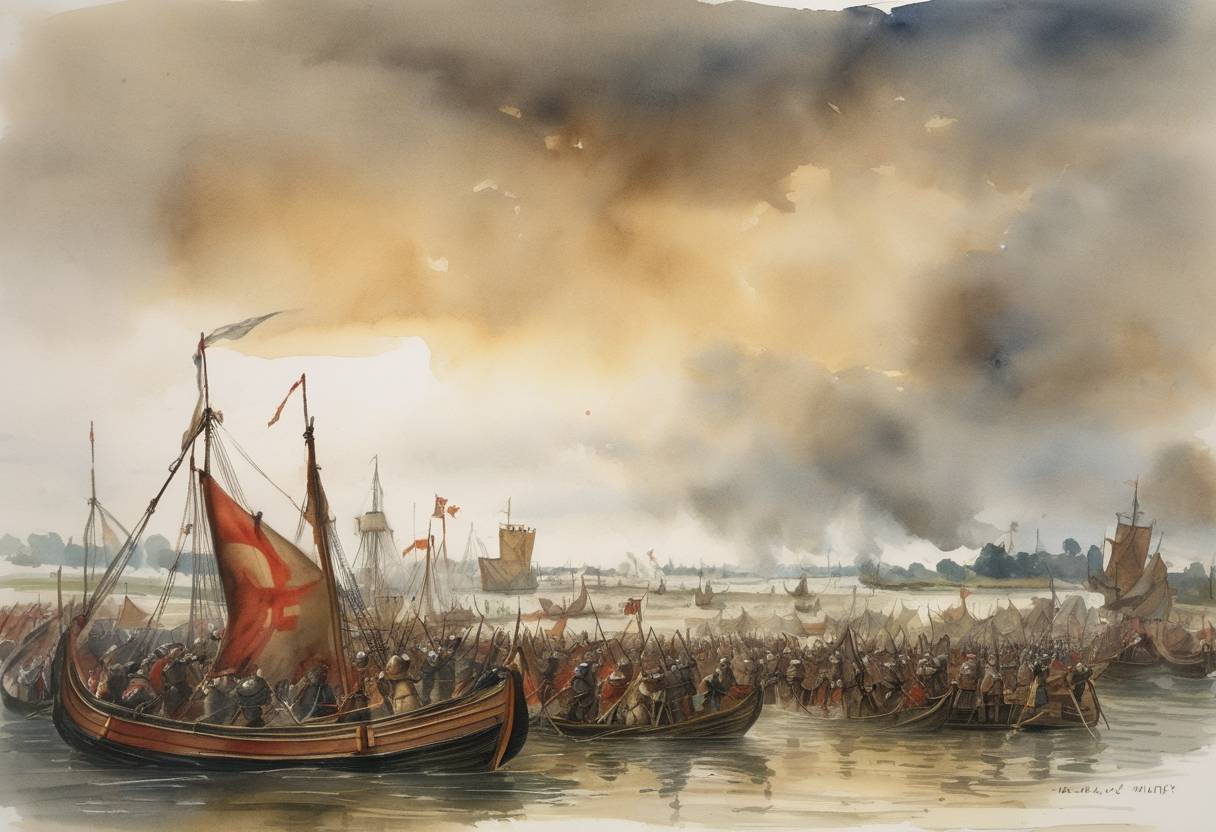
The Battle of Maldon took place on August 10, 991, near Maldon in Essex, England. This conflict was part of a series of Viking raids that troubled England during the late 10th century. The historical backdrop entailed increasing Viking incursions into English territories, likely seeking plunder and exerting influence over the resource-rich lands.
English Forces: Led by Earl Byrhtnoth, the Ealdorman of Essex. Byrhtnoth was renowned for his leadership and courage. His forces comprised predominantly of local fyrd, which were militia forces of farmers and peasants called upon for service.
Viking Invaders: The Viking forces were led by an unknown chieftain, possibly Olaf Tryggvason, a prominent figure of the time. The Viking raiders had traveled extensively across Northern Europe, their reputation for ferocity well-known.
The encounter began when the Viking forces landed on Northey Island, near the coast. Byrhtnoth, aware of the incursion, quickly mobilized his relatively small force to intercept the invaders. Faced with a tactical decision, Byrhtnoth allowed the Vikings to cross a causeway to the mainland, seeking a battlefield advantage by engaging them in open combat.
Despite being outnumbered, the English put up a determined resistance. Byrhtnoth’s troops displayed remarkable valor and loyalty. The battle, however, turned against the English. Byrhtnoth was slain amid the combat, a demoralizing blow for the English forces that ultimately led to their defeat.
The loss at Maldon was significant; it underscored the persistent threat Viking forces posed to England. The battle’s outcome highlighted the limitations of the Anglo-Saxon military arrangements in confronting well-organized and experienced Norse warriors. Following the battle, the English were compelled to pay tribute, known as “Danegeld”, in an attempt to stave off further Viking assaults.
The battle was immortalized in the Old English poem “The Battle of Maldon,” which depicts Byrhtnoth as a hero of noble spirit who prioritized honor and valor, even at the cost of defeat. The poem remains a seminal piece of Old English literature, providing insights into the values and warfare of the period.
Source: en.wikipedia.org