The Battle of Tannenberg: A Decisive German Victory
1914 · Tannenberg, Germany
World War I: The Battle of Tannenberg ends in a decisive German victory over Russian forces.
February 28, 1288
A significant event known as the 'Battle of Worringen' took place near the town of Worringen, located in present-day Germany. This confrontation was a decisive moment in the War of the Limburg Succession between Henry VI, Count of Luxembourg, and Adolf V, Count of Berg, among others. The battle concluded with a pivotal victory for a coalition of local forces led by John I, Duke of Brabant, which shaped the territorial politics of the region.
Worringen, Germany
The Battle of Worringen was not fought on February 28, 1288. The battle actually took place on June 5, 1288. Nonetheless, here is detailed information on this important historical event that significantly impacted the region’s political landscape.
The Battle of Worringen was a critical confrontation during the War of the Limburg Succession, which was ignited by the lack of a male heir following the death of Waleran IV, Duke of Limburg, in 1279. His death triggered a dispute over the succession of the Limburg territory, involving several noble families and regional powers. The primary contenders for control were Henry VI, Count of Luxembourg, who had a dynastic claim through marriage, and Adolf VIII of Berg, who supported John I, Duke of Brabant.
Stakes and Alliances: Both parties sought to consolidate and expand their influence within the Holy Roman Empire. Henry VI’s claim was backed by the Archbishopric of Cologne and other regional powers, while John I garnered support from the cities within Limburg and from his allies, including citizens eager to reduce ecclesiastical influence over local governance.
Buildup of Forces: Tensions escalated as both sides amassed large armies, each comprising knights, nobles, and mercenaries from various regions. The strategic location of Worringen, near Cologne, was chosen due to its proximity to the contested territories.
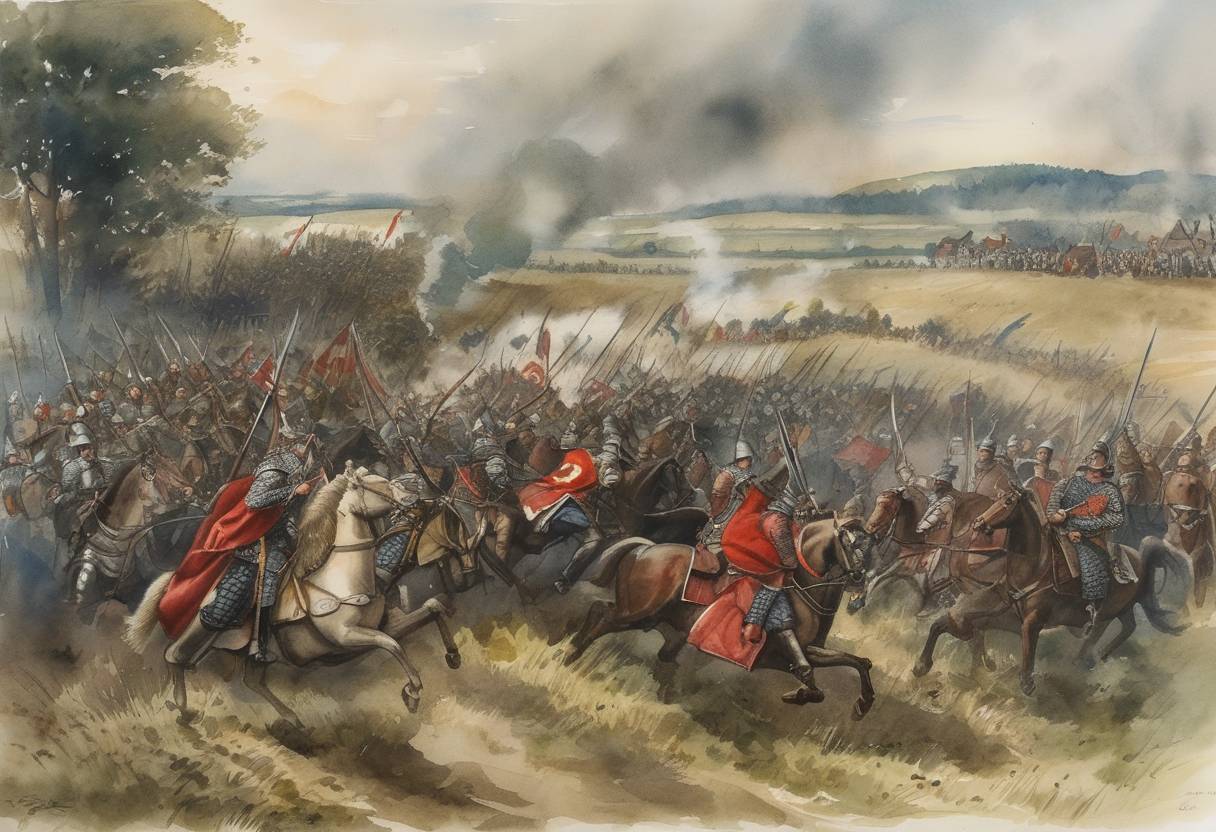
Course of the Battle: On the day of the conflict, the battle unfolded on open fields near Worringen. John I of Brabant led a diverse coalition against the forces of Luxembourg. The fighting was intense and brutal, characterized by traditional medieval warfare with cavalry charges, archers, and infantry battles.
Outcome: The coalition led by John I of Brabant emerged victorious. Henry VI was captured and numerous nobles from the opposing faction were killed or captured, fundamentally altering the balance of power in the region.
Territorial and Political Impact: The victory solidified John I’s control over Limburg, significantly enhancing the territorial power and influence of the Duchy of Brabant. This shifted the power dynamics within the region, reducing the influence of the Archbishop of Cologne and changing the political landscape of the surrounding principalities.
Legacy: The battle is often seen as a pivotal moment in the weakening of feudal power structures, paving the way for the rise of urban centers and a more modern form of territorial governance. It also exemplified the growing influence of urban forces, as towns like Cologne had sided with Brabant, seeking increased autonomy and freedom from ecclesiastical control.
The Battle of Worringen remains a noteworthy event in the medieval history of present-day Germany and the Low Countries, illustrating the complex interplay of regional rivalries, the shifting allegiances of powerful families, and the gradual emergence of modern political entities.