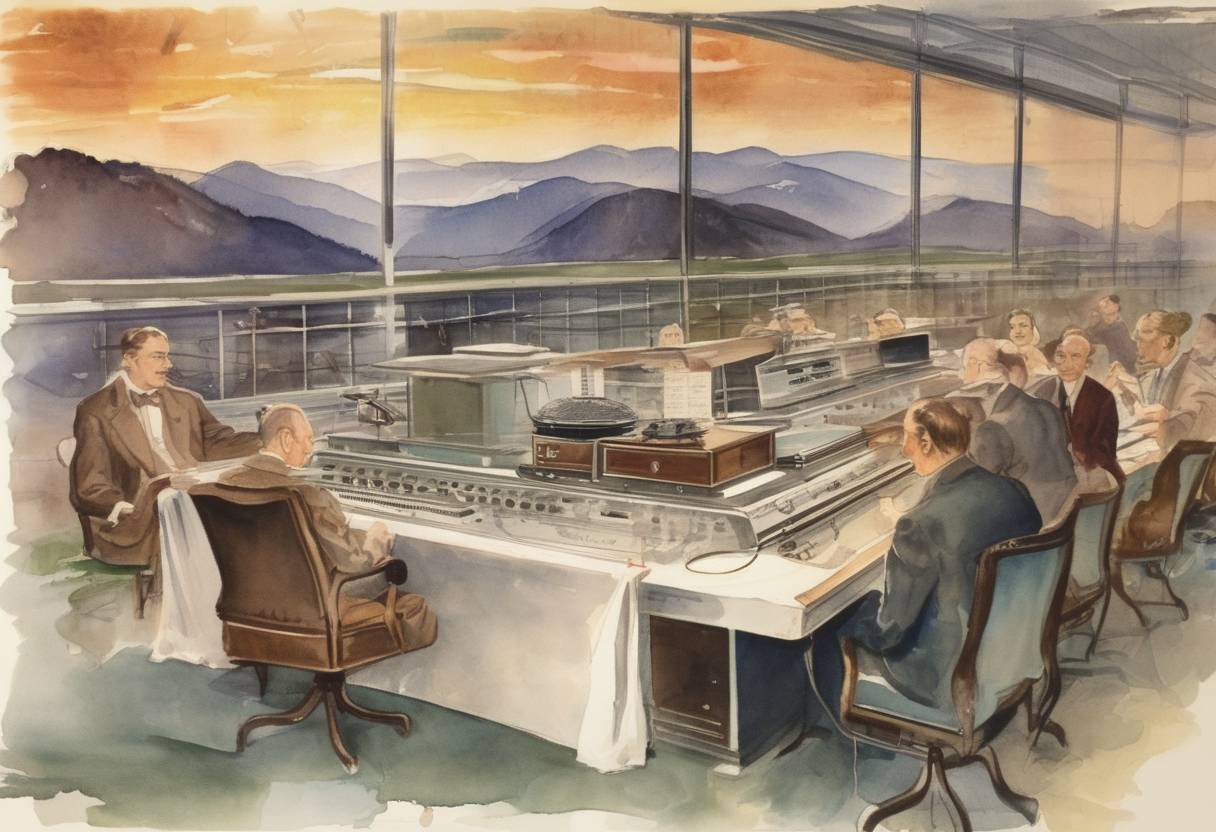
Edwin Armstrong’s First Public Demonstration of FM Radio Broadcasting
On June 11, 1935, Edwin Howard Armstrong, a pioneering American electrical engineer and inventor, conducted the first public demonstration of Frequency Modulation (FM) radio broadcasting. This event took place in Alpine, New Jersey, marking a significant milestone in the history of radio technology.
Background
Before FM radio, Amplitude Modulation (AM) was the standard for radio broadcasting. However, AM radio was plagued by static interference from electrical equipment and atmospheric conditions. Edwin Armstrong, known for his earlier inventions such as the regenerative circuit and the superheterodyne receiver, sought to address these issues with a new approach to radio transmission.
The Demonstration
Armstrong’s demonstration in Alpine showcased the superior sound quality and reduced static interference of FM radio compared to AM. He set up a transmitter on the Palisades, a high ridge in New Jersey, and broadcasted to an audience of engineers, radio industry professionals, and journalists. The demonstration involved transmitting music and speech, highlighting FM’s ability to deliver clear and high-fidelity audio.
Technical Innovations
FM radio works by varying the frequency of the carrier wave, unlike AM radio, which varies the amplitude. This method significantly reduces noise and interference, providing a clearer and more reliable signal. Armstrong’s FM system also included innovations in receiver design, which further enhanced its performance.
Impact and Legacy
The successful demonstration of FM radio was a pivotal moment in broadcasting history. Despite initial resistance from the established AM radio industry and regulatory challenges, FM radio eventually gained widespread adoption. It revolutionized the radio industry by offering better sound quality and paved the way for modern broadcasting standards.
Armstrong’s work laid the foundation for future developments in radio and communication technologies. Today, FM radio remains a popular medium for music and news broadcasting worldwide, a testament to Armstrong’s vision and ingenuity.
Conclusion
Edwin Armstrong’s first public demonstration of FM radio on June 11, 1935, was a groundbreaking event that showcased the potential of frequency modulation. It marked the beginning of a new era in radio broadcasting, characterized by improved sound quality and reduced interference, and solidified Armstrong’s legacy as one of the most influential inventors in the field of radio technology.