Death of Roman Emperor Claudius - October 13, 54 AD
54 · Rome, Roman Empire
Roman Emperor Claudius dies, possibly poisoned by his wife Agrippina, paving the way for Nero to become emperor.
January 17, 0038
Caligula accepts the titles of the Principate, marking the beginning of his reign as Roman Emperor.
Rome, Roman Empire | Roman Empire
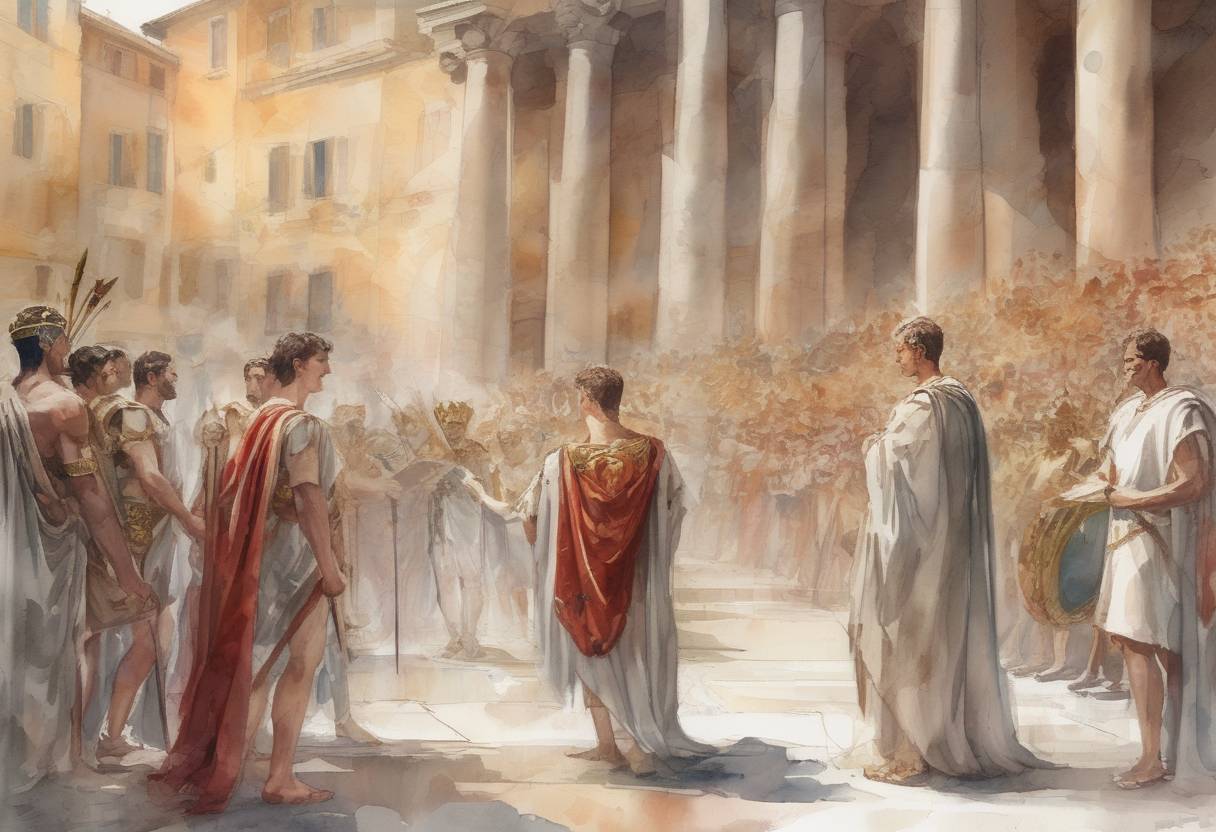
On January 17, 38 AD, Gaius Julius Caesar Augustus Germanicus, more commonly known as Caligula, formally accepted the titles of the Principate, marking the official beginning of his reign as Roman Emperor. This event followed the death of his predecessor and adoptive grandfather, Emperor Tiberius, in March 37 AD.
Caligula was born on August 31, 12 AD, into the Julio-Claudian dynasty, a lineage that traced its roots to the first Roman Emperor, Augustus. He was the son of the popular Roman general Germanicus and Agrippina the Elder, making him a great-grandson of Augustus. His nickname “Caligula,” meaning “little boots,” was affectionately given to him by soldiers during his childhood when he accompanied his father on military campaigns.
Upon Tiberius’s death, Caligula was named co-heir with Tiberius’s grandson, Gemellus. However, Caligula quickly consolidated power, and the Roman Senate recognized him as the sole emperor.
Caligula’s accession was initially met with widespread approval. The Roman populace and Senate were eager for a change after the reclusive and often harsh rule of Tiberius. Caligula’s early actions as emperor were well-received; he granted bonuses to the Praetorian Guard, provided public games and spectacles, and recalled political exiles.
On January 17, 38 AD, Caligula formally accepted the titles associated with the Principate, solidifying his position as the ruler of the Roman Empire. The Principate was the system of monarchy headed by an emperor, which maintained the facade of the Roman Republic’s institutions.
Caligula’s reign, however, soon took a dramatic turn. Historical accounts, primarily from sources such as Suetonius and Cassius Dio, describe his rule as increasingly erratic and tyrannical. He is often remembered for his extravagant spending, alleged madness, and acts of cruelty. Notable incidents include claims of declaring himself a living god, appointing his horse Incitatus as a priest, and engaging in numerous acts of political purges and executions.
Despite the sensational accounts of his reign, some modern historians suggest that these narratives may be exaggerated or biased, as they were written by authors hostile to Caligula’s memory.
Caligula’s reign was short-lived; he was assassinated on January 24, 41 AD, by members of the Praetorian Guard, who were disillusioned with his leadership. His death marked the end of his tumultuous rule and led to the ascension of his uncle, Claudius, as the next Roman Emperor.
Caligula’s reign remains a subject of fascination and debate among historians, serving as a cautionary tale of the potential excesses of absolute power and the complexities of historical narratives.
In summary, Caligula’s acceptance of the titles of the Principate on January 17, 38 AD, marked the beginning of one of the most infamous reigns in Roman history, characterized by both initial promise and subsequent notoriety.
Source: en.wikipedia.org