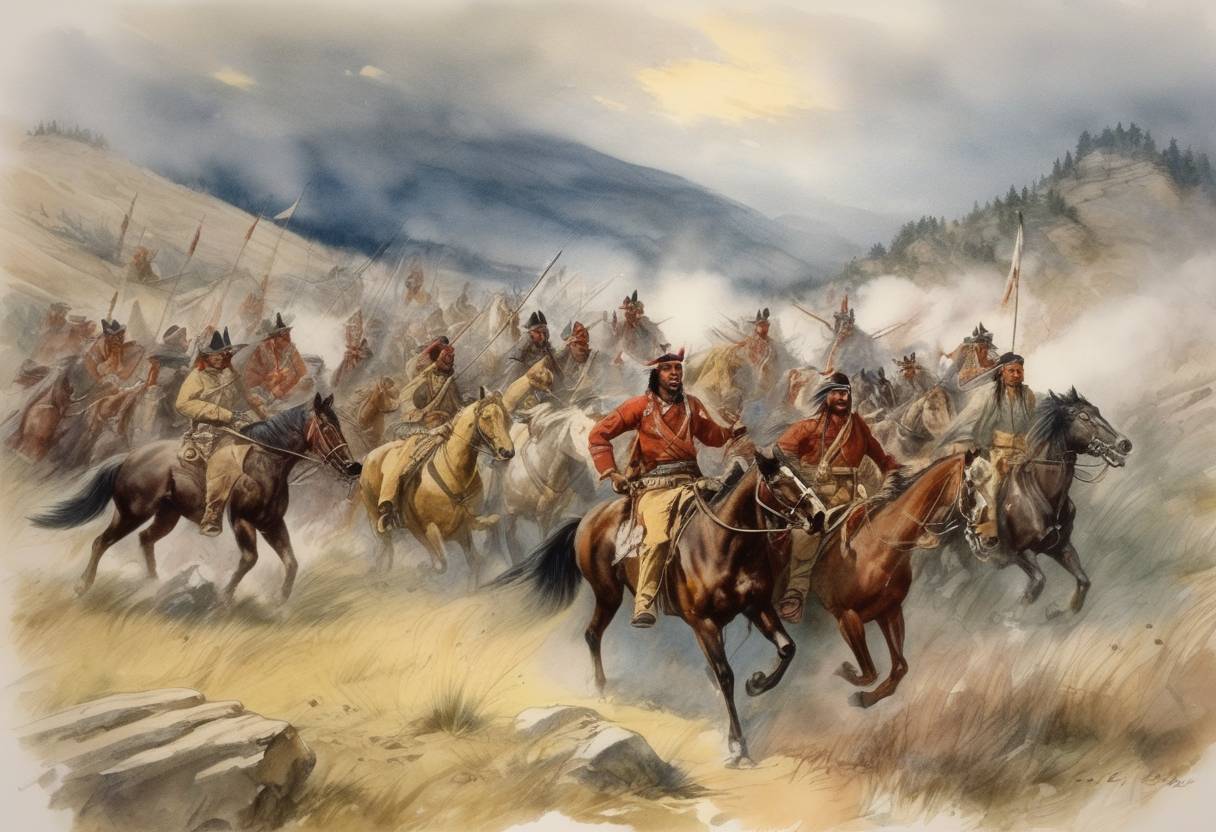
Battle of Wolf Mountain
On January 8, 1877, Crazy Horse and his band of Native American warriors faced the U.S. Cavalry in what would become their final battle during the Great Sioux War of 1876, fought at Wolf Mountain, in the Montana Territory.
Background
The Great Sioux War of 1876 was a series of battles and negotiations involving the Lakota Sioux and Northern Cheyenne tribes against the United States. The war arose primarily from the U.S. government’s desire to seize control of the Black Hills, a region sacred to the Native Americans, following the discovery of gold.
Following the Battle of the Little Bighorn in June 1876, the U.S. Army ramped up military efforts to suppress the remaining resistant Native American forces. By December, many Native American groups had either been subdued or forced to surrender.
Events Leading to the Battle
After a challenging winter campaign, Crazy Horse, a respected military leader, led his followers across the harsh landscape with dwindling supplies. General Nelson A. Miles, a prominent U.S. Army officer in the region, was tasked with suppressing the remaining resistance through a winter campaign that used the adverse weather conditions against the Native Americans.
The Battle
The Battle of Wolf Mountain commenced on the morning of January 8, 1877. General Miles’s forces engaged the Native American warriors in a location close to the Tongue River in present-day Big Horn County, Montana. The intense cold and snow added to the battle’s hardships.
The U.S. forces, employing disciplined tactics and heavy firepower, managed to hold their ground despite the fierce assaults by Crazy Horse and his warriors. The Native Americans, hampered by severe winter conditions and lack of resources, found it difficult to sustain their offensive.
Aftermath
Although the Battle of Wolf Mountain was not decisively concluded, the strategic attrition significantly weakened Crazy Horse’s forces. This confrontation marked the last major battle led by Crazy Horse.
Subsequently, Crazy Horse surrendered to U.S. authorities in May 1877, signaling the near end of organized military resistance from the Sioux and their allies. The Great Sioux War effectively ended with the surrender of other key leaders and the subsequent forced relocation of Native American tribes onto reservations.
Significance
The Battle of Wolf Mountain underscored the U.S. military’s determination to enforce relocation policies and seize control of the Black Hills. This event highlighted the challenges faced by Native American tribes resisting U.S. expansion and foreshadowed the eventual decline in their autonomy and traditional way of life.