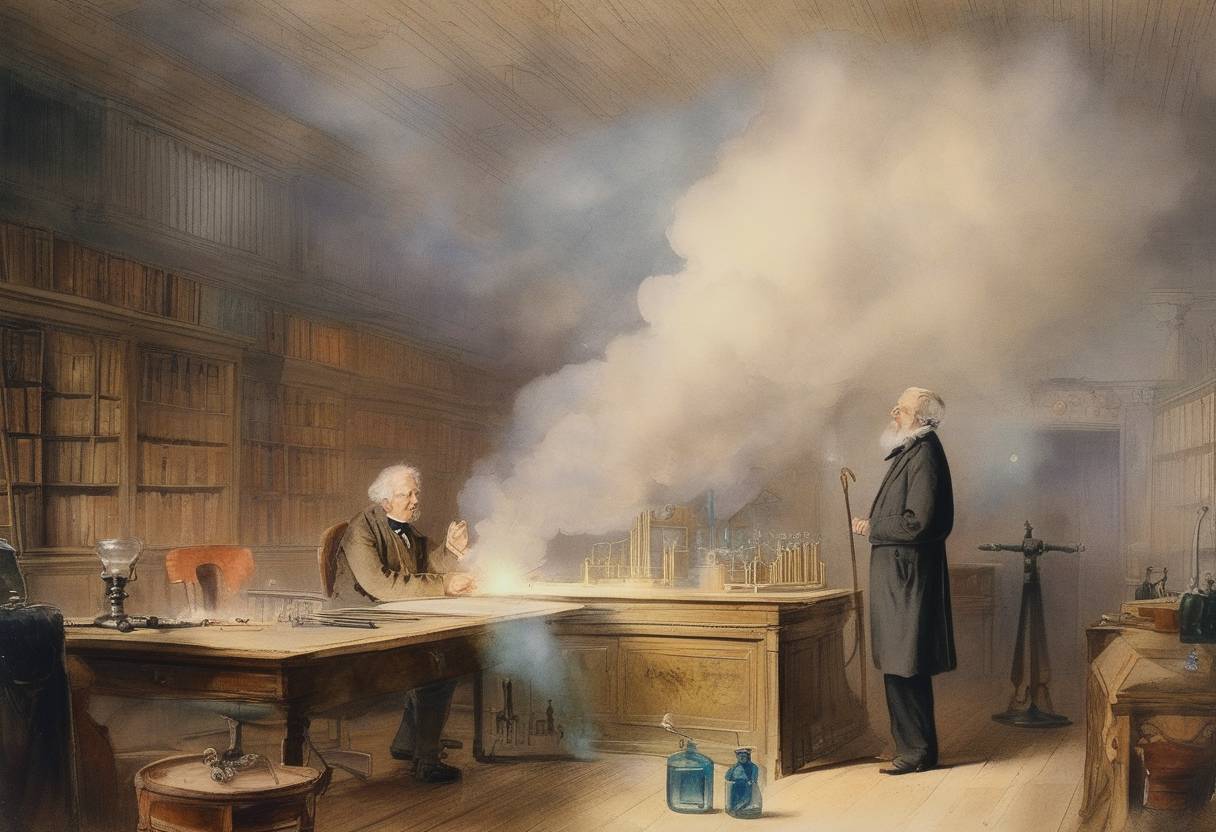
Discovery of Argon
On June 29, 1895, chemist William Ramsay and physicist Sir John William Strutt, known as Lord Rayleigh, jointly announced the discovery of a new element, argon, subsequently adding a novel element to the periodic table and contributing significantly to the series of noble gases.
Background and Research
The path to discovering argon began with Lord Rayleigh’s experiments in atmospheric density. During the early 1890s, Rayleigh noted a discrepancy in the density of nitrogen derived from the atmosphere as compared to nitrogen obtained from chemical compounds. This anomaly suggested the presence of another, previously unrecognized component in the atmospheric nitrogen.
Intrigued by Rayleigh’s findings, Ramsay, a distinguished chemist experienced in gas studies, collaborated with Rayleigh to explore the puzzling results further. They meticulously removed known gases from atmospheric air, mainly by using chemical means to eliminate oxygen, carbon dioxide, and nitrogen.
The Discovery
Through a combination of chemical isolation and Lord Rayleigh’s precise density measurements, Ramsay and Rayleigh isolated a gas that resisted chemical reactivity, a property indicating it was a new element. They named this gas “argon,” derived from the Greek word “argos,” meaning inactive or inert, to reflect its lack of chemical activity.
On June 29, 1895, their joint announcement of argon’s discovery was a crucial advancement in chemistry, highlighting the existence of noble gases, a previously unrecognized group of elements.
Significance and Impact
Argon’s discovery played a pivotal role in expanding the periodic table by catalyzing the identification of the noble gases group. Following argon, Ramsay continued to discover other inert gases, including helium on Earth, neon, krypton, and xenon, further advancing our understanding of the periodic table.
Moreover, the recognition of argon and subsequent noble gases necessitated a revision of chemical models and reiterated the complexity and richness of atmospheric composition and chemical behaviors.
William Ramsay’s and Lord Rayleigh’s work not only shaped the field of chemistry significantly but also earned them profound recognition. Ramsay was awarded the Nobel Prize in Chemistry in 1904 for his contributions to the discovery of inert gases, and Lord Rayleigh received the Nobel Prize in Physics in 1904 for his pioneering work in precision gas density measurements.
In summary, the announcement on June 29, 1895, marked a transformative moment in chemical science, reshaping previous scientific paradigms and inaugurating a fresh exploration of elemental properties and classifications.