The Second Mongol Invasion of Japan: Kamikaze Typhoon - August 12, 1281
1281 · Tsushima Island, Japan
The second Mongol invasion of Japan is thwarted by the kamikaze typhoon, which destroyed much of the Mongol fleet.
August 15, 1281
The second Mongol invasion of Japan ends in failure after the invading fleet is destroyed by a typhoon known as the kamikaze, or 'divine wind.'
Hakata Bay, Japan | Mongol Empire
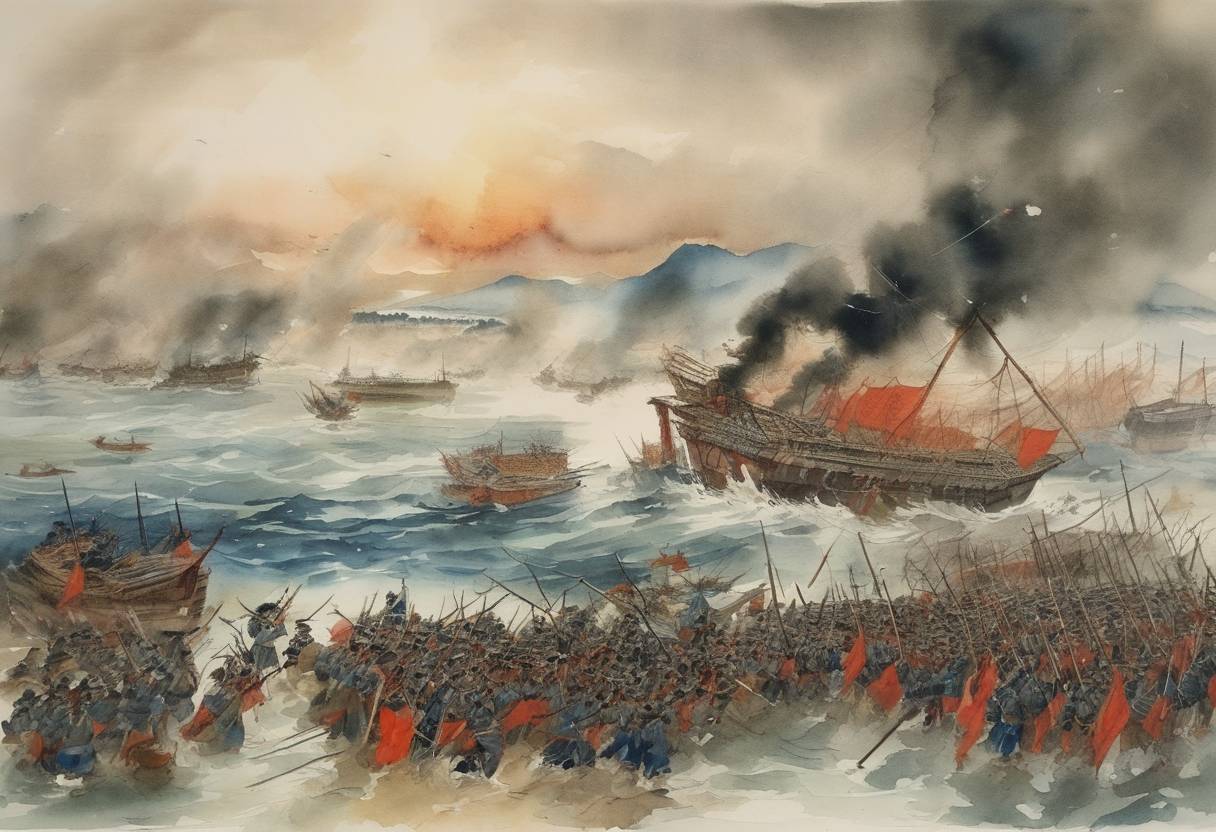
On August 15, 1281, the formidable Mongol Empire’s second attempt to invade Japan came to an abrupt and catastrophic end. This event is famously tied to a massive typhoon, known as the kamikaze, or “divine wind,” which played a pivotal role in neutralizing the threat posed by the invaders.
In the late 13th century, the Mongol Empire, led by Kublai Khan, saw rapid expansion across Asia. After conquering much of China, Korea, and other territories, Kublai Khan turned his attention to Japan. The Mongols initially attempted to invade Japan in 1274 but retreated after facing significant resistance and logistical challenges.
Determined to subdue Japan, Kublai Khan launched a second invasion in 1281. This time, the forces were significantly larger, reportedly comprising over 140,000 troops, which included both Mongol and Korean soldiers. The fleet set sail in two major contingents: one from Korea and the other, larger force, from southern China.
The plan was to simultaneously converge on northern Kyushu, Japan’s closest point to the Korean Peninsula. However, the campaign was fraught with logistical challenges, including differences in size and speed between the vessels from the two contingents and monsoon delays. The task of coordinating such a vast fleet proved exceedingly difficult.
As the Mongol fleets approached the Japanese coast, their progress met an unforeseen force of nature. On August 15, 1281, a powerful typhoon struck the Tsushima Strait, devastating the Mongol fleet. The storm’s violent winds and waves destroyed a significant portion of the ships, causing massive casualties and scattering the surviving ships.
Japanese samurai, who had been preparing to defend their homeland, capitalized on the disarray caused by the typhoon. They launched attacks on the remaining Mongol forces, who were demoralized and weakened from the storm.
The failure of the second Mongol invasion marked a critical point in Japanese history. The storm that protected Japan was seen as a divinely sent wind, which bolstered the belief among the Japanese of their islands being divinely protected.
Additionally, this failure marked the end of Mongol attempts to invade Japan, as the losses suffered were too great to risk another similar endeavor. The repulsions also had severe financial implications for Kublai Khan’s empire, underscoring the limits of the empire’s expansive reach.
The legacy of the kamikaze became deeply embedded in Japanese culture, symbolizing divine protection. This cultural memory would later be evoked during World War II, as Japanese pilots were named “kamikaze” in a nod to this historical event.
Source: www.britannica.com