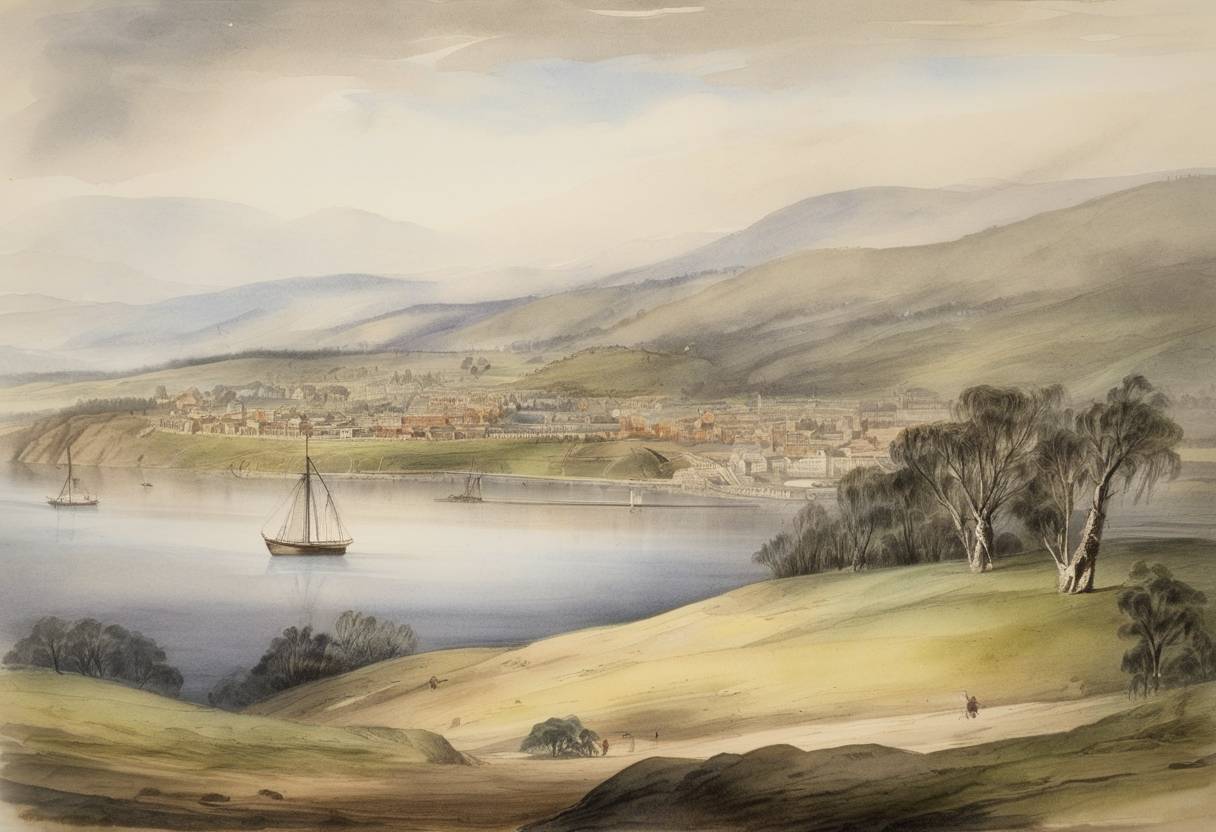
Establishment of Hobart as a Penal Colony
Context and Background
The establishment of Hobart as a penal colony on September 10, 1804, was part of Britain’s broader strategy to alleviate overcrowding in British prisons and secure its claims to territories in the southern hemisphere. This initiative followed the foundation of the first Australian colony at Sydney Cove in 1788.
Key Events Leading to the Establishment
- Selection of Location: The area that is now Hobart was selected due to its strategic location with a deep harbor, abundant timber, and fresh water, making it ideal for settlement and supplies.
- Leadership: Lieutenant Governor David Collins was tasked with establishing the colony. Initially, he was sent to Port Phillip in present-day Victoria but deemed it unsuitable due to the lack of fresh water and arable land.
- Settlement: Collins, with a group of convicts, military personnel, and free settlers, navigated to Van Diemen’s Land (now Tasmania) and anchored at Risdon Cove. Shortly after, the settlement was moved to Sullivan’s Cove, which became Hobart.
On this day, David Collins officially established the Hobart penal colony. The initial efforts focused on setting up basic infrastructure, including shelters and a rudimentary administration system.
Notable Consequences
- Convict Labor: Convicts formed the backbone of the labor force, constructing buildings, roads, and infrastructure, fostering the early development of Hobart.
- Relations with Indigenous People: The establishment, like elsewhere in Australia, led to conflicts with the indigenous Tasmanian Aboriginals. This had lasting impacts on the indigenous communities, leading to significant cultural and demographic changes.
- Economic Development: Despite its beginnings as a penal colony, Hobart quickly became a central port and economic hub, facilitating trade between Australia, Europe, and Asia.
Broader Historical Significance
The establishment of Hobart as a penal colony represents a significant chapter in the broader narrative of British colonial expansion. It played a critical role in the settlement and development of Australia and continues to shape Tasmania’s cultural and historical landscape.