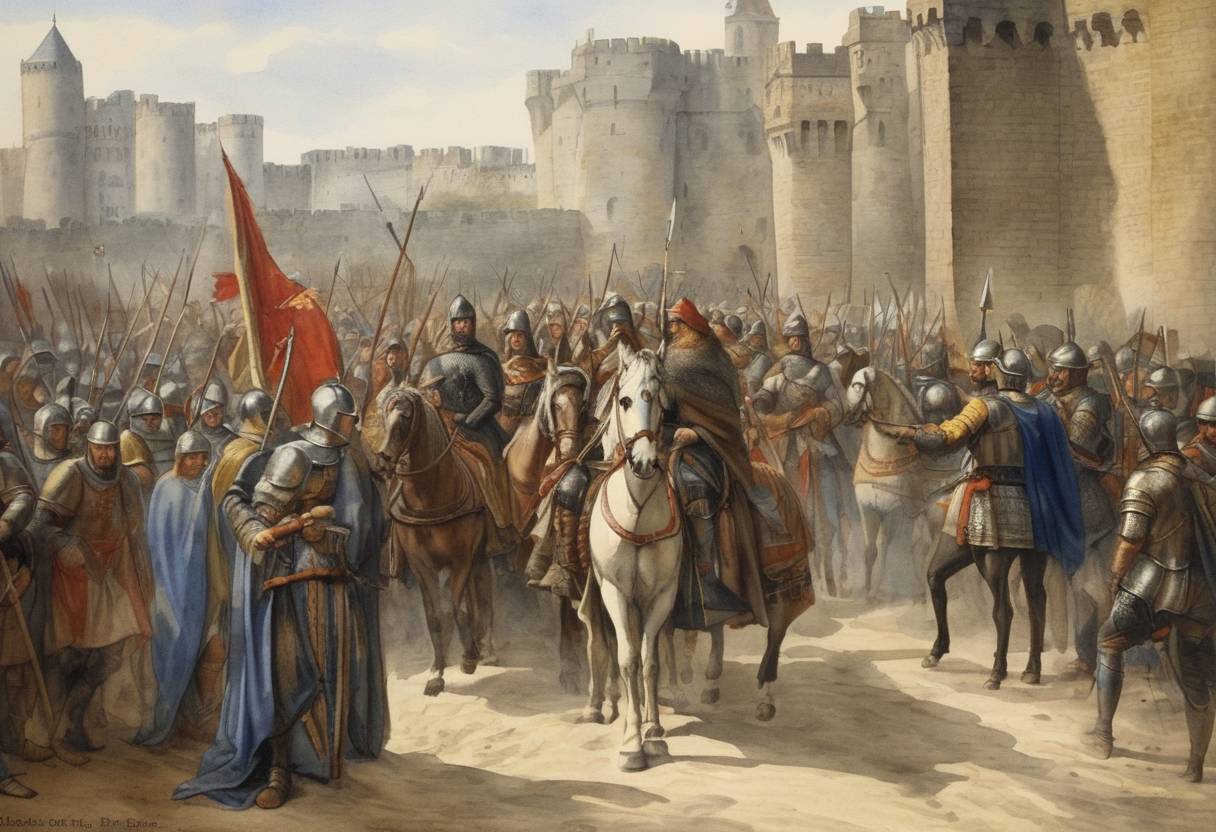
Godfrey of Bouillon Sets Out from Lorraine: June 25, 1096
Godfrey of Bouillon, a pivotal figure in the First Crusade, embarked on his journey from Lorraine to Jerusalem on June 25, 1096. This marked a critical phase of the mass mobilization of European forces heading towards the Holy Land, spurred by Pope Urban II’s call to reclaim Jerusalem from Muslim control.
Context and Background
The First Crusade (1096–1099) was a military expedition initiated by Pope Urban II in 1095 at the Council of Clermont. This call to arms was motivated by reports of Muslim Turk incursions and the desire to secure pilgrimage routes to Jerusalem, which had become increasingly dangerous. Godfrey, a Frankish noble, was among several European leaders to take up the cause, driven by religious fervor, the promise of spiritual salvation, and potential territorial gains in the East.
Departure from Lorraine
Godfrey of Bouillon was the Duke of Lower Lorraine, a region in what is today northeastern France and parts of Belgium. His leadership extended from familial influence as the eldest son of Count Eustace II of Boulogne and Ida of Lorraine. On June 25, 1096, Godfrey and his followers began their journey, forming one of the primary contingents of the Crusader forces. His army was diverse, comprising knights, foot-soldiers, and non-combatants motivated by faith and adventure.
Significance of the Journey
Godfrey’s departure is significant for several reasons:
Leadership and Unity: Godfrey’s expedition is noted for its discipline and organization. Unlike many other contingents, Godfrey maintained cohesion among his troops, ensuring their readiness for the challenges ahead.
Strategic Route: His forces traveled via the land route through Germany and Hungary, avoiding the logistical difficulties faced by those who opted for sea routes. This decision facilitated better supply lines and ease in recruiting additional manpower en route to the Byzantine Empire.
Diplomacy and Alliances: Along the journey, Godfrey’s diplomatic skills were pivotal. His negotiations ensured safe passage through the lands he traversed, crucial for maintaining the momentum of the march to Jerusalem.
Aftermath and Legacy
Godfrey of Bouillon would emerge as a key leader in the successful siege of Jerusalem in 1099, becoming its first ruler as “Advocate of the Holy Sepulchre” rather than taking the title of king, out of religious modesty. His initial departure on June 25, 1096, set the stage for a critical Crusader victory, establishing a precedent for future Crusades and significantly impacting Christian-Muslim relations in the medieval period.
Today, Godfrey of Bouillon’s departure is remembered as a seminal event in the chronicles of the First Crusade, exemplifying the complex interplay of faith, politics, and military ambition in medieval Europe.