The End of the Siege of Paris: A Decisive Victory for Prussia
1871 · Paris, France
The Siege of Paris ends, marking a decisive victory for Prussia in the Franco-Prussian War.
August 23, 1793
The French Revolutionary Wars saw the city of Mainz surrendered to Prussian and Austrian forces after a prolonged siege. This marked a significant moment in the conflict as the French Revolutionary Army faced setbacks.
Mainz, Germany | Prussian and Austrian Armies
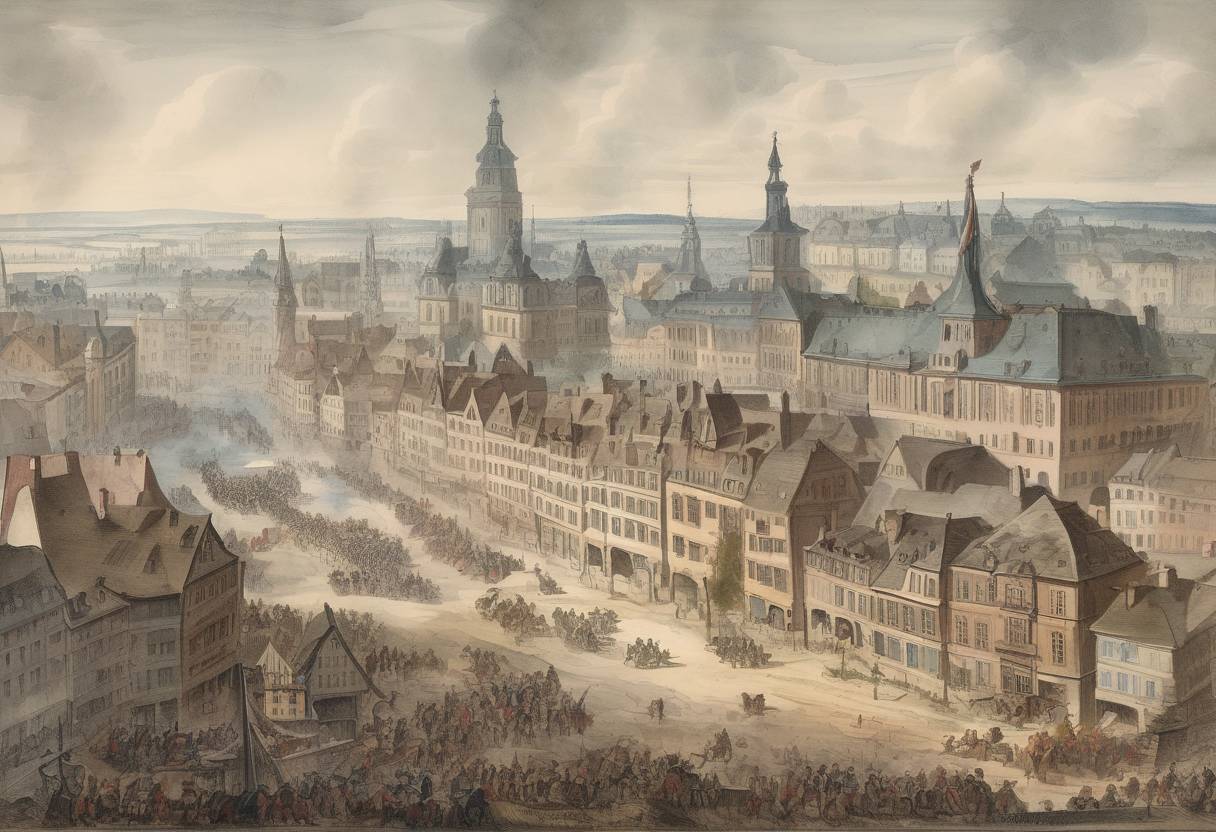
The surrender of Mainz on August 23, 1793, was a pivotal event during the French Revolutionary Wars, marking a significant setback for the French Revolutionary Army. This event unfolded amidst the broader context of the War of the First Coalition, where revolutionary France faced a formidable alliance of European monarchies intent on curbing the spread of revolutionary ideals.
The French Revolutionary Wars: Initiated in 1792, these wars were a series of military conflicts between the newly established French Republic and various European monarchies. The War of the First Coalition (1792–1797) saw France pitted against Austria, Prussia, Great Britain, Spain, and several other states.
Strategic Importance of Mainz: Located on the Rhine River, Mainz was a key strategic fortress. Its capture by French forces in 1792 had provided a critical foothold for France in German territories, threatening the security of the Holy Roman Empire.
Commencement: The siege began in April 1793 when Prussian and Austrian forces, under the command of the Duke of Brunswick and General von Kalkreuth, laid siege to the city. The French garrison, commanded by General Jean-Baptiste Kléber, was tasked with defending the city.
Prolonged Conflict: The siege lasted for several months, characterized by intense artillery bombardments and attempts by the French to break the encirclement. Despite their efforts, the French defenders were increasingly isolated and faced severe shortages of supplies and reinforcements.
Capitulation: On August 23, 1793, after enduring months of siege and with no relief in sight, the French garrison at Mainz surrendered to the coalition forces. The terms of surrender allowed the French troops to withdraw with honors but required them to pledge not to fight against the coalition for a year.
Aftermath and Consequences: The fall of Mainz was a significant blow to the French Revolutionary Army. It not only deprived France of a crucial strategic position but also emboldened the coalition forces. The loss highlighted the challenges faced by the revolutionary government in maintaining its territorial gains amidst internal and external pressures.
Impact on the French Revolutionary Wars: The surrender of Mainz underscored the volatility of the early revolutionary campaigns. It demonstrated the resilience of the coalition forces and the difficulties faced by France in sustaining its military efforts across multiple fronts.
Legacy: Despite this setback, the French Revolutionary Army would eventually recover and achieve significant victories in subsequent years, leading to the expansion of French influence across Europe. The events at Mainz, however, served as a reminder of the precarious nature of revolutionary warfare and the formidable opposition faced by France.
In summary, the surrender of Mainz on August 23, 1793, was a critical moment in the French Revolutionary Wars, reflecting the intense military and political challenges of the era. It highlighted the strategic importance of the city and the broader struggle between revolutionary France and the coalition of European monarchies.
Source: en.wikipedia.org