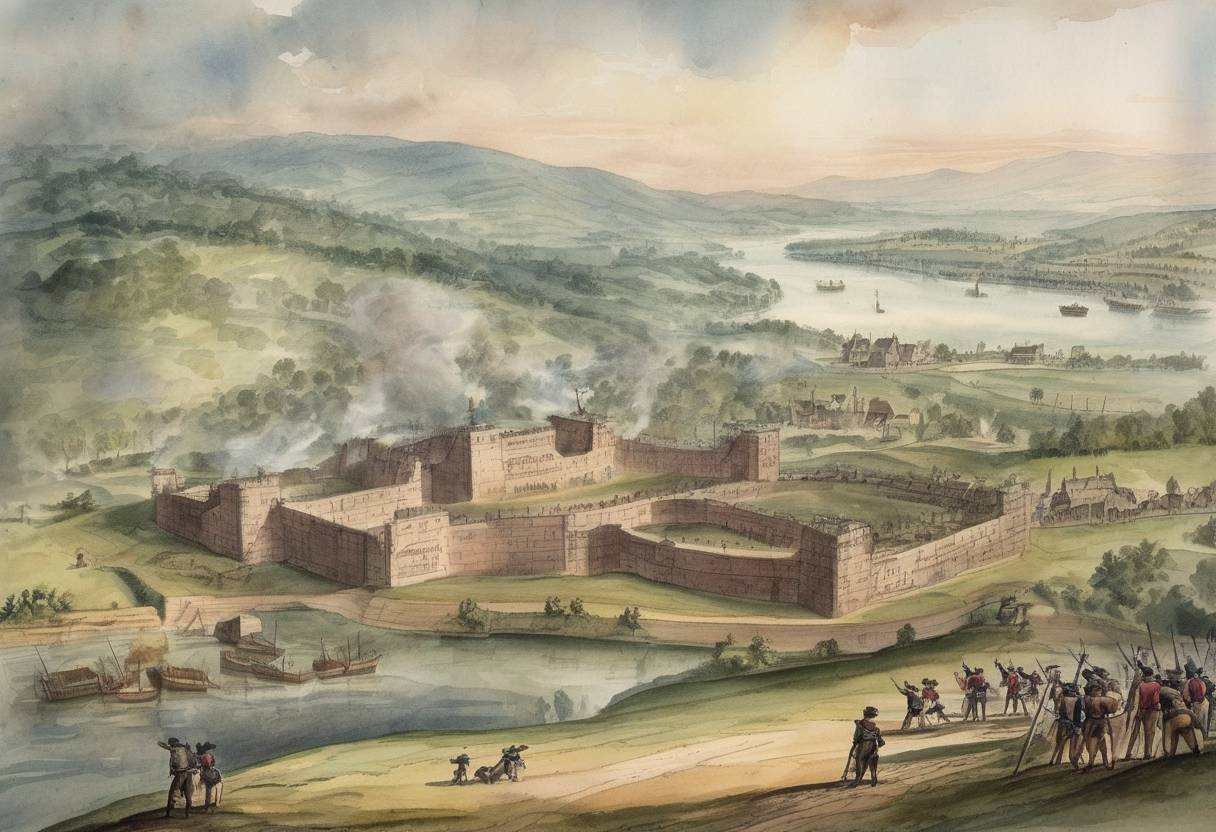
Capture of Fort Duquesne: November 25, 1758
On November 25, 1758, during the French and Indian War, British forces successfully captured Fort Duquesne from the French, marking a significant turning point in the conflict. The fort was strategically located at the confluence of the Allegheny and Monongahela Rivers, in present-day Pittsburgh, Pennsylvania. This event was part of the larger struggle between Britain and France for control over North America.
Background
Fort Duquesne was originally constructed by the French in 1754 as part of their efforts to consolidate control over the Ohio Valley, a region both the French and British claimed. The fort’s location was crucial for controlling the interior of the continent and the lucrative fur trade routes. The British had previously attempted to seize the fort in 1755, but their forces, led by General Edward Braddock, suffered a devastating defeat in the Battle of the Monongahela.
The British Campaign
By 1758, the British, under the leadership of General John Forbes, launched a renewed campaign to capture Fort Duquesne. Forbes’ strategy involved constructing a road through the wilderness to facilitate the movement of troops and supplies, which became known as Forbes Road. This logistical preparation was crucial for the success of the campaign.
The British forces, numbering around 6,000, included regular troops, colonial militia, and Native American allies. The campaign was marked by a slow and methodical advance, with the British constructing a series of forts along the way to secure their supply lines.
The Capture
As the British forces approached Fort Duquesne in November 1758, the French, realizing they were outnumbered and unable to defend the fort, decided to abandon it. On the night of November 24, the French set fire to the fort and retreated northward. The next day, British forces entered the smoldering remains of Fort Duquesne without resistance.
Aftermath and Significance
Following the capture, the British rebuilt and renamed the fortification Fort Pitt, in honor of William Pitt the Elder, the British Secretary of State who had been instrumental in directing the war effort. The capture of Fort Duquesne was a pivotal moment in the French and Indian War, as it effectively ended French control in the Ohio Valley and opened the region to British expansion.
The fall of Fort Duquesne also weakened French alliances with Native American tribes in the region, as many tribes began to shift their support to the British. This victory contributed to the eventual British triumph in the French and Indian War, which was formalized with the Treaty of Paris in 1763, leading to British dominance in North America.
The site of Fort Pitt would later become the city of Pittsburgh, a key industrial and cultural center in the United States. The capture of Fort Duquesne remains a significant event in the history of the American frontier and the broader context of colonial competition in North America.