Capture of Utrecht - January 16, 1795
1795 · Utrecht, Netherlands
French Revolutionary forces captured Utrecht during the War of the First Coalition, marking the end of Dutch resistance against the French invasion.
March 10, 1800
The Siege of Genoa began as part of the French Revolutionary Wars, where the Austrians besieged the city defended by French forces led by General André Masséna. The situation would lead to a significant famine in the city.
Genoa, Italy | French Revolutionary Army
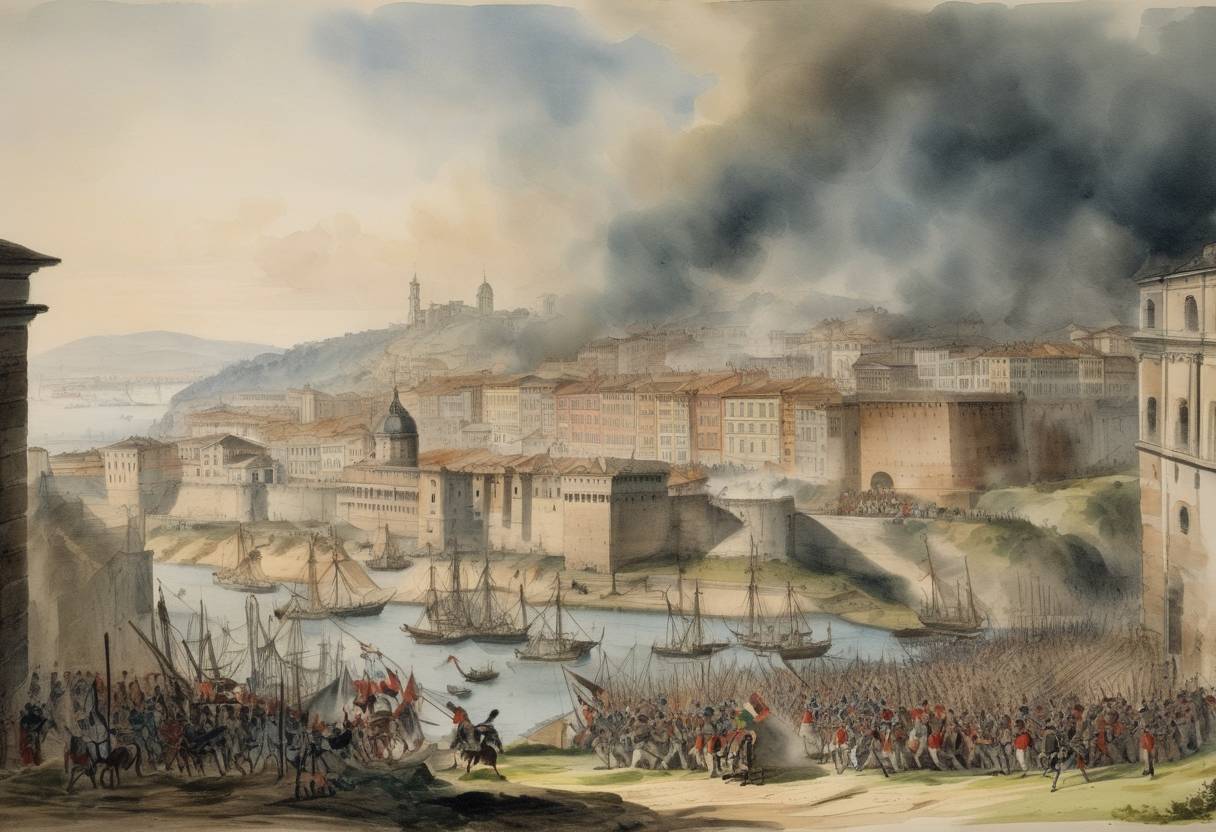
On March 10, 1800, the Austrians initiated the Siege of Genoa during the French Revolutionary Wars. This event marked the outset of a critical conflict wherein Austrian forces, aiming to curb French territorial advancements in Italy, targeted the strategic port city of Genoa. Under the command of General André Masséna, French forces were tasked with defending the city, which became a vital stronghold due to its location and resources.
The siege occurred as a part of the War of the Second Coalition, an integral phase of the larger French Revolutionary Wars. Tensions were heightened as European monarchies sought to diminish the influence of revolutionary France and reclaim territories lost during the War of the First Coalition.
Before the siege, France had considerably expanded its influence in Italy under the leadership of Napoleon Bonaparte. The capture and control of key Italian cities were crucial for France to maintain its dominance in the region. Therefore, Genoa, with its significant naval and commercial value, became a focal point for both French and Austrian strategic interests.
Led by General Michael von Melas, the Austrian troops commenced the siege on March 10. The operation involved bottling up Genoa, effectively cutting off supplies and reinforcements, and exerting continuous military pressure on the French defenders. The mountainous terrain surrounding Genoa posed logistical challenges, which both sides struggled to navigate.
General Masséna, noted for his resilience and tactical acumen, orchestrated the city’s defense. However, the onset of the siege precipitated dire straits within Genoa. The blockade led to severe food shortages, resulting in a widespread famine that severely affected both the civilian population and French troops.
The protracted siege lasted until June 1800, with the city’s inhabitants enduring immense hardships. Reports describe extreme scarcity leading to starvation and disease. Despite the formidable resistance by Masséna, the dire conditions forced him to eventually negotiate a surrender, allowing for an honorable exit for French forces while inadvertently giving Austria control over Genoa.
This outcome, however, did not translate into a strategic victory for the Austrians. Subsequent developments, including Napoleon’s decisive victory at the Battle of Marengo on June 14, 1800, shifted the balance of power back towards France, emphasizing the transient nature of territorial control during this tumultuous period in European history.
The siege underscored the broader struggles of the Second Coalition against revolutionary France, encapsulating the themes of endurance, strategic importance of territorial control, and the humanitarian crises associated with prolonged military conflicts.
Source: www.britannica.com