Establishment of the Irish Free State: December 6, 1922
1922 · Dublin, Ireland
The Irish Free State was established as a self-governing dominion of the British Commonwealth of Nations.
June 28, 1922
The Irish Civil War began, a conflict between supporters of the Anglo-Irish Treaty and its opponents, which lasted until 1923.
Dublin, Ireland | Irish Free State
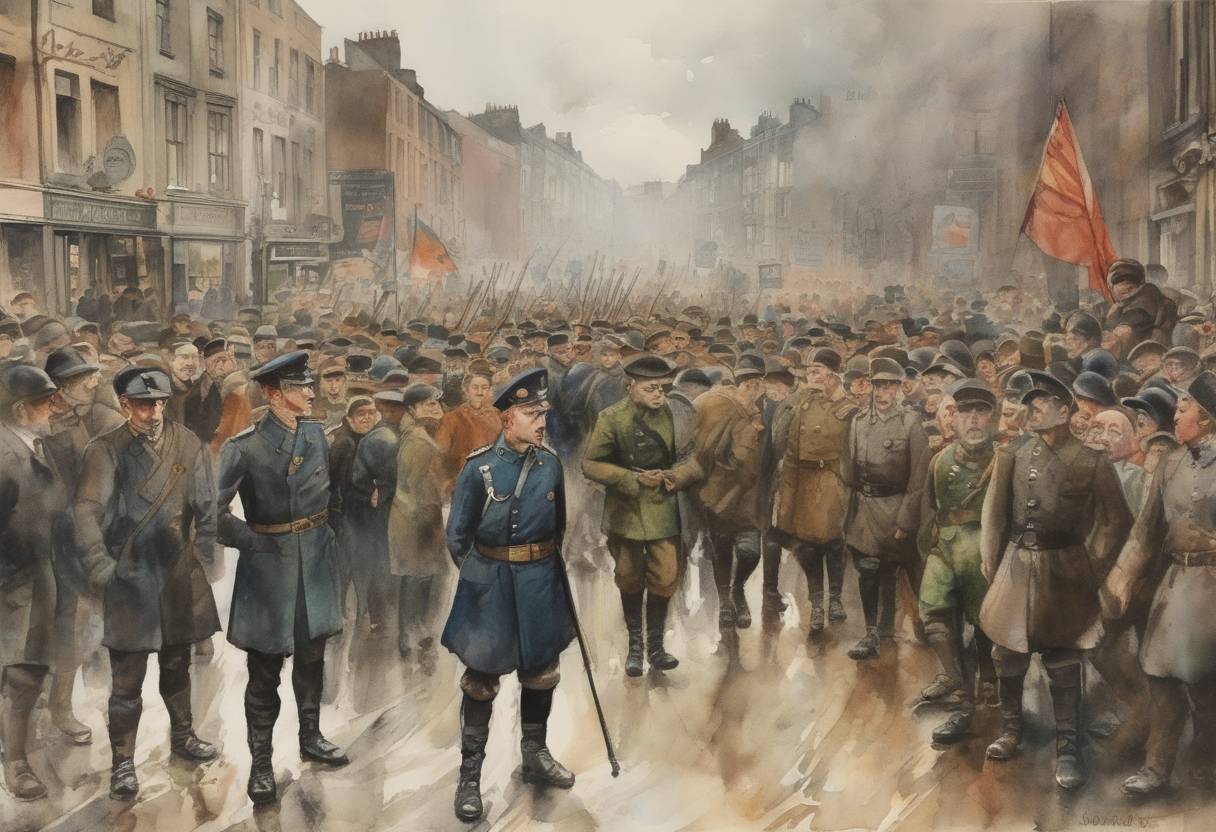
The Irish Civil War, a pivotal conflict in Ireland’s history, commenced on June 28, 1922. This war was primarily fought between two factions of Irish nationalists: those who supported the Anglo-Irish Treaty and those who opposed it.
The roots of the Irish Civil War can be traced back to the Anglo-Irish Treaty, signed on December 6, 1921. This treaty concluded the Irish War of Independence and established the Irish Free State as a self-governing dominion within the British Commonwealth. However, the treaty was contentious because it required Irish parliamentarians to swear allegiance to the British Crown and partitioned Ireland, leaving Northern Ireland as part of the United Kingdom.
Pro-Treaty Faction: Led by Michael Collins and Arthur Griffith, this group believed the treaty was a pragmatic step towards full Irish independence. They argued that it provided a foundation for future sovereignty and was the best compromise achievable at the time.
Anti-Treaty Faction: Led by Éamon de Valera and other prominent figures, this faction opposed the treaty, viewing it as a betrayal of the Irish Republic declared in 1916. They were particularly against the oath of allegiance to the British monarch and the partition of Ireland.
Tensions between the two factions escalated into violence when the Provisional Government, led by Michael Collins, ordered the shelling of the Four Courts in Dublin on June 28, 1922. The Four Courts had been occupied by anti-treaty forces since April 1922, and the attack marked the official start of the civil war.
Occupation of the Four Courts: In April 1922, anti-treaty forces seized the Four Courts, a significant government building in Dublin, as a symbol of their opposition.
Assassination of Sir Henry Wilson: The killing of the British Field Marshal in June 1922 increased pressure on the Provisional Government to assert control and maintain order, contributing to the decision to attack the Four Courts.
The Irish Civil War lasted until May 1923, resulting in a victory for the pro-treaty forces. However, the conflict had profound and lasting impacts on Ireland:
Casualties and Destruction: The war caused significant loss of life and widespread destruction, deepening divisions within Irish society.
Political Landscape: The civil war solidified the division between pro-treaty and anti-treaty factions, leading to the formation of two dominant political parties in Ireland: Fianna Fáil and Fine Gael.
Legacy of Division: The civil war left a legacy of bitterness and division that influenced Irish politics and society for decades.
The Irish Civil War was a tragic chapter in Ireland’s struggle for independence, highlighting the complexities and challenges of nation-building in the aftermath of colonial rule.
Source: en.wikipedia.org