Publication of Herman Melville's *Moby-Dick* in the United States
1851 · New York, United States
Herman Melville's novel 'Moby-Dick' is published in the United States.
September 8, 1820
The American whaling ship Essex, which would later inspire Herman Melville’s novel ‘Moby-Dick’, departs Nantucket for the Pacific Ocean.
Nantucket, United States | American whaling industry
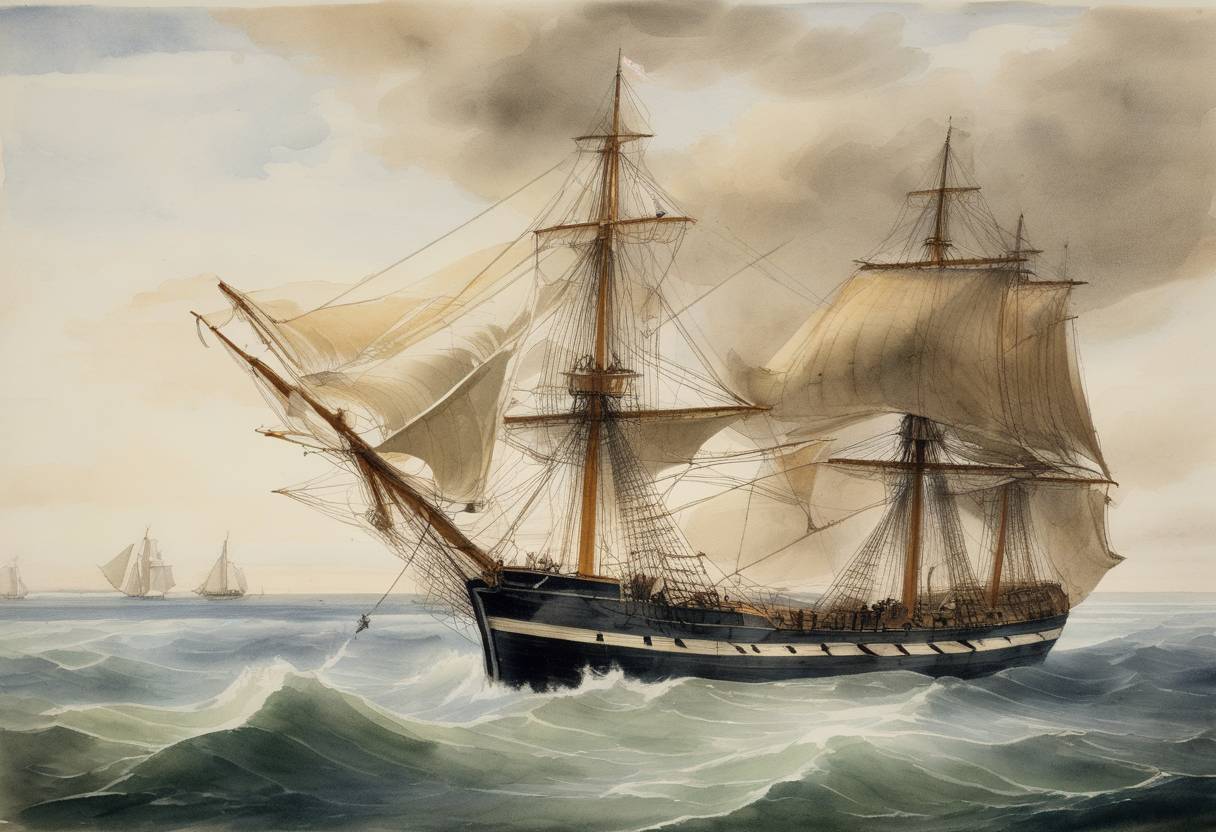
On August 9, 1820, the American whaling ship Essex departed from Nantucket, setting sail for a whaling voyage in the Pacific Ocean. This journey would ultimately lead to one of the most harrowing tales of survival at sea and serve as a pivotal inspiration for Herman Melville’s classic novel, Moby-Dick.
The Essex was a 238-ton whaling ship launched from Nantucket, Massachusetts, one of the most prominent whaling ports of the early 19th century. Commanded by Captain George Pollard Jr., the Essex set out with a crew of 21 men. The primary mission of the voyage was to hunt sperm whales for their oil, a highly valuable commodity during this period as a primary source of lighting fuel.
Prior to this fateful journey, the Essex had already completed several successful whaling expeditions in the Atlantic and Indian Oceans. The trip that began on August 9, 1820, was part of a well-established whaling route, aimed at exploiting rich whaling areas in the Pacific, which promised high yields.
The departure of the Essex marks the beginning of what would become a legendary maritime disaster. On November 20, 1820, the Essex was struck and sunk by a sperm whale in the Pacific Ocean—a rare and shocking occurrence that left the crew stranded thousands of miles from land.
The sailors’ subsequent ordeal, involving limited resources, adrift on the open ocean, and forced to make unimaginable decisions for survival, became one of the most well-known survival stories of the 19th century. Their story was initially recounted by first mate Owen Chase and others who survived the event, providing a firsthand account of the disaster.
Herman Melville, captivated by the story of the Essex, later used it as an inspiration for his novel Moby-Dick. First published in 1851, this work has become a monumental piece of American literature, exploring themes of obsession, the limits of human endurance, and the relationship between humanity and nature.
The events surrounding the Essex’s last voyage remain a significant historical episode, highlighting the dangers faced by whalers and influencing literary and cultural narratives long after the ship’s ill-fated expedition ended.
Source: www.history.com