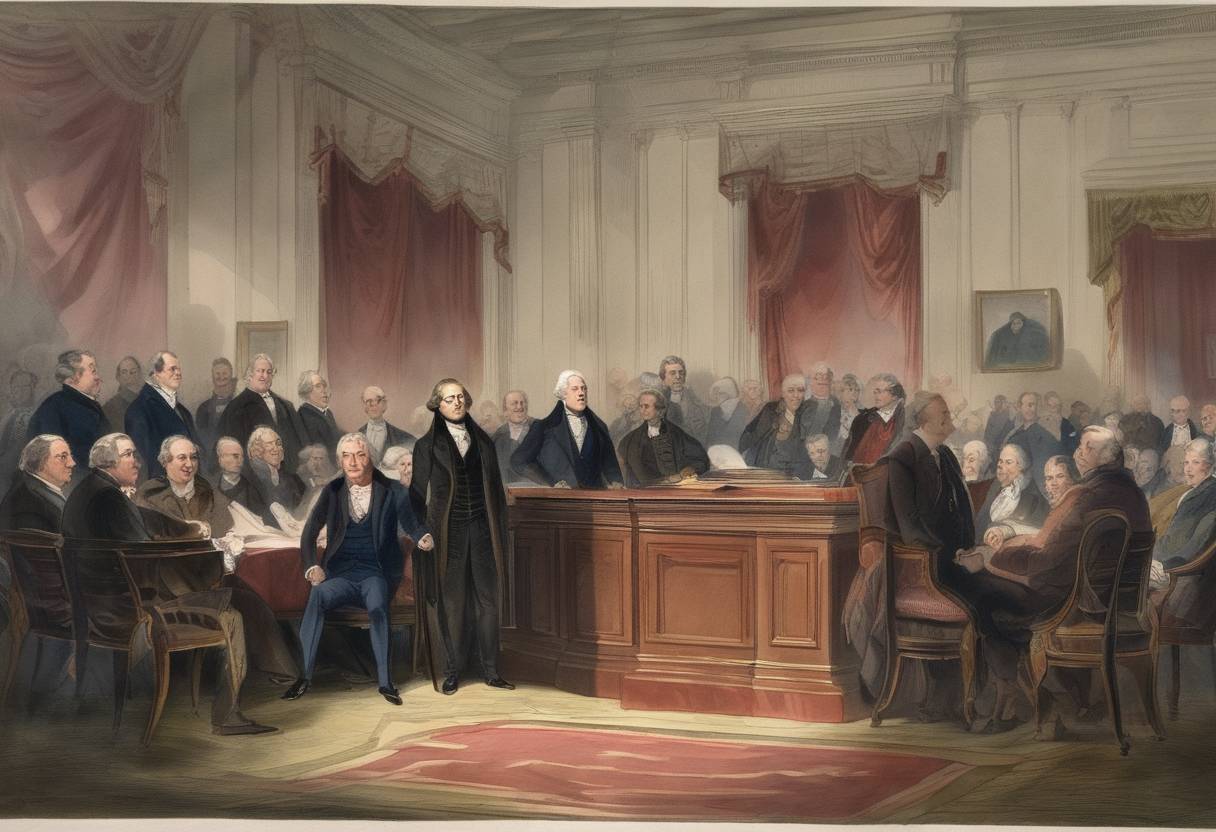
The United States Presidential Election of 1824
On December 1, 1824, the outcome of the United States presidential election was determined as no candidate secured a majority in the Electoral College. This election is notable for being the first and only time when the decision was made under the provisions of the Twelfth Amendment through a contingent election in the House of Representatives.
Background
The election of 1824 was unique in American history as it involved four main candidates, all from the Democratic-Republican Party:
- John Quincy Adams, the Secretary of State and son of former President John Adams.
- Andrew Jackson, a war hero and senator from Tennessee.
- William H. Crawford, the Secretary of the Treasury.
- Henry Clay, the Speaker of the House.
The political landscape at the time was characterized by the absence of clear party lines due to the breakdown of the Federalist Party, leaving the Democratic-Republicans as the dominant political force.
Electoral College Outcome
When the Electoral College votes were tallied, Andrew Jackson received the most popular and electoral votes but did not achieve the required majority to win the presidency outright. The final electoral vote count was:
- Andrew Jackson: 99 electoral votes
- John Quincy Adams: 84 electoral votes
- William H. Crawford: 41 electoral votes
- Henry Clay: 37 electoral votes
Since no candidate received a majority of the electoral votes (131 out of 261), the decision was moved to the House of Representatives as dictated by the Twelfth Amendment.
Contingent Election and Outcome
On February 9, 1825, the House of Representatives held the contingent election. In this process, each state delegation had one vote, determined by the majority preference of its House members. Henry Clay, having finished fourth, was eliminated from the contingent election, but he wielded significant influence and threw his support behind John Quincy Adams.
Thanks to Clay’s backing, Adams was able to secure the presidency, winning 13 state delegations, compared to 7 for Jackson and 4 for Crawford.
Aftermath and Significance
The election of 1824 and the subsequent House decision marked a turning point in U.S. politics. It underscored the limitations and complexities of the Electoral College system. The election also fueled accusations of a “corrupt bargain” between Adams and Clay, significantly impacting the political capital and future endeavors of all involved, particularly Andrew Jackson. Jackson’s loss galvanized his supporters and led to the formation of the Democratic Party, paving the way for his successful presidential bid in the 1828 election.
This election highlighted the evolving landscape of American politics, setting the stage for the robust party system that would dominate in later years.