Pope John Paul II's First Visit to Poland - June 2, 1979
1979 · Warsaw, Poland
Pope John Paul II begins his first official visit to his native Poland, marking a significant moment in the history of the Cold War.
August 15, 1370
Mass for the Assumption of Mary is first celebrated in St. Mary's Basilica in Gdańsk, Poland, symbolizing the growing influence of Marian devotions in the region.
Gdańsk, Poland | Catholic Church
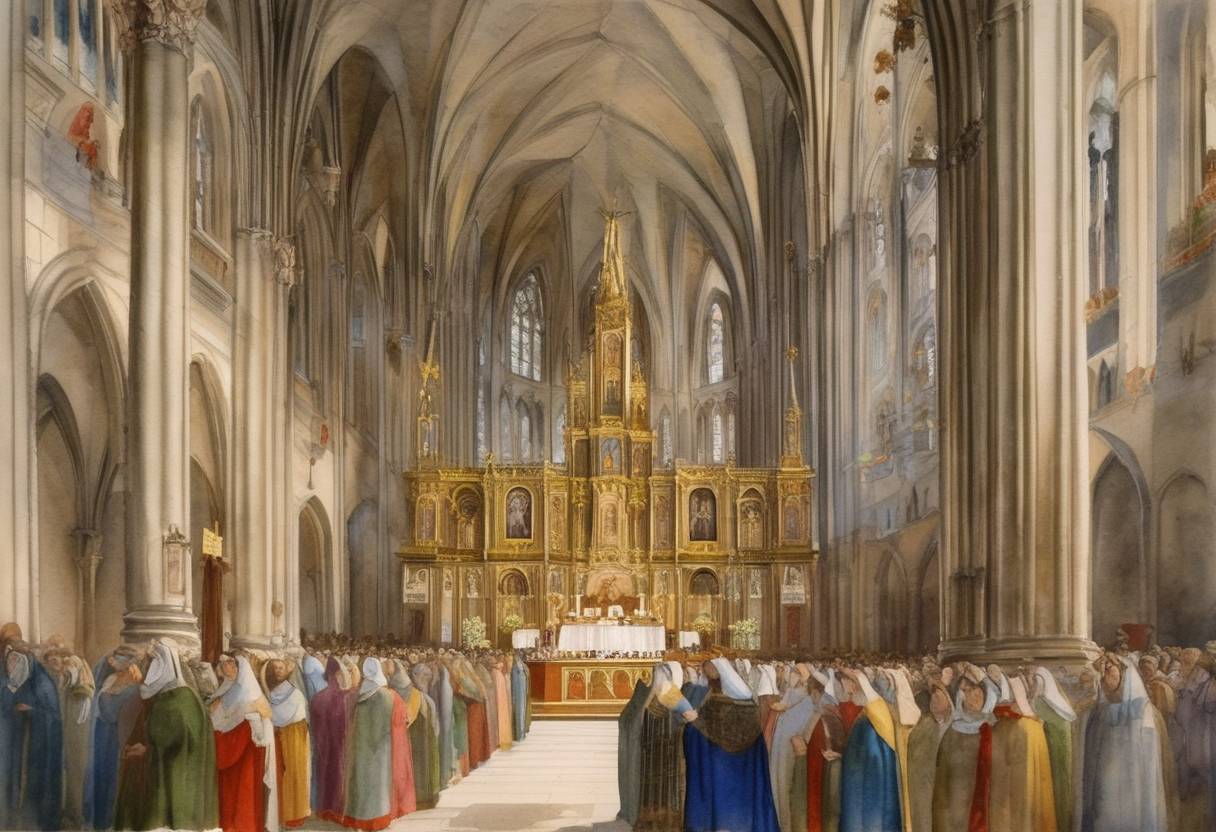
On August 15, 1370, St. Mary’s Basilica in Gdańsk, a prominent church in northern Poland, marked a significant religious event by celebrating its first Mass dedicated to the Assumption of the Virgin Mary. This celebration was a momentous occasion that underscored the increasing veneration of Mary within the region, reflecting broader religious trends in medieval Europe.
St. Mary’s Basilica, known as Bazylika Mariacka in Polish, is one of the largest brick churches in the world. Its construction began in the mid-14th century, around 1343, and it reached a critical phase in the late 14th century. The church was situated in Gdańsk, a city that would later gain substantial importance as a Hanseatic League port, contributing to the spread of both commerce and religious influences.
The Assumption of Mary into Heaven is a Catholic doctrine that asserts Mary’s bodily taking up into Heaven at the end of her earthly life. By the 14th century, the celebration of the Assumption had spread throughout many parts of Catholic Europe and was associated with various feasts and special services.
Celebration of the Mass: The inaugural Mass dedicated to the Assumption was held, marking a pivotal point in the liturgical calendar of Gdańsk. It featured traditional liturgical practices, hymnic devotion, and sermonizing that highlighted Mary’s significance in salvation history.
Cultural and Religious Influence: This celebration was emblematic of the Marian devotions that were gaining substantial traction during this period. Marian feasts were becoming more firmly entrenched in the liturgical practices, symbolizing both religious fervor and the theological developments of the time.
The celebration of the Assumption Mass at St. Mary’s Basilica in 1370 not only reinforced Marian devotion but also played a role in shaping the spiritual and communal life of Gdańsk. As the church further developed over the subsequent decades, it became a focal point for local religious practices and a site of pilgrimage.
This event is illustrative of the era’s theological interests and the Church’s increasing attention on Marian doctrines, which played integral roles in defining and unifying Christian communities across Europe.
In conclusion, the Assumption Mass at St. Mary’s Basilica in Gdańsk on August 15, 1370, was more than a religious service. It was a reflection of the dynamic interplay between faith, culture, and community, setting a precedent for subsequent marian celebrations and establishing a legacy of devotion that would continue to evolve over centuries.
Source: www.basilica.pl