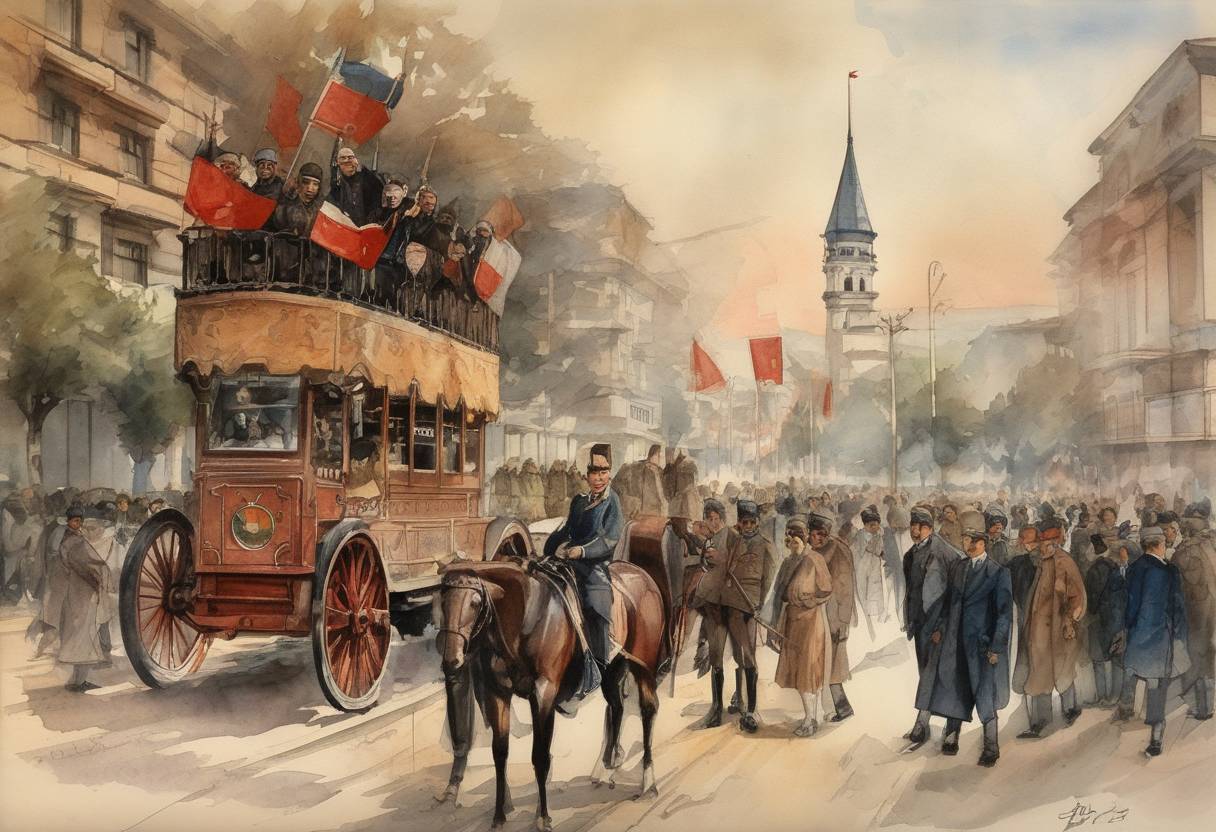
The Proclamation of the Republic of Turkey: October 29, 1923
On October 29, 1923, a pivotal moment in world history occurred with the proclamation of the Republic of Turkey. This event marked the official end of the Ottoman Empire, which had been a dominant power in the region for over six centuries. Mustafa Kemal Atatürk, a visionary leader and reformer, became the first President of the newly established republic, setting Turkey on a path of modernization and secularization.
Context and Background
The decline of the Ottoman Empire had been ongoing for several centuries, exacerbated by military defeats, territorial losses, and internal strife. The empire’s participation in World War I on the side of the Central Powers led to further devastation and the eventual occupation of its territories by Allied forces.
Following the war, the Treaty of Sèvres in 1920 sought to partition the Ottoman lands, but it was met with fierce resistance from Turkish nationalists. Under the leadership of Mustafa Kemal, a former Ottoman military officer, the Turkish War of Independence was launched against occupying forces and the Sultan’s government.
Key Events Leading to the Proclamation
Turkish War of Independence (1919-1923): Mustafa Kemal, later known as Atatürk, led the nationalist movement against both the occupying Allied forces and the Ottoman Sultanate. The successful military campaigns culminated in the Treaty of Lausanne in 1923, which recognized the sovereignty of the new Turkish state.
Abolition of the Sultanate (November 1, 1922): The Grand National Assembly of Turkey, established by Atatürk in Ankara, abolished the Sultanate, effectively ending the Ottoman rule and paving the way for a republican form of government.
Proclamation of the Republic: On October 29, 1923, the Grand National Assembly declared Turkey a republic. Mustafa Kemal Atatürk was unanimously elected as the first President, symbolizing a new era for the Turkish nation.
As President, Atatürk implemented a series of radical reforms aimed at transforming Turkey into a modern, secular, and national state:
- Secularization: The Caliphate was abolished in 1924, and religious influence was significantly reduced in state affairs.
- Legal and Educational Reforms: The legal system was overhauled, adopting a civil code inspired by European models. Education was secularized and made accessible to all citizens.
- Language and Cultural Reforms: The Turkish alphabet was changed from Arabic to Latin script, and efforts were made to promote Turkish culture and language.
- Economic and Social Changes: Atatürk encouraged industrialization and modernization of agriculture, alongside promoting women’s rights and gender equality.
Aftermath and Historical Significance
The establishment of the Republic of Turkey marked a significant shift in the political landscape of the Middle East and the broader Islamic world. Atatürk’s vision and reforms laid the foundation for a modern nation-state, influencing subsequent generations and setting a precedent for secular governance in a predominantly Muslim country.
The legacy of the Republic’s founding and Atatürk’s leadership continues to shape Turkey’s national identity and its role on the global stage. The anniversary of the republic’s proclamation is celebrated annually as Republic Day, a national holiday in Turkey, commemorating the country’s journey towards modernization and independence.