Treaty of Neuberg: September 9, 1379
1379 · Neuberg an der Mürz, Austria
The Treaty of Neuberg was signed, dividing the Habsburg lands between Albert III and Leopold III.
September 9, 1379
Peace of Neuberg is concluded at Neuberg Castle between Duke Albert III of Austria and Duke Leopold III of Austria, dividing the Habsburg hereditary lands of the Duchy of Austria between them.
Neuberg, Austria | House of Habsburg
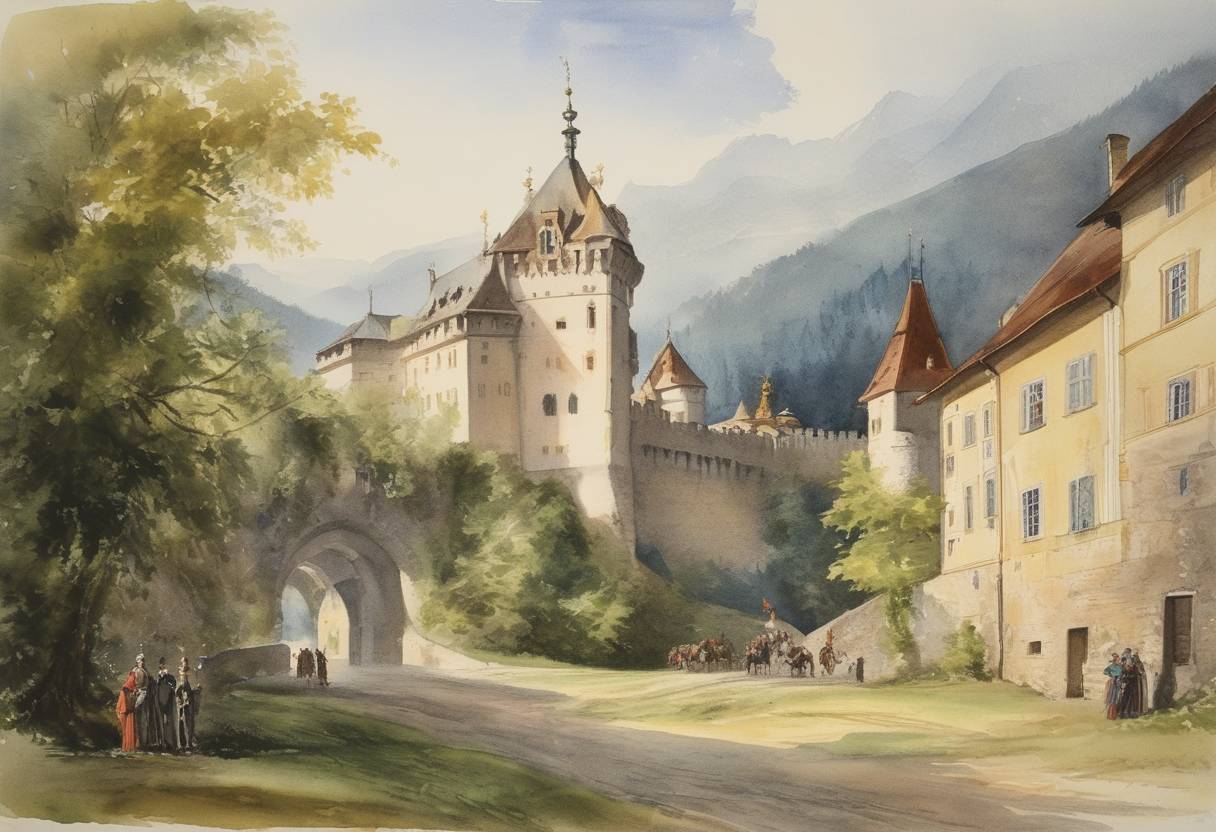
On September 9, 1379, the Peace of Neuberg was concluded at Neuberg Castle, effectively dividing the Habsburg hereditary lands of the Duchy of Austria between Duke Albert III and Duke Leopold III. This event marked a significant moment in the internal politics of the Habsburg dynasty, shaping the distribution and governance of their territories.
The House of Habsburg was a prominent European dynasty that originally rose to power in the late medieval period. Before the Peace of Neuberg, the Habsburgs co-ruled their extensive hereditary lands as a collective entity. However, the growing complexity and diversity of these territories, coupled with internal family dynamics, necessitated a formal division to ensure more orderly governance.
Territorial Division: The treaty divided the Habsburg hereditary lands into different spheres of control. Duke Albert III received the western part of the lands, including Upper Austria, while Duke Leopold III took control of the eastern territories, which comprised Lower Austria, Steiermark (Styria), Carinthia, and Carniola.
Administrative Autonomy: This division allowed each duke to independently administer their territories, establish local governance, and pursue regional policies.
Preservation of Unity: While the territories were administratively divided, the agreement ensured that the Habsburg lands remained theoretically united under the greater Habsburg heritage, maintaining an overarching sense of dynastic unity.
The Peace of Neuberg is often seen as a precursor to later territorial divisions within the Habsburg dynasty, setting a pattern of partitioning lands among family members. This division was reflective of broader trends in European noble families at the time, who often divided lands to prevent disputes.
The treaty also contributed to the political stability of the Habsburg domains by reducing familial conflicts. However, it also laid the groundwork for potential fragmentation and local independence, which might have weakened the centralized power of the dynasty. Nonetheless, the Habsburgs continued to expand their influence, eventually becoming one of the most powerful dynasties in Europe.
Overall, the Peace of Neuberg illustrated the practical realities of medieval governance and the challenges of managing sprawling and diverse territories under a feudal system.
Source: en.wikipedia.org