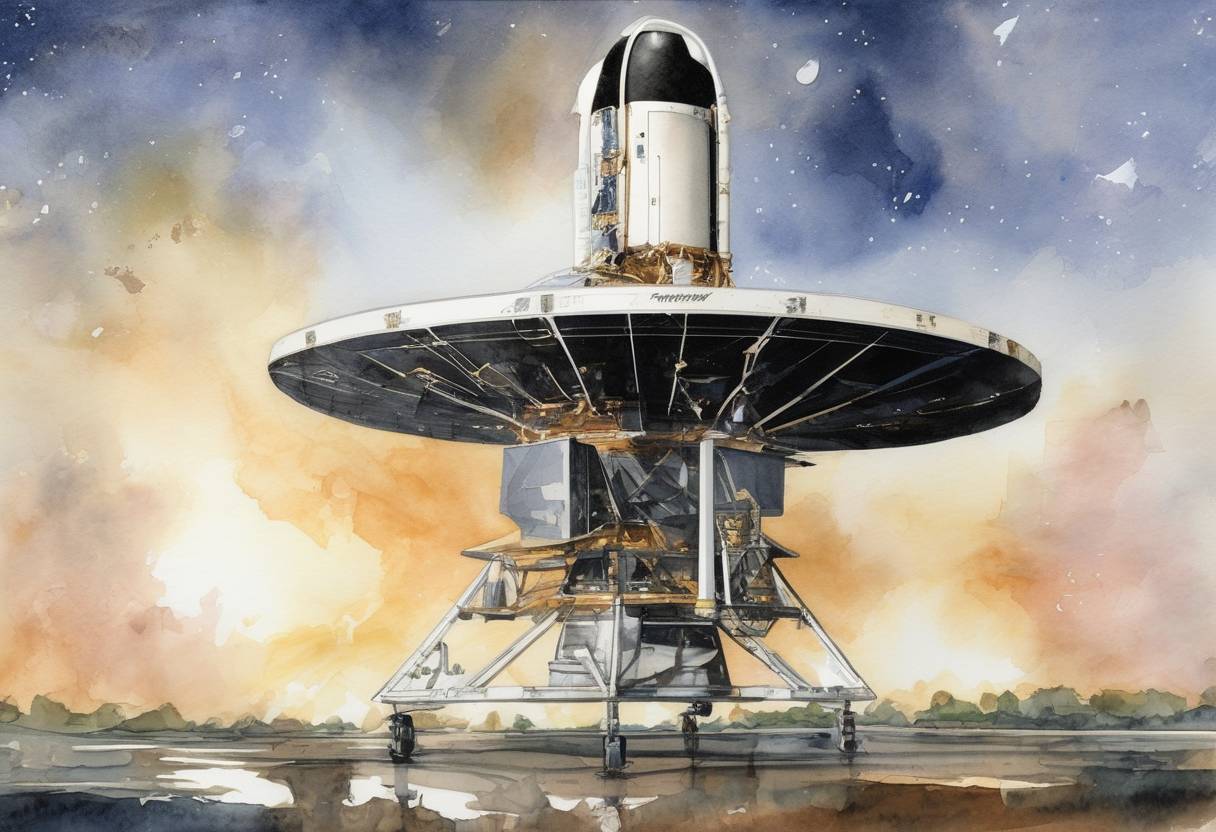
NASA’s New Horizons Launch: January 19, 2006
On January 19, 2006, NASA launched the New Horizons spacecraft, marking the beginning of a groundbreaking mission to study Pluto, its moons, and the Kuiper Belt. This mission represented a significant milestone in space exploration, as it aimed to provide humanity with its first close-up view of Pluto and its environment.
Context and Background
- Pluto’s Discovery: Pluto was discovered in 1930 by astronomer Clyde Tombaugh. For decades, it was considered the ninth planet in our solar system until its reclassification as a “dwarf planet” by the International Astronomical Union in 2006.
- Mission Objectives: The primary goal of the New Horizons mission was to conduct a flyby study of Pluto and its moons, particularly Charon, and to explore the Kuiper Belt, a region of the solar system beyond Neptune filled with icy bodies and remnants from the solar system’s formation.
Key Events Leading to the Launch
- Development and Planning: The New Horizons mission was developed by NASA’s New Frontiers program, with the spacecraft being built by the Johns Hopkins University Applied Physics Laboratory in collaboration with the Southwest Research Institute.
- Launch Vehicle: The spacecraft was launched aboard an Atlas V rocket from Cape Canaveral Air Force Station in Florida. The launch vehicle provided the necessary velocity to propel New Horizons on its long journey to the outer solar system.
The Journey and Achievements
- Trajectory and Speed: New Horizons was one of the fastest spacecraft ever launched, reaching a speed of about 36,000 miles per hour (58,000 kilometers per hour). It used a gravity assist from Jupiter in 2007 to increase its speed and adjust its trajectory toward Pluto.
- Pluto Flyby: On July 14, 2015, New Horizons made its closest approach to Pluto, coming within 7,800 miles (12,500 kilometers) of the surface. The spacecraft sent back detailed images and data, revealing Pluto’s complex geology, diverse surface features, and thin atmosphere.
- Extended Mission: After its successful Pluto flyby, New Horizons continued its journey into the Kuiper Belt. On January 1, 2019, it conducted a flyby of Arrokoth (previously known as 2014 MU69), providing insights into the early solar system.
Significance and Impact
- Scientific Discoveries: The data collected by New Horizons transformed our understanding of Pluto, revealing it as a dynamic world with mountains, glaciers, and possible cryovolcanism.
- Inspiration and Legacy: The mission inspired a renewed interest in planetary science and exploration, highlighting the importance of studying distant celestial bodies to understand the history and evolution of our solar system.
The New Horizons mission stands as a testament to human curiosity and the desire to explore the unknown, expanding our knowledge of the solar system’s outer reaches and paving the way for future explorations.