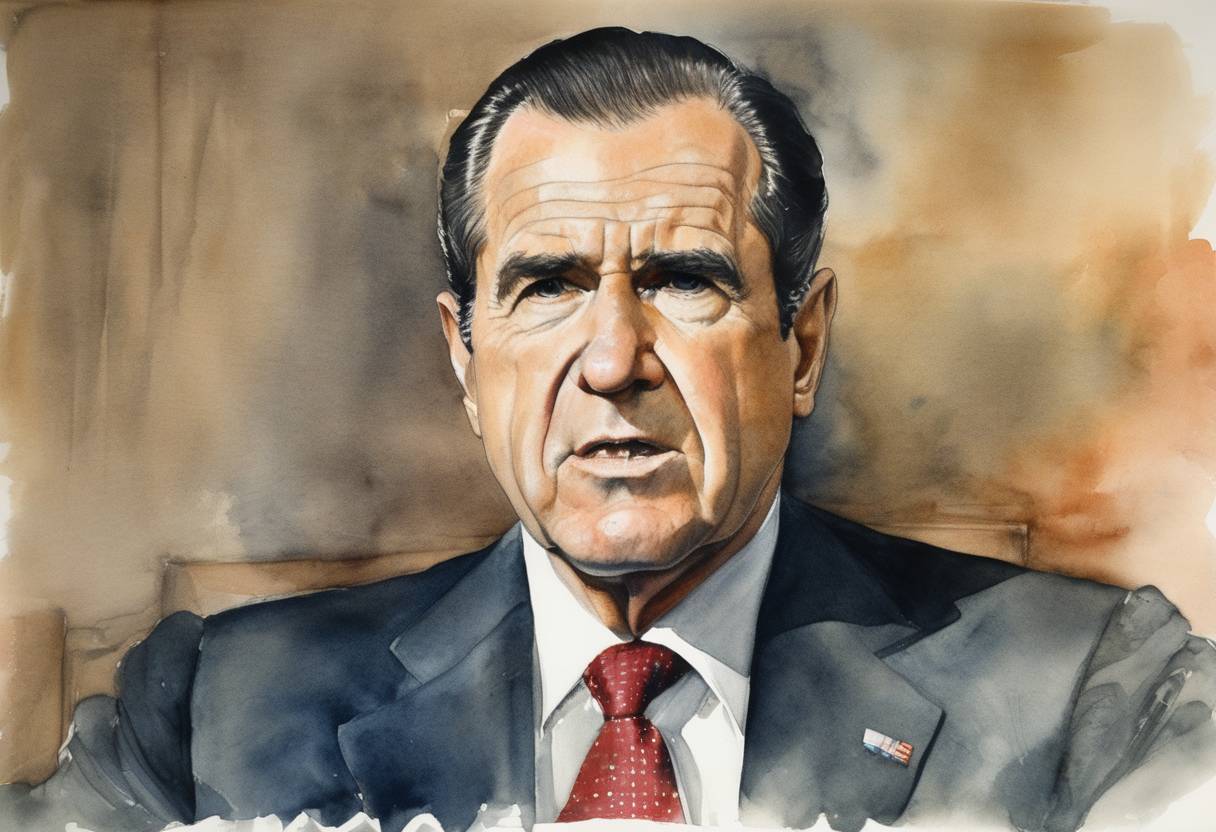
Richard Nixon Announces the Release of Watergate Tapes Transcripts
On April 29, 1974, President Richard Nixon delivered a significant announcement concerning the Watergate scandal that had embroiled his administration. During a televised address from the White House, Nixon declared that he would release edited transcripts of the White House tapes. These tapes were recordings of conversations held in the Oval Office and other locations, made between 1971 and 1973, that had become central to the investigation into the Watergate scandal.
Context Leading to the Announcement
The Watergate scandal began with a break-in at the Democratic National Committee headquarters at the Watergate complex in Washington, D.C., on June 17, 1972. The subsequent investigation revealed attempts by members of Nixon’s administration to cover up their involvement. As the scandal unfolded, it was revealed that Nixon had a secret recording system in the White House that captured many of his conversations.
The demand for access to these recordings became a focal point of the investigation, led by the special prosecutor Archibald Cox, and later his successor Leon Jaworski, as well as by the Senate Watergate Committee. Up until this announcement, Nixon had staunchly resisted calls to release the full tapes, citing executive privilege and concerns over national security.
Key Aspects of the Speech
Release of Transcripts: Nixon announced that transcripts of 46 conversations, encompassing around 1,200 pages, would be delivered to the House Judiciary Committee. These were selected from the requested materials believed to be relevant to the investigation.
Defense of Actions: In his speech, Nixon attempted to justify why he had not previously released the tapes, expressing concern about the precedent it would set and the potential implications for the confidentiality of presidential communications.
Edited Content: Nixon acknowledged that the tapes had been edited to remove content deemed irrelevant or sensitive. This move was made in response to ongoing demands for transparency and as an effort to comply partially with the investigation’s requirements.
Impact and Aftermath
The decision to release edited transcripts instead of the tapes themselves was met with skepticism and criticism. Many perceived this as a move lacking transparency, as there were concerns about the integrity and completeness of the edited materials. This skepticism contributed to mounting pressure on Nixon.
The controversy over the tapes would reach a climax when, in July 1974, the U.S. Supreme Court ruled unanimously in United States v. Nixon that Nixon must release the unedited tapes to government investigators. This ruling was crucial in providing further evidence of Nixon’s involvement in the Watergate cover-up, ultimately leading to his resignation on August 8, 1974.
This announcement and the subsequent release of these transcripts marked a pivotal moment in the Watergate scandal and in U.S. political history, highlighting the complex interplay between executive privilege, judicial power, and transparency.