The Scuttling of the CSS Arkansas on August 6, 1862
1862 · Baton Rouge, United States
The Confederate ironclad CSS Arkansas was scuttled on the Mississippi River after suffering damage during the American Civil War.
February 17, 1864
The H.L. Hunley became the first submarine to sink an enemy warship during the American Civil War.
Charleston, United States | Confederate States Navy
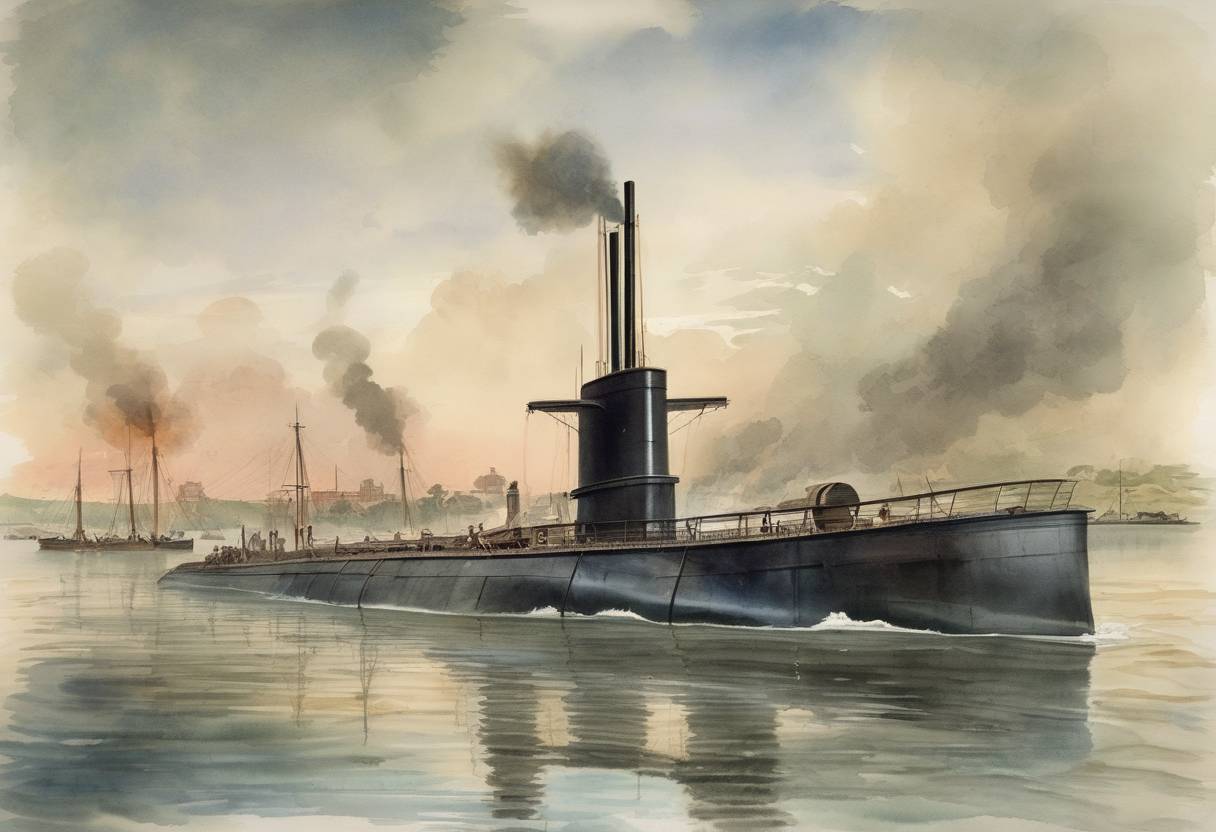
On February 17, 1864, during the American Civil War, the Confederate submarine H.L. Hunley made history by becoming the first submarine to successfully sink an enemy warship. This event marked a significant milestone in naval warfare and demonstrated the potential of submarine technology.
The H.L. Hunley was a hand-powered submarine developed by the Confederate States of America. Named after its financier, Horace Lawson Hunley, the vessel was designed to break the Union blockade of Southern ports. The blockade was part of the Union’s Anaconda Plan, aimed at suffocating the Confederacy’s economy and war effort.
Constructed in Mobile, Alabama, and later transported to Charleston, South Carolina, the Hunley was a cylindrical iron vessel measuring about 40 feet in length and operated by a crew of eight. It was equipped with a spar torpedo, a copper cylinder filled with gunpowder, mounted on a 16-foot pole at its bow.
On the night of February 17, 1864, the H.L. Hunley set out from Charleston Harbor to attack the USS Housatonic, a Union sloop-of-war stationed as part of the blockade. The Hunley approached the Housatonic stealthily, and at around 8:45 PM, it detonated its spar torpedo against the hull of the Union ship.
The explosion caused the Housatonic to sink rapidly, resulting in the loss of five crew members. The rest of the crew managed to escape in lifeboats. The attack demonstrated the effectiveness of submarine warfare, as the Hunley had managed to bypass the Union’s naval defenses and deliver a crippling blow.
Tragically, the H.L. Hunley did not return from its mission. It sank shortly after the attack, taking all eight crew members with it. The exact cause of the sinking remains a subject of speculation, with theories ranging from damage sustained during the attack to accidental flooding.
The Hunley’s achievement had a profound impact on naval strategy and technology. It highlighted the potential of submarines as offensive weapons and spurred further development in submarine design and tactics.
The wreck of the H.L. Hunley was discovered in 1995 and raised in 2000. It is now preserved and displayed at the Warren Lasch Conservation Center in North Charleston, South Carolina, where ongoing research continues to uncover details about its construction and final mission.
The Hunley’s daring mission and its role in naval history remain a testament to the ingenuity and bravery of its crew, marking a pivotal moment in the evolution of naval warfare.
Source: en.wikipedia.org