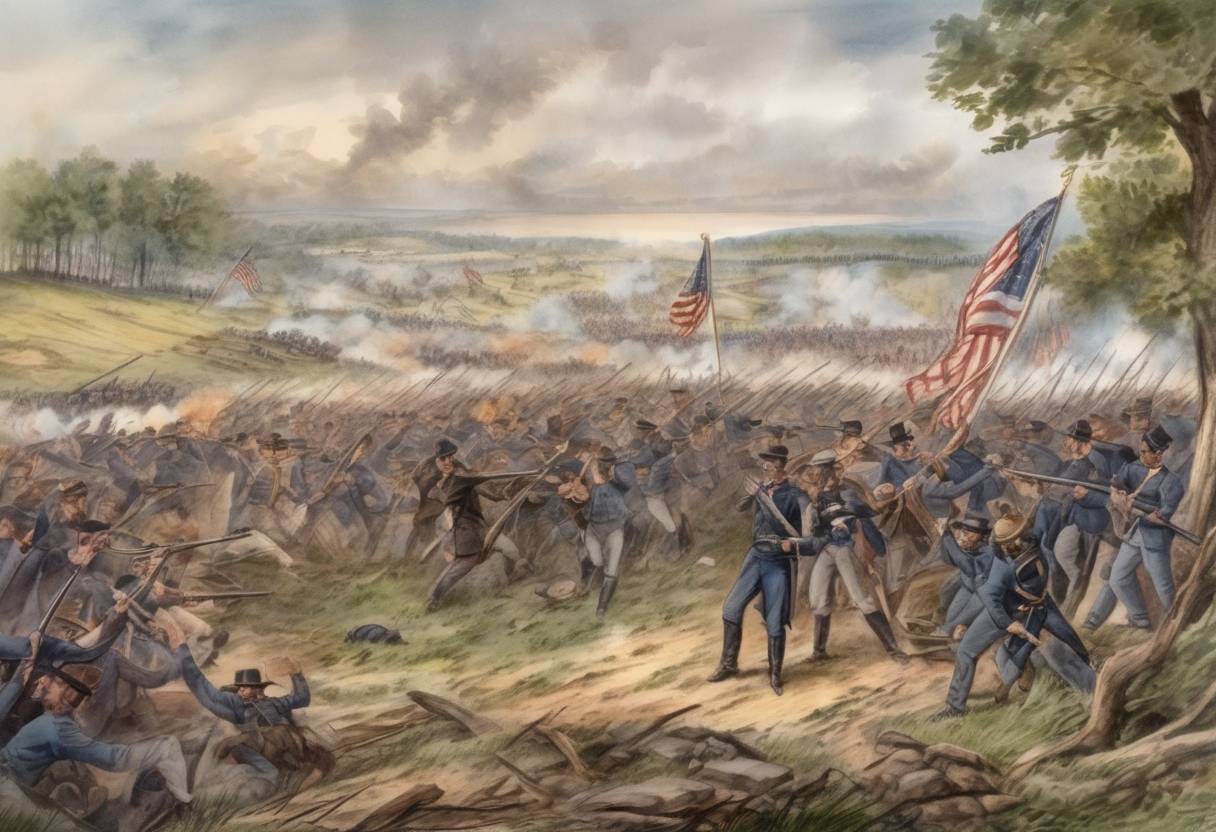
The Battle of Gettysburg: A Turning Point in the American Civil War
Overview
The Battle of Gettysburg, fought from July 1 to July 3, 1863, was one of the most significant engagements of the American Civil War. It concluded with a decisive victory for the Union forces under the command of Major General George G. Meade. This battle is often cited as a turning point in the war due to its scale, the high number of casualties, and its impact on Confederate morale and strategy.
Context Leading to the Battle
The battle occurred during the Confederate Army’s second invasion of the North, led by General Robert E. Lee. Following a victory at the Battle of Chancellorsville in May 1863, Lee sought to capitalize on Confederate momentum by advancing into Pennsylvania. His objectives included relieving pressure on Virginia’s farmlands, influencing Northern public opinion, and potentially encouraging foreign intervention.
Key Events of the Battle
Day 1 (July 1, 1863): The battle began when Confederate forces encountered Union cavalry west of Gettysburg. Initial skirmishes escalated as reinforcements arrived, resulting in the Confederates pushing Union forces through the town to high ground south of Gettysburg.
Day 2 (July 2, 1863): Lee launched attacks on both Union flanks. The fighting was intense at locations such as Little Round Top, the Wheatfield, and the Peach Orchard. Despite heavy Confederate assaults, Union forces held their positions.
Day 3 (July 3, 1863): The battle’s climax came with Pickett’s Charge, a massive Confederate assault on the Union center at Cemetery Ridge. The attack, led by Major General George Pickett, was repelled with significant Confederate losses.
Aftermath and Significance
The Union victory at Gettysburg ended Lee’s invasion of the North. The battle resulted in approximately 51,000 soldiers killed, wounded, or missing, making it the bloodiest battle of the Civil War. The defeat weakened the Confederate Army, which never fully recovered its offensive capability.
The victory bolstered Northern morale and is often considered a turning point in the Civil War. It coincided with the Union’s capture of Vicksburg on July 4, 1863, further splitting the Confederacy and marking a shift in the war’s momentum in favor of the Union.
Broader Historical Impact
The Battle of Gettysburg is remembered as a pivotal moment in American history. It underscored the Union’s resolve and capacity to repel Confederate advances. President Abraham Lincoln later commemorated the battle in his famous Gettysburg Address, delivered in November 1863, which redefined the war’s purpose and emphasized the principles of liberty and equality.
The battle’s legacy continues to be studied and honored, symbolizing the sacrifices made during the Civil War and the enduring struggle for national unity and civil rights.